From Vibe Coding to Enterprise-Grade: A Practical Guide to Engineering with Claude Code + Codex

A three-level progression path for AI programming from Vibe Coding to engineering Skills, with enterprise-grade hands-on practice.
The article outlines the progression of AI coding tools from "toys" to "productivity" in three levels: Vibe Coding generates runnable demos from a single sentence but produces hard-to-maintain code that cannot handle enterprise complexity; Plan Mode has the AI propose a plan for human review, suitable for moderately complex projects; the Skill system based on the Claude Code plugin Super Power covers the entire process from requirements to deployment and is the core of engineering. It also compares Claude Code and Codex in capability and availability, mentions domestic models as alternatives, and uses a model aggregation platform project to show that AI profits are concentrated in upstream compute and token distribution.
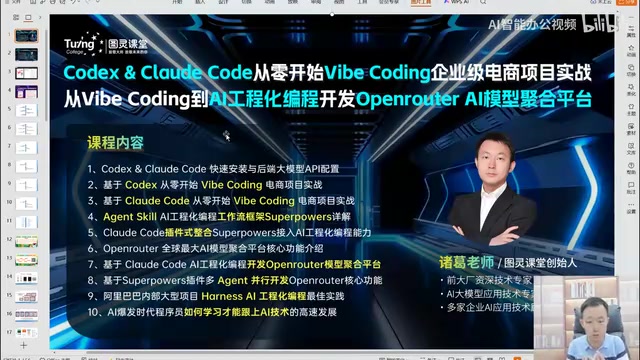
AI coding tools are moving from "toys" to "productivity." A Bilibili creator used a complete hands-on tutorial to demonstrate how to build an e-commerce project from scratch with Claude Code and Codex, and then transition to enterprise-grade engineering development. Behind this lies a clear progression path: from Vibe Coding (vibe-based programming), to structured development with Plan Mode, and then to full-process management based on engineering Skills.
The Limits of Vibe Coding: Why "one-sentence development" can't handle enterprise-grade projects
The core of Vibe Coding is "idea as code"—you describe the requirement, and the AI generates the implementation. In the tutorial, the creator demonstrated quickly building an e-commerce demo with Claude Code and seeing a runnable page within minutes. This experience indeed lowers the barrier to programming.
The problem emerges once the project becomes more complex. The creator pointed out that code produced by Vibe Coding is often "dead or damaged code" that is hard to maintain; once a bug appears in production, a non-technical product manager will struggle to direct the AI to fix it precisely and can easily fall into an endless loop. This explains why some "AI replaces programmers" cases on the market ultimately remain at the level of small tools and small websites—their functionality is simple and can be described clearly in a couple of sentences. Enterprise-grade projects involve complex tech stacks such as distributed systems, microservice architectures, and high concurrency, which Vibe Coding cannot support.
Vibe Coding was coined in early 2025 by Andrej Karpathy, former Tesla AI director and OpenAI founding member. It refers to a programming style in which developers are fully immersed in the "vibe," describe intent in natural language, let large models generate all the code, and hardly review it line by line themselves. It relies on large models' code completion and instruction-following capabilities, with typical tools including Cursor, Claude Code, and Windsurf. Its advantage is compressing the cycle from idea to runnable prototype to the minute level, making it suitable for one-off scripts, demos, and low-risk small tools; its limitations are the lack of architectural constraints, test coverage, and traceable change records. The generated results depend heavily on prompt quality, and deep defects are difficult to locate manually. The industry generally views Vibe Coding as an exploratory tool rather than a delivery tool.
Plan Mode: From "saying whatever comes to mind" to "following a method"
The second level of advancement in the tutorial is Plan Mode. Both Claude Code and Codex have this capability built in: the AI first produces an implementation plan before writing code. The creator's approach is to first use Plan Mode to sort out the requirement structure, and then let the tool execute. Compared with Vibe Coding's direct generation, Plan Mode makes the development process much more controllable and is suitable for projects of moderate complexity.
The key shift at this stage is that the developer changes from a "requirement describer" to a "plan reviewer." The AI is responsible for proposing the implementation path, and the human is responsible for judging whether it is reasonable. The creator emphasized that this mode is already being used in practice in many small and medium-sized companies.
Engineering Programming: Super Power and real enterprise workflows
The core value of the tutorial lies in the third level—engineering development based on the Claude Code plugin Super Power. Super Power provides a series of Skills covering the entire process from requirements analysis, development, and testing to deployment and release. The creator used it to develop an enterprise-grade e-commerce project, with a workflow closer to a real enterprise environment.
According to the creator, this system is in the same vein as Anthropic's internal Harness AI engineering programming approach. Although the details of internal documents cannot be obtained, the general idea is to constrain the quality of AI output through structured workflows rather than relying on a single generation. Codex also supports similar engineering practices. The creator also mentioned that leading domestic big tech companies are promoting similar systems.

Skill in the Claude Code ecosystem refers to a reusable capability module: usually composed of a structured instruction file (such as a Markdown-format SKILL.md) plus optional scripts, templates, and reference materials, invoked automatically by Claude in appropriate scenarios through an agreed name. Skills solidify domain knowledge about "how to complete a certain type of task," such as code review checklists, interface design specifications, and deployment check steps, thereby turning AI output from one-off performance into repeatable process execution. Compared with relying solely on long prompts, Skills have the characteristics of version management, on-demand loading, and cross-session reuse, which is also the key mechanism that distinguishes "engineering programming" from Vibe Coding.
Tool Selection: The real trade-offs between Claude Code and Codex
The tutorial's evaluation of the two main tools is worth noting. The creator believes that Claude Code is used most by professional programmers, has a mature engineering system internally, and has done a lot of optimization for professional programming. But he also admitted that due to Anthropic's access restrictions and account-ban risks, he has reduced his use of Claude Code and turned more to Codex—especially after the latest GPT version was released, Codex's capabilities improved noticeably.
This trade-off between "capability" and "availability" is a real problem faced by many domestic developers. In the tutorial, Claude Code's backend was connected to domestic models (such as Zhipu GLM) as an alternative. The creator rated GLM as in China's first tier, DeepSeekAd as having the best cost-performance, and MiniMax, Kimi, Hunyuan, and others as also usable.
Model Aggregation Platforms: Another practical project and business observation
The second project in the tutorial is to develop an AI model aggregation platform similar to OpenRouter. The creator uses this to bring up a business judgment: the most profitable area in AI today is not consumer-facing applications (Doubao, Yuanbao, and others are all losing money), but selling compute power, selling tokens, and running model aggregation "wrapper" websites. He mentioned that a friend of his runs a token website with a team of only a dozen or so people and annual sales of one to two hundred million yuan.
Whether this observation is universally applicable is another matter, but it reveals the profit distribution in the AI industry chain: upstream infrastructure and middle-layer distribution are often easier to monetize than downstream applications. For developers, understanding this helps judge the direction of technical investment.
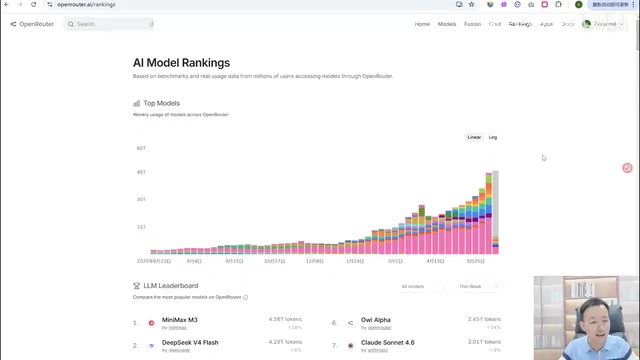
OpenRouter is an AI model aggregation and routing platform. Through a single API, developers can call dozens of models from multiple vendors such as OpenAI, Anthropic, Google, and Meta. The platform handles unified authentication, billing, rate limiting, and failover. Its core value lies in shielding differences among vendor interfaces and allowing automatic routing to a suitable model based on price, latency, or capability. So-called "wrapper" websites are built on this kind of aggregation layer, purchasing tokens downstream and providing a unified entry point and value-added services upstream, earning the price difference or subscription fees. This type of business is asset-light and small in team size, but highly dependent on upstream pricing and channel stability, with relatively limited competitive barriers.
Environment and Toolchain: VS Code + CLI + desktop app
The environment used in the tutorial is VS Code with the Claude Code plugin, as well as the Codex desktop app and CLI command line. The creator's assessment of traditional IDEs such as IntelliJ was quite sharp: if they do not embrace the AI era, they may face elimination within two or three years. This judgment may be aggressive, but it reflects that AI coding tools are reshaping developers' workflows.
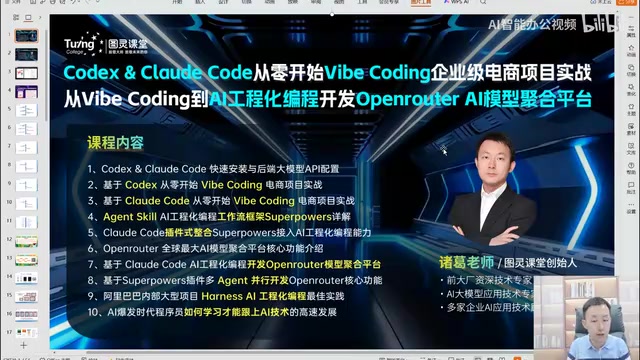
The creator repeatedly emphasized "practice first" and disliked theoretical lecturing. The tutorial comes with hundreds of pages of installation and configuration documentation, covering the use of Codex and Claude Code from beginner to advanced levels. This combination of "documentation + hands-on practice" is more valuable to developers who want to systematically master AI programming than scattered tips and tricks.
Takeaways for Developers
The value of this tutorial is not in teaching you to write code with a certain tool, but in showing a reusable progression path: first use Vibe Coding to quickly validate ideas, then use Plan Mode to manage complexity, and finally use an engineering Skill system to deliver enterprise-grade projects. Tools will iterate, but this "from light to heavy" methodology has continuity.
One sentence from the creator is worth remembering: in the AI era, no industry allows you to "stop learning"; continuous learning is the only stability.
One-line Summary
A three-level progression path for AI programming from Vibe Coding to engineering Skills, with enterprise-grade hands-on practice.
Paragraph Summary
The article outlines the progression path of AI coding tools from "toys" to "productivity," divided into three levels: Vibe Coding generates runnable demos from a single sentence, but the resulting code is hard to maintain and cannot handle enterprise-grade complexity; Plan Mode lets the AI propose a plan first and the human review it, suitable for moderately complex projects; the Skill system based on the Claude Code plugin Super Power covers the entire process from requirements to deployment and is the core vehicle of engineering. The article also compares the capability and availability trade-offs between Claude Code and Codex, mentions domestic models as alternatives, and uses a model aggregation platform project to point out that AI profits are concentrated in upstream compute and token distribution.
Related articles

DiDi Open-Sources X-Helix: Making AI Coding Tools Truly Understand Enterprise Java Microservices
DiDi open-sources X-Helix, an AI coding engineering framework that adds a standards layer on top of Claude Code and Codex to solve compilation failures and missed internal method calls in enterprise Java microservice projects, with knowledge accumulation and team reuse.

LLM Interview Focus Shifts to Agents: Harness Engineering and Langfuse Tracing Become Must-Know Topics
2026 LLM application interviews now focus on AI agents: multi-agent systems, Harness engineering, Langfuse tracing/evaluation, and security mechanisms are must-know topics. This article covers interview trends and resume tips.

Claude Code Advanced Guide: 10 Tips to Stop Approving Manually
Based on The Benmore Brief's Claude Code tutorial, 10 practical tips: from Auto mode, effort levels, and side chats to phone remote control and scheduled tasks—stop approving every step.