Die With Me: An AIM Buddy List for Claude Code and Codex Users
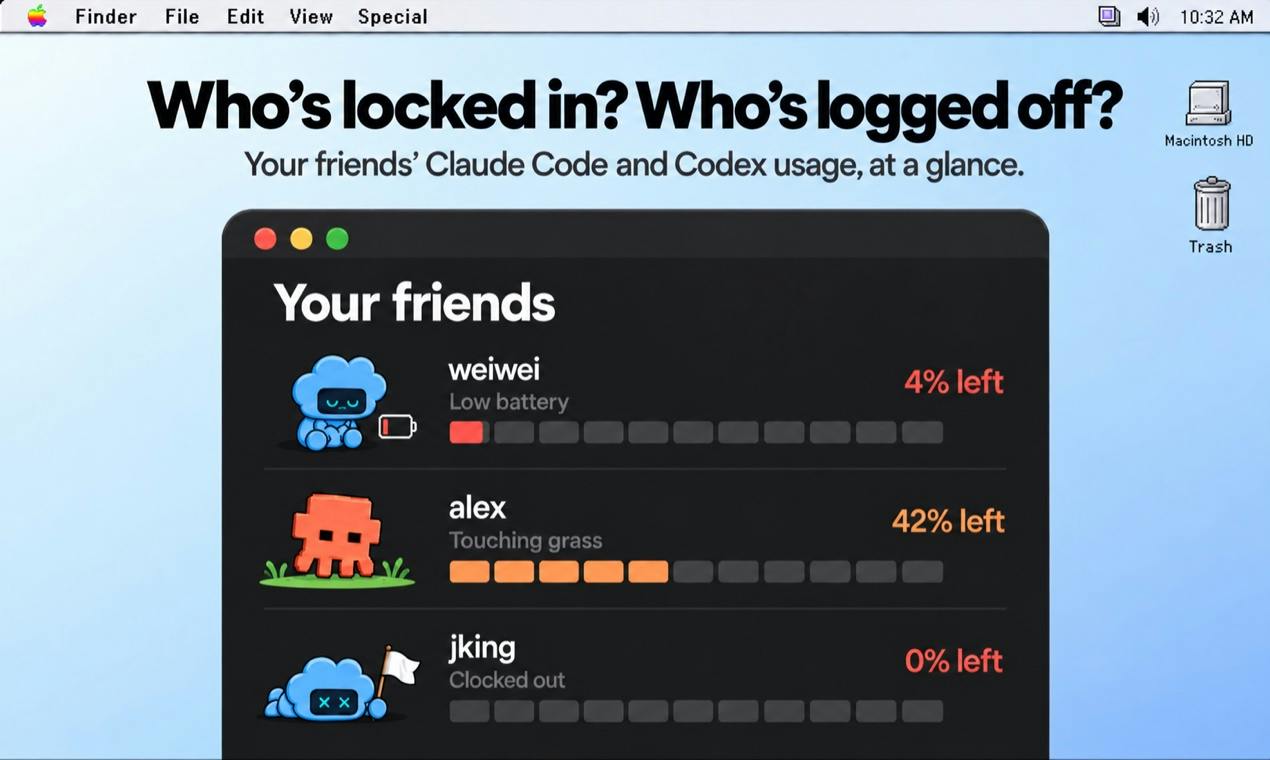
Die With Me reimagines the AIM buddy list for AI coding tools, turning quota downtime into developer social time.
Die With Me is a Mac app by indie developer Weiwei that applies the AIM buddy list concept to Claude Code and Codex usage: users can see friends' AI quota statuses as desktop mascots, and unlock a chat room when their own quota runs out — turning forced downtime into a social moment. Rather than solving the technical quota problem, it delivers emotional value. The app earned 79 upvotes on Product Hunt (12th for the day) and reflects a broader signal: AI coding tools are now so embedded in developer workflows that the anxiety around their limits is fertile ground for new products.
When AI Credits Become a Social Currency
If you're a heavy user of Claude Code or Codex, you've probably been there: you're deep in a coding session, and suddenly the AI tells you you've hit your usage limit — nothing to do but wait for the quota to reset. A Product Hunt launch called Die With Me turns that awkward moment into a social opportunity.
Its pitch is refreshingly straightforward: "An AIM buddy list for your friends' Claude Code and Codex usage." For anyone who lived through the early days of instant messaging, AOL Instant Messenger's buddy list carries a lot of collective nostalgia. Die With Me takes that retro social logic and maps it onto today's hottest AI coding tools.
AIM (AOL Instant Messenger) was launched by America Online in 1997 and became the dominant social tool across North America in the early 2000s, with over 100 million registered users at its peak. Its buddy list displayed each contact's online status and personal message in real time, creating a unique social language of "digital presence" — who was online, who was busy, whose away message was cryptically meaningful. All of it mattered deeply to the teenagers of that era. AIM shut down in 2017, but the visibility-and-lightweight-social model it pioneered deeply influenced the design logic of nearly every messaging product that followed. Die With Me borrows this already-nostalgic visual language, and it lands with particular resonance among developers — a demographic whose age skews right into AIM's golden years.
What the Product Actually Does
The core experience breaks down into a few parts. On Mac, you can see your friends' Claude Code and Codex quota status through small "mascots" — cute little characters that visually reflect each person's current AI usage.
Beyond checking statuses, you can set your own status (just like writing an AIM away message back in the day) and "visit" friends' rooms. The most interesting design decision: when your AI quota runs out, a chat room unlocks.
As the official tagline puts it with a vivid kind of poetry — "Your AI clocks out, but your friends are still here." When the code stops flowing, instead of waiting alone, you can hang out with friends who are equally "out of fuel." That twist — transforming a forced work stoppage into a social moment — is exactly what sets it apart from your typical productivity tool.
Claude Code is Anthropic's AI coding assistant for developers, deeply integrated into terminal and code editor environments, supporting code generation, debugging, and refactoring. Codex was OpenAI's early code generation model, whose capabilities were later folded into products like GitHub Copilot. Both operate on pay-per-use or subscription quota models, and heavy users can burn through their daily or monthly allowance in just a few hours of intensive coding. This kind of hard limit barely existed before AI coding tools went mainstream — but as developers have grown rapidly dependent on AI assistance, "quota anxiety" has become a new collective experience for this user group, spawning niche demand around quota management, usage optimization, and social companionship.
A Small Product That Hits a Precise Emotional Note
Die With Me landed 79 upvotes on Product Hunt, ranking 12th for the day. It was built by indie developer Weiwei and sits across three categories: Social Media, Developer Tools, and Artificial Intelligence.
From a product strategy standpoint, it zeroes in on a very specific user emotion: the frustration of hitting AI usage limits, which has become a widespread pain point for AI coding tool users. Both Anthropic's Claude Code and OpenAI's Codex have usage quotas, and heavy-use developers frequently run into them. Rather than trying to solve the technical problem of "not enough credits," Die With Me approaches things from the angle of emotional value — turning the waiting period into a moment of companionship.
This approach is emblematic of independent development at its best: no grand narrative, just a lightweight, fun, emotionally resonant solution to a specific niche scenario. Even the product name — "Die With Me" — carries a dark humor to it, nodding to the "going down together" feeling when everyone's AI quota hits zero at once.
The Industry Signal It Reflects
Look a little deeper, and the very existence of this kind of product is a signal: AI coding tools have become so deeply embedded in developers' daily workflows that "quota" has become a topic substantial enough to build a social product around.
As more and more developers rely on AI assistants like Claude Code and Codex to write code, the behaviors, constraints, and even "downtime moments" surrounding their use could give rise to entirely new product opportunities. Die With Me might just be a lightweight social toy, but it reflects something real about how AI tools are reshaping the way developers collaborate and connect.
For everyday users, its value is probably more about fun and a sense of community than hard productivity gains. But if you and a group of friends are all using the same AI tools, having a buddy list where you can "see" each other's status brings back just a little of that warmth from the old IM days.
Related articles
WAN 2.1 Physics Motion LoRA Benchmark: Rankings and Methodology for 11 Models Tested
A Reddit user benchmarked 11 physics-motion LoRAs on WAN 2.1 using optical flow analysis. Only 3 worked meaningfully; 4 scored below the no-LoRA baseline. Full rankings and methodology inside.
Lucid Partners with Bolt to Target European Robotaxi Market
Lucid Motors has signed a letter of intent with European mobility platform Bolt to explore Robotaxi services in Europe, though no vehicle orders have been placed yet.
AI Assistants Enter the "Phone Call" Era: Instinct and Meta Muse Add Voice Task Execution
AI assistants Instinct and Meta Muse now make phone calls on your behalf — booking restaurants, canceling subscriptions — marking a leap from chat tools to real-world agents.