diff-tour: After AI Writes the Code, Learn Senior Engineers' Code-Reading Mindset Through Guided Navigation

diff-tour turns git diff into an interactive tour, training engineers to read code like senior reviewers.
diff-tour is an open-source developer tool addressing the gap where engineers can't understand or spot problems in AI-generated code. It turns a git diff into an interactive arrow-key tour, each stop focusing on change intent, reading order, senior-level questions, issue severity, and pause signals. Read-only and built on existing AI coding CLIs, its core value is breaking senior engineers' review paths into reproducible steps that train users to spot edge cases and design flaws via guess-first questioning. It got 71 votes and ranked 13th on Product Hunt.
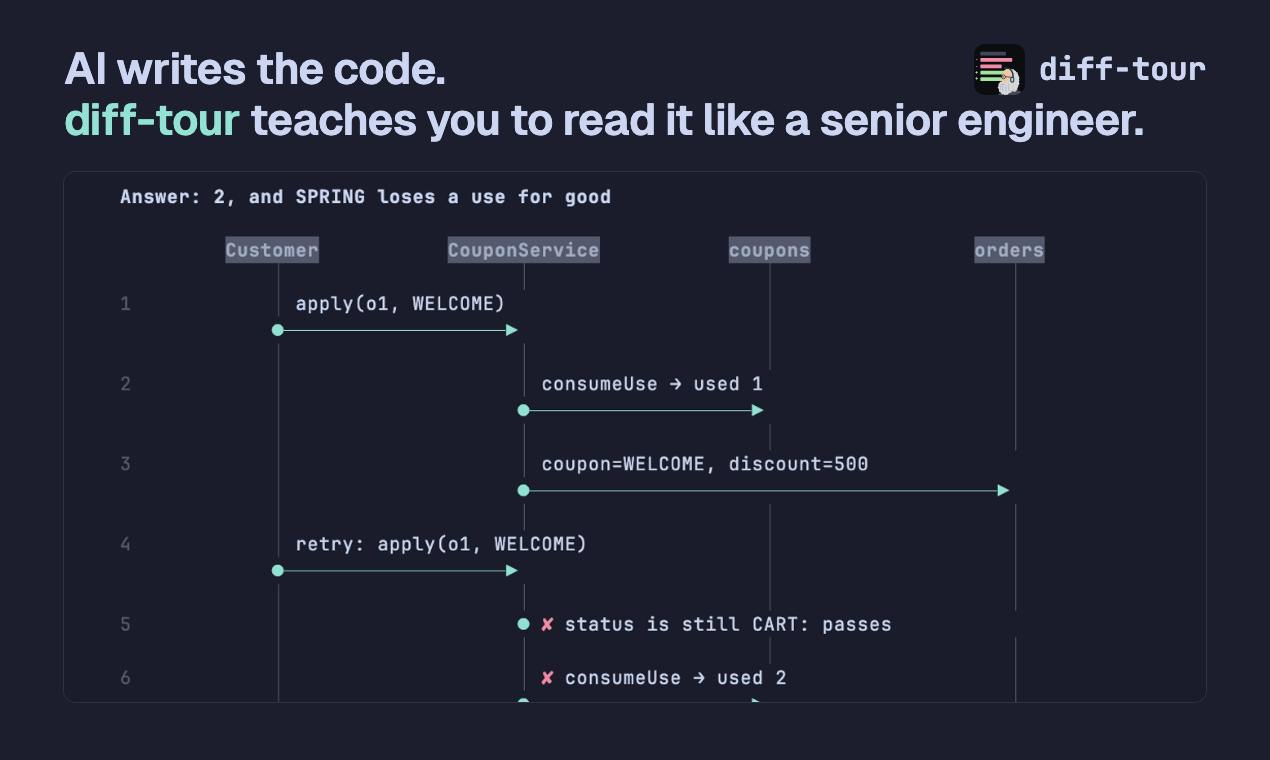
AI writing code is no longer novel, but there's an awkward reality: when AI hands you code, many engineers find they can't understand it, can't spot problems, let alone judge whether the code is reliable. diff-tour attempts to bridge this gap—it turns a git diff into an interactive code review tour, using left and right arrow keys to walk you step by step through a senior engineer's thought process.
When AI Becomes the Code Author, Engineers' Core Skills Are Shifting
diff-tour's tagline on Product Hunt is direct: "AI writes the code. Learn to read it like a senior engineer." This statement points to an industry-wide anxiety. In the past, writing code was engineers' home turf; now, the barrier to generating code has been dramatically lowered, and the truly scarce skill has become reading code, evaluating code, and judging whether code should be merged.
diff-tour's creator Dai Aoki positions the product at the intersection of education and software engineering. Its basic assumption is that understanding code hasn't become less important with AI's intervention—it's become more important; and "understanding code" at the operational level means learning to examine a change the way a senior engineer would.
Turning git diff into an Interactive Tour
diff-tour's core interaction isn't complex: input a diff, then navigate forward and backward with the → and ← keys like flipping through slides. Each stop guides you to focus on specific content—what this change is for, where to look first, and what questions a senior engineer would ask here.
The information layers it covers are quite close to real code review scenarios:
- Change intent: what problem this diff aims to solve, rather than translating what the code does line by line.
- Reading order: what to look at first and what later, avoiding getting lost in irrelevant details.
- Senior-level questions: things like "What happens if this runs twice?" "Can this operation be rolled back?"—these are the angles most likely to expose design flaws during review.
- Issue severity: which are blocking issues that must be fixed, and which are just nits (minor nitpicks).
- Pause signals: where senior engineers would say "wait a minute," and why.
You might not have noticed that these questions are posed to the user as questions, letting you guess and think first, then compare with the answer. This "output before input" design leaves stronger cognitive traces than passively reading explanations.
git diff is a command in the Git version control system used to display file changes, marking added, deleted, and modified content line by line. In code review scenarios, the diff is the first-hand material reviewers see, but the raw diff only shows "what happened," not "why it changed" or "where to be alert." For less experienced engineers, facing a diff with dozens of file changes, it's easy to get stuck in line-by-line reading and miss the overall design intent and potential risks. diff-tour's value lies in layering structured explanation on top of the raw diff, transforming linear textual differences into a focused, ordered cognitive path.
Two Key Design Trade-offs
The first trade-off is read-only. diff-tour doesn't modify your codebase or intervene in the editing process—it simply overlays explanation and guidance on top of the diff. For a tool used in real project reviews, this lowers the trust barrier—you don't need to worry about it touching anything.
The second trade-off is running on top of your existing AI coding CLI. The product doesn't build a separate AI infrastructure from scratch, but reuses the command-line environment developers already have. This means low onboarding cost, while leaving model selection and quotas in users' hands. Combined with the product being open source, it's more friendly to developers who care about auditability and customization.
According to Product Hunt data, diff-tour received 71 votes and 7 comments, ranking 13th among products that day. This isn't a breakout result, but in the relatively niche developer tools category, it shows it touched on some people's real needs.
AI coding CLI refers to AI programming assistants running in command-line interfaces, such as Claude Code, GitHub Copilot CLI, Cursor CLI, and others. These tools typically allow developers to interact directly with models in the terminal to generate, modify, or explain code, and support custom models, API keys, and quota management. diff-tour's choice to build on such CLIs rather than creating its own AI backend means it reuses users' existing authentication, model preferences, and billing systems, avoiding reinventing the wheel while allowing privacy-sensitive users to continue using model providers they trust. This "thin layer" design is increasingly common in developer tools, focusing the product on interaction and content design.
What It's Really Teaching
Treating diff-tour as a "code explainer" underestimates it. It's closer to a thinking training tool: by breaking down senior engineers' review paths into reproducible steps, it lets users repeatedly practice identifying risks in diffs, distinguishing severity, and asking the right questions.
This also explains why it places "what senior engineers would ask" at such a core position. What truly separates skill levels in code review is often not whether you can understand syntax, but whether you can think of those edge cases—repeated execution, rollback, concurrency, failure paths. diff-tour crystallizes these questions into tour stops, giving less experienced engineers a chance to go through them from a higher vantage point.
"Edge cases" in code review refer to scenarios outside the normal path that, once triggered, may cause failures—for example: the same operation executed repeatedly (missing idempotency), incomplete rollback after transaction failure, race conditions under concurrent requests, external dependency timeouts or abnormal returns, empty or malformed input, etc. Senior engineers often reflexively ask these questions during review, while novices tend to focus only on "whether the code runs." By crystallizing these follow-up questions into tour stops, diff-tour is actually training a systematic risk-scanning habit—first assuming the code will fail, then working backward to determine which edge conditions might cause it to fail.
Who It's For
For engineers new to a team who haven't yet built systematic code review habits, diff-tour offers a ready-made practice path. For developers already using AI coding tools but finding they "can only get a rough idea" of the output code, it fills in the understanding gap. For teams wanting to make senior engineers' review intuition explicit and pass it down, such tools also provide a discussable template.
Of course, it can't replace real code review. The tour offers generalized review perspectives; judgments specific to a project or business scenario still need to be made by humans. But in an era where AI-generated code is increasingly common, treating "reading code" as a skill requiring deliberate practice—this direction itself is worth taking seriously.
One-line Summary
diff-tour turns git diff into an interactive tour, training engineers to read code like senior reviewers.
Paragraph Summary
diff-tour is an open-source developer tool designed to address the gap where engineers "can't understand or spot problems" in AI-generated code. It transforms a git diff into an interactive tour browsable with left and right arrow keys, with each stop focusing on change intent, reading order, questions senior engineers would ask, issue severity, and pause signals. The product uses a read-only design and runs on users' existing AI coding CLIs, lowering trust barriers and onboarding costs. Its core value isn't explaining code syntax, but breaking down senior engineers' review paths into reproducible steps, training users to identify edge cases and design flaws through "guess first, then look" questioning. It received 71 votes on Product Hunt and ranked 13th that day, validating real demand in niche developer tools.
Related articles

AI Can Read Neural Network Weights Directly: Do Models Already Exceed Expectations?
A Reddit developer experiment shows language models can directly read neural network weights and infer their function. Astra, Opus 5.5, and Muse Spark 1.3 all passed the test, sparking discussion on model generalization and training sources.

India's Microdrama Market Explodes: EloElo Secures $80M Investment from NBCUniversal
EloElo secures $80M from NBCUniversal to boost StoryTV, its microdrama platform with over 33M monthly active users, as India's microdrama market draws global capital.

Acoustic Detection of Multi-Rotor UAVs: Fusing Handcrafted Features with Pre-Trained Embeddings
Study reveals data leakage from random splits in UAV acoustic detection, proposes source-disjoint protocol with stacked ensemble of handcrafted features and YAMNet embeddings, achieving 95.29% accuracy for low-cost drone detection.