Diffusion Language Model Decoding Flaws: How Fallback Commits Cause Errors

In diffusion language model threshold decoding, fallback commits are the main error source; committing only at the frontier recovers most accuracy.
A commit-level analysis of four off-the-shelf diffusion language models (DLMs) found that models are only truly confident near the leftmost masked position (the frontier), and that fallback commits, though only 11–35% of total commits, trigger 61–72% of failures avoidable by left-to-right decoding. Accuracy loss mainly stems from committing tokens before left-side text is generated, not from the number of commits per step; premature EOS tokens are the worst case. A frontier-only commit strategy recovers most lost accuracy across all four models without retraining, offering a low-cost, high-reward decoding optimization for DLM deployment.
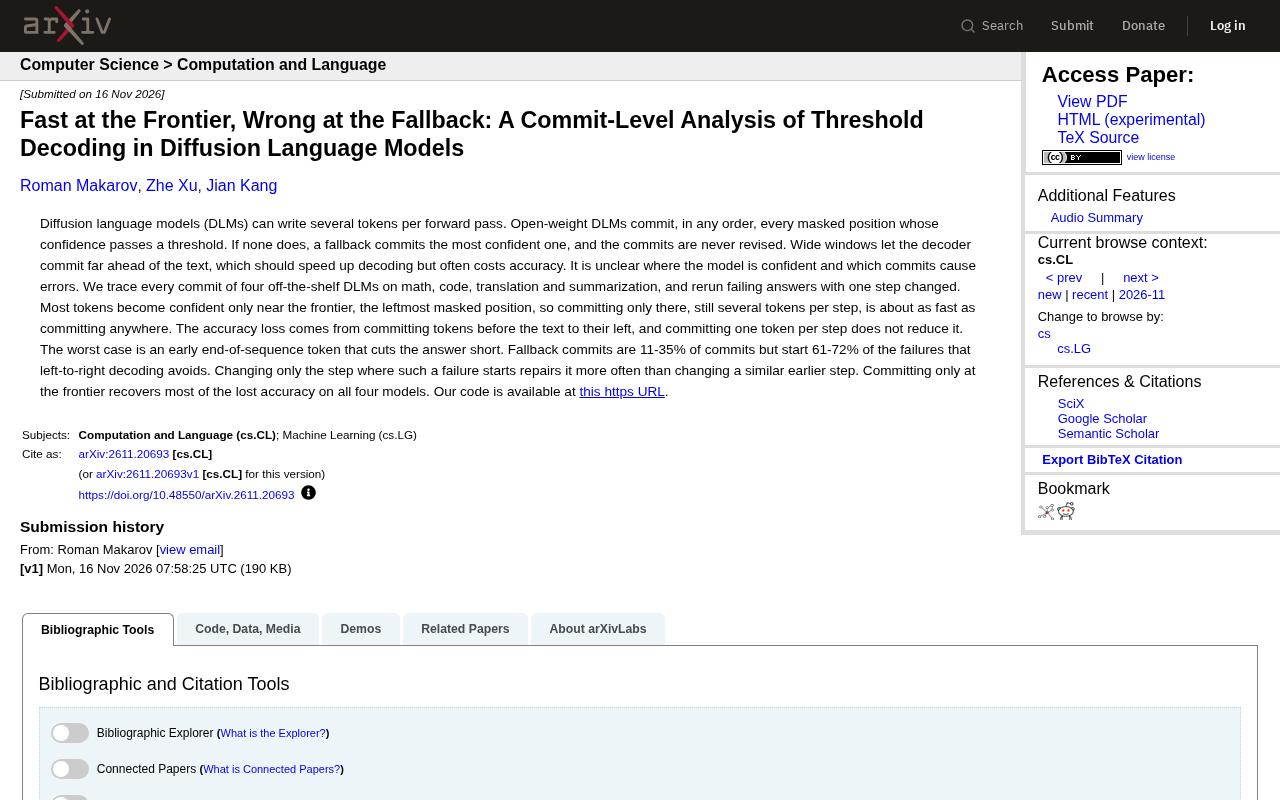
Diffusion language models (DLMs) can generate multiple tokens in a single forward pass—a parallel decoding capability that makes them attractive for their speed. But behind that speed lies an accuracy cost: a commit-level analysis of four off-the-shelf DLMs found that models only become confident near the "frontier" (the leftmost masked position), and that fallback commits, while accounting for only 11–35% of total commits, trigger 61–72% of failures that left-to-right decoding could have avoided.
The Allure and Pitfalls of Parallel Decoding
Open-weight DLMs use threshold decoding: in each forward pass, all masked positions whose confidence exceeds the threshold are committed simultaneously, in no particular order. If no position meets the threshold, a fallback mechanism forces the commit of the single highest-confidence position. Crucially, once these commits are made, they are never revised.
A wide window lets the decoder commit far ahead of the generated text, which in theory accelerates decoding but in practice often hurts accuracy. The question is: at which positions are models truly confident, and which commits cause errors? This study attempts to answer that by tracking every commit of four off-the-shelf DLMs on math, code, translation, and summarization tasks, and re-running with single-step modifications targeting failed answers.
"Confidence" in threshold decoding is typically determined by the softmax probabilities the model outputs for each masked position, often using the maximum probability or negative entropy as the metric. Because diffusion language models predict all masked positions simultaneously in each forward pass, confidence distributions can differ significantly across positions: positions near already-generated text tend to receive more contextual support, while positions far from the frontier rely on less left-side context. The fallback mechanism kicks in when no position exceeds the threshold, forcing the selection of the single highest-confidence position to avoid decoding stagnation. While this design guarantees at least one token of progress per round, it also means the model is forced to make irreversible decisions when overall confidence is low, amplifying the risk of error propagation.
The Frontier Is the True Source of Confidence
The study found that most tokens only become confident near the frontier (i.e., the leftmost masked position). This means that committing only at the frontier—while still committing multiple tokens per step—achieves roughly the same speed as committing at arbitrary positions.
This finding directly challenges the intuition that "a wider window is necessarily faster." Since the model isn't truly confident at positions beyond the frontier, committing those positions early yields limited speed gains while introducing accuracy risks.
Root Causes of Errors: Missing Left-Side Text and Premature Termination
Accuracy loss mainly comes from committing tokens before the left-side text has been generated. Surprisingly, reducing the number of commits per step to a single token does not reduce this loss. The real culprit is ordering, not batch size.
The worst case is a premature end-of-sequence (EOS) token that truncates the answer outright. Although fallback commits account for only 11–35% of total commits, they initiate 61–72% of failures that left-to-right decoding could have avoided. In other words, the fallback mechanism forces decisions precisely when the model is least certain, and these decisions often become the starting point of errors.
Further experiments show that modifying only the step at which a failure originates repairs the problem better than modifying earlier similar steps. This confirms the key role of fallback commits as an error source.
The end-of-sequence (EOS) token acts as a terminator in both autoregressive and diffusion language models; once committed, decoding ends and no further tokens are generated. In parallel decoding scenarios, because multiple positions may be committed simultaneously, the EOS token can be selected prematurely before the left-side context has been sufficiently generated, leading to truncated answers or missing key reasoning steps. This premature termination differs from ordinary token errors because it directly changes the output length and structure and cannot be repaired by subsequent commits. The study treats premature EOS as the worst case precisely because it destroys the integrity of the entire sequence at once, rather than affecting only local token accuracy.
How the Frontier-Commit Strategy Fixes Things
The good news is that the frontier-only commit strategy restores most of the lost accuracy across all four models. This simple adjustment requires no model retraining and no additional external tools—it directly optimizes the commit logic during decoding.
From an engineering perspective, this means that when deploying DLMs, one can balance speed and quality by modifying the decoding strategy: retain the multi-token parallelism per step but restrict commits to the frontier, avoiding the risks of committing ahead of time.
Implications for DLM Deployment
This commit-level analysis reveals a structural flaw in threshold decoding for diffusion language models: the fallback mechanism, which should be a safety net, becomes an error amplifier. For developers focused on DLM inference efficiency and reliability, the frontier-commit strategy offers a low-cost, high-reward improvement direction.
The code is open-sourced on GitHub (rmakarovv/fast-at-the-frontier); interested readers can reproduce the experiments or validate this strategy on their own models.
Related articles

The ARTEX Alert: How AI Agents Do Hackers' Work
FBI issues a 13-page alert on the AI agent tool ARTEX: attackers use it to automate penetration testing, with some cases achieving privileged access in under three hours. This article analyzes ARTEX's architecture, real attack cases, the authorization paradox, and AI agent security boundaries.

FBI Warns: Open-Source AI Pentesting Framework ARTEX Weaponized — From Competition Winner to Threat Dossier in Three Weeks
FBI threat bulletin warns that open-source AI pentesting framework ARTEX was weaponized — just three weeks from GitHub release to first weaponization, linked to South Korean financial breaches, supply chain attacks, and large-scale operations. Timeline, attack evidence, and defense recommendations.

Tokendoctor: The Money-Saving Solution That Cuts Claude Code Costs by 38%
Tokendoctor claims it can reduce Claude Code usage costs by 38% through token efficiency optimization. This article analyzes its principles, community reactions, and practical implications for developers.