Tokendoctor: The Money-Saving Solution That Cuts Claude Code Costs by 38%

Tokendoctor claims it can cut Claude Code costs by 38%, sparking interest in cost optimization for AI coding tools.
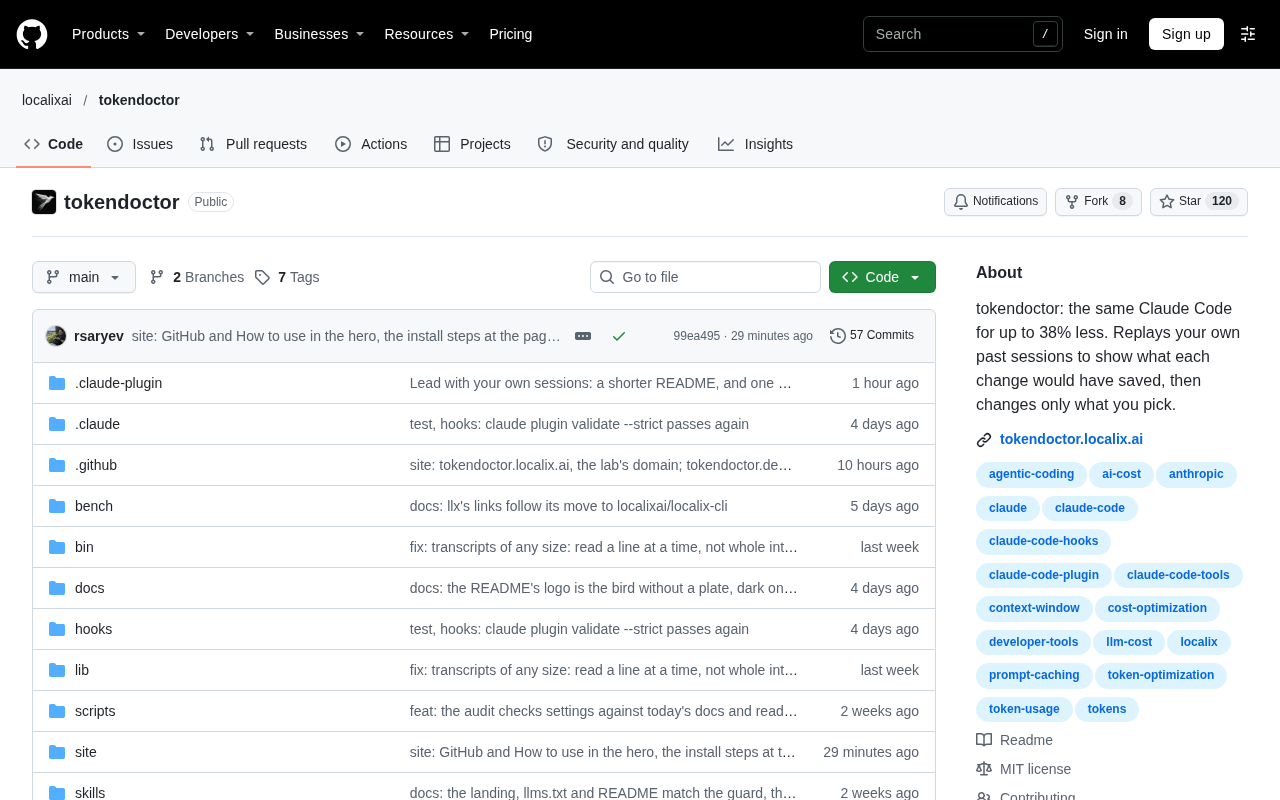
The Tokendoctor project on Hacker News claims it can reduce the cost of using the same Claude Code by up to 38%, sparking developer discussion about the cost of AI coding assistants. The article analyzes why Claude Code's token-based billing model is a pain point for heavy users and speculates that Tokendoctor may reduce ineffective token consumption through intelligent context management, request compression, or cache reuse. The post currently has modest traction, with only 10 points and 2 comments, but it reflects that the AI coding tool market is shifting from a feature race to refined operations focused on cost and efficiency. The article also reminds developers to evaluate the impact of third-party optimization tools on code generation quality, response speed, long-term maintenance, and code security before adopting them.
In today's world where AI coding assistants are increasingly widespread, cost has become a focal point for developers. A project called Tokendoctor has appeared on Hacker News, claiming to reduce the cost of using the same Claude Code by up to 38%. This news quickly sparked discussion. Although there are currently few comments, the underlying demand for cost optimization of AI tools is worth exploring in depth.
Why Claude Code Costs Have Become a Pain Point
As a coding assistance tool launched by Anthropic, Claude Code has built a solid reputation among developers thanks to its powerful code understanding and generation capabilities. However, its token-based billing model exposes heavy users to considerable expenses. Especially as project scale expands and conversation rounds increase, token consumption rises rapidly, bringing cost pressure along with it. Tokendoctor targets exactly this pain point, attempting to compress expenses through technical means without sacrificing functionality.
Token-based billing is the common pricing foundation for large language model APIs: the model splits input text into tokens (roughly equivalent to words or word roots), and then charges separately for input tokens and output tokens. Taking the Claude series as an example, input and output unit prices differ, with output usually being more expensive, and long contexts significantly driving up the cost of a single request. In coding assistant scenarios, each interaction often carries a large amount of context such as system prompts, historical conversations, and relevant file snippets. The more rounds and the larger the repository, the more tokens are repeatedly transmitted. This characteristic of "context growing linearly with conversation" is the structural reason why bills for tools like Claude Code inflate quickly, and it also explains why optimization methods such as context compression and cache reuse can directly affect costs.
How Tokendoctor Achieves a 38% Cost Reduction
According to the project title and limited public information, Tokendoctor's core idea is to optimize token usage efficiency. Although the specific technical details have not been fully disclosed, the phrase "the same Claude Code for up to 38% less" suggests that it may reduce unnecessary token consumption through mechanisms such as intelligent context management, request compression, or cache reuse, thereby lowering bill amounts. For developers who work with Claude Code every day, such a savings margin has practical appeal.
The several mechanisms mentioned in the article deserve a bit more elaboration. Context management refers to filtering, trimming, or summarizing historical conversations and code snippets before sending requests, keeping only the parts most relevant to the current task and avoiding repeated billing for irrelevant content. Request compression usually takes the form of streamlining prompts, removing redundant formatting and repeated explanations, or creating structured summaries of long files. Cache reuse leverages the prompt caching capabilities offered by some model providers to bill repeated prefix content at a discounted price, thereby reducing unit cost while maintaining the same context. The common feature of these methods is reducing "ineffective tokens" rather than weakening model capabilities, but the effect depends heavily on the specific implementation and usage scenario.
Reactions from the Developer Community and Potential Impact
On Hacker News, the post received 10 points and 2 comments, and discussion activity is still in its early stages. But it is foreseeable that if Tokendoctor can indeed consistently achieve the claimed savings, it may attract a group of cost-sensitive developers. At the same time, it also sends a signal to AI tool providers: in competition where features are converging, cost optimization and efficiency improvements will become important directions for differentiation.
Hacker News is a technology community under Y Combinator, known for its rigorous discussion of new products, open-source projects, and technical details. A project gaining attention there often means it has touched on a real technical pain point, but community comments also often quickly point out issues such as promotional data lacking reproducible benchmarks and optimization effects depending on specific workloads. Therefore, the post receiving only a small number of points and comments in its early stage should be understood as "yet to be verified" rather than "already recognized." For cost optimization tools, whether they can publish reproducible comparative tests and open-source implementations usually determines the direction of community reputation.
Taking a Rational View of Cost Optimization Tools
Although Tokendoctor's promises are tempting, developers still need to evaluate carefully before adopting it. On the one hand, it is necessary to confirm whether its optimization affects code generation quality or response speed; on the other hand, attention should be paid to its long-term maintenance and security. After all, coding assistants involve code privacy and project security, and any third-party optimization tool should undergo rigorous verification.
Overall, the emergence of Tokendoctor reflects that the AI coding tool market is shifting from a pure feature race to refined operations focused on cost and efficiency. For developers at large, this is undoubtedly a trend worth watching.
Related articles

CapCover Filter: Semantic Approximate Membership Queries Without Neighbor Search
CapCover Filter is a geometric data structure that summarizes embeddings with spherical caps to support semantic approximate membership queries at any similarity threshold. On five real datasets, it eliminates 20%-100% of index accesses with only 2% memory overhead, improving FAISS query throughput by up to 382%.

The ARTEX Alert: How AI Agents Do Hackers' Work
FBI issues a 13-page alert on the AI agent tool ARTEX: attackers use it to automate penetration testing, with some cases achieving privileged access in under three hours. This article analyzes ARTEX's architecture, real attack cases, the authorization paradox, and AI agent security boundaries.

FBI Warns: Open-Source AI Pentesting Framework ARTEX Weaponized — From Competition Winner to Threat Dossier in Three Weeks
FBI threat bulletin warns that open-source AI pentesting framework ARTEX was weaponized — just three weeks from GitHub release to first weaponization, linked to South Korean financial breaches, supply chain attacks, and large-scale operations. Timeline, attack evidence, and defense recommendations.