Dify Beginner's Guide: Building Enterprise-Grade AI Agents and Knowledge Bases with Zero Code

A Bilibili creator released a Dify hands-on tutorial, analyzing its zero-code, private deployment advantages and differences from Coze.
Based on a Bilibili creator's Dify hands-on tutorial, this article introduces Dify's positioning and core features as an open-source large model application development platform. Dify supports non-technical users in building chat assistants, Agents, knowledge bases, and complex workflows through drag-and-drop, and can connect to enterprise data and APIs. The article highlights the differences between Dify and Coze: Coze focuses on cloud hosting for quick validation of consumer ideas; Dify supports private deployment with data 100% local, better meeting compliance needs in finance and healthcare. The tutorial includes 40+ enterprise projects, targeting deployment within one week.
In the field of large model application development, enabling both technical and non-technical users to quickly build production-grade AI applications has always been a core pain point. A Bilibili creator recently released a highly acclaimed Dify hands-on tutorial, claiming to teach through 40+ enterprise-level projects. Based on that tutorial, this article provides an in-depth analysis of Dify's core positioning, its differences from Coze, and why private deployment has become key to enterprise selection.
What Is Dify: An Open-Source Large Model Application Development Platform
According to the creator, Dify is an open-source large model application development platform designed to help developers quickly build production-grade AI applications. Its core value lies in enabling non-technical personnel to participate in AI application positioning and data operations, visually presenting abstract concepts such as Agents and Knowledge Bases through a drag-and-drop interface.
For beginners, Dify offers a what-you-see-is-what-you-get learning path. The creator emphasized in the video that you can create chat assistants, Agents, or use text to generate specific applications, and even build complex workflows through zero-code methods.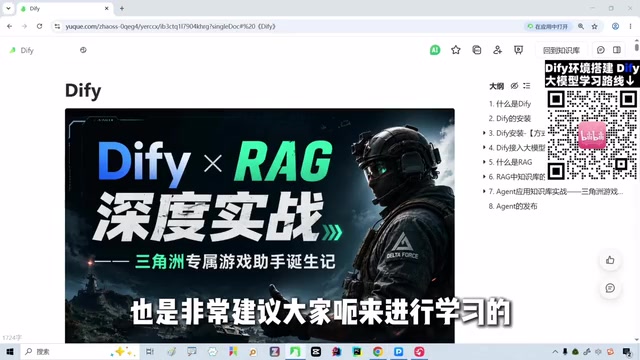
This means that whether you're a product manager, business operator, or a developer just getting started with AI, you can quickly validate ideas with Dify. For example, calling enterprise tools or enterprise data to solve real business problems without diving deep into underlying code. The creator mentioned that once the course cases are working, they can be directly used for graduation theses or small project implementations.
Agent refers to an AI system that can autonomously perceive its environment, make decisions, and call external tools to complete tasks. Unlike traditional chatbots, an Agent not only passively answers questions but can also proactively plan steps, call APIs, access databases, and even operate other software. For example, a customer service Agent can automatically query order systems, send emails, and log tickets. Dify abstracts the Agent's "think-act" process into draggable nodes through a visual interface, allowing non-technical users to understand its operating logic.
Knowledge Base in Dify typically refers to a document management system based on Retrieval-Augmented Generation (RAG) technology. After users upload PDFs, Word documents, and other materials, Dify automatically splits text, generates vector embeddings, and stores them in a vector database. When a user asks a question, the system first retrieves the most relevant document fragments, then passes them to the large model to generate an answer. This ensures answer accuracy while avoiding model hallucinations, and allows enterprise private data to be utilized by large models without fine-tuning.
Dify Core Features: From Chat Assistants to Complex Workflows
Dify's features cover multiple levels of AI application development. The most basic is the chat assistant, suitable for quickly building Q&A bots; the advanced Agent mode allows models to autonomously call tools; and Workflow supports multi-step task orchestration.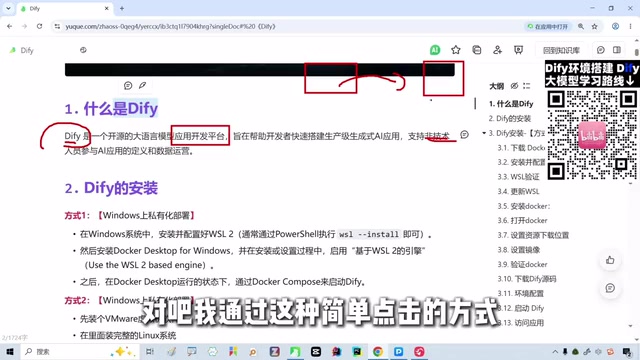
The creator demonstrated the process of building an Agent through simple clicks during a livestream. This visual operation lowers the barrier to Agent development, allowing non-technical users to understand the basic logic of AI applications. At the same time, Dify supports connecting enterprise data and APIs, enabling AI applications to truly integrate into business processes.
You may not have noticed that Dify's positioning is not to replace programming, but to provide a more efficient development paradigm. For complex requirements, developers can still extend through code nodes.
Workflow is the engine in Dify for orchestrating multi-step tasks, similar to a flowchart in visual programming. Each node represents an operation, such as calling a large model, executing conditional judgments, requesting external APIs, or processing data. Nodes define execution order and data flow through connections. For example, a contract review workflow can execute in sequence: extract contract text → call model to identify risk clauses → query enterprise compliance database → generate review report → send email notification. Workflows enable complex business logic to be implemented without writing code, and support debugging and version management, suitable for enterprise-level automation scenarios.
Dify vs Coze: The Battle Between Private Deployment and Cloud Hosting
The creator compared Dify with another popular tool, Coze, multiple times during the course. Coze recently updated to version 3.0, with significant design changes that have left some longtime users feeling uncomfortable. The creator pointed out that Coze currently focuses on cloud hosting, which is more friendly to non-programmers, allowing one-click generation of mini-programs, web applications, or Android clients.
However, cloud hosting also raises data security concerns. The creator asked rhetorically: "Which company owns Coze? Are you comfortable handing your enterprise data over to them for management?" In contrast, Dify supports private deployment, with data able to remain 100% local. This is crucial for industries with strong compliance requirements such as finance and healthcare.
This difference determines the applicable scenarios for each: Coze is suitable for quickly validating consumer-facing ideas, while Dify is better suited for enterprise-level applications with data sovereignty requirements. The creator also mentioned that there is considerable criticism of Coze 3.0 online, with its reputation declining, while Dify's private deployment features are attracting more and more developers.
Private Deployment refers to installing software on an enterprise's own servers or private cloud environment, rather than using a vendor's public cloud services. With Dify, enterprises can deploy it in their internal data centers, with all data (including user conversations, uploaded documents, and model call records) stored entirely on their own infrastructure, not shared with third parties. This approach meets the data compliance requirements of industries such as finance, healthcare, and government, including GDPR, Classified Protection 2.0, and others. At the same time, private deployment allows enterprises to deeply customize models, integrate internal systems, and avoid risks from vendor lock-in or service changes. The downside is the need to maintain servers and updates yourself, with higher initial investment.
Cloud Hosting, on the other hand, is managed by the service provider, with users accessing it directly through a browser without worrying about underlying infrastructure. Coze adopts this model, with advantages including being ready to use out of the box, elastic scaling, and low cost, suitable for rapid validation and small projects. However, enterprise data must be uploaded to the service provider's servers, posing privacy leakage and compliance risks, and customization capabilities are limited. The choice between the two models is essentially a trade-off between data sovereignty and convenience.
Learning Path: Get Your Agent Deployed in One Week
According to the creator's plan, this tutorial covers modules including knowledge base construction, workflow design, and Dify practical cases through 40+ enterprise-level hands-on projects. The course has a tight pace, with the goal of getting students from beginner to deployment within one week.
For beginners, the creator suggests starting with Dify, because its drag-and-drop interface allows intuitive understanding of Agent and knowledge base concepts. Before writing code, first build understanding through visual tools, and later diving into technical details will be easier.
The notes and materials provided by the tutorial also lower the learning barrier. The creator emphasized that all classroom materials will be provided, and students only need to follow along with hands-on practice. This project-driven learning approach is more efficient than simply reading documentation.
Summary
As an open-source large model application development platform, Dify has become a popular choice for AI Agent development thanks to its zero-code visualization, private deployment, and rich enterprise-level features. Compared with Coze's cloud hosting model, Dify has clear advantages in data security and compliance. For developers who want to quickly build AI applications and master Agent deployment, this Bilibili tutorial provides an efficient hands-on path.
One-line Summary
A Bilibili creator released a Dify hands-on tutorial, analyzing its zero-code, private deployment advantages and differences from Coze.
Paragraph Summary
Based on a Bilibili creator's Dify hands-on tutorial, this article systematically introduces Dify's positioning and core features as an open-source large model application development platform. Dify supports non-technical users in building chat assistants, Agents, knowledge bases, and complex workflows through a drag-and-drop interface, and can connect to enterprise data and APIs. The article focuses on comparing Dify and Coze: Coze focuses on cloud hosting, suitable for quickly validating consumer-facing ideas; Dify supports private deployment with data remaining 100% local, better meeting compliance needs in finance, healthcare, and other industries. The tutorial includes 40+ enterprise-level projects, aiming to get students from beginner to Agent deployment within one week, and suggests beginners first build understanding through the visual interface before diving into code details.
Related articles

How Big Can Stars Really Get? The Physical Limits of the Largest Stars
Red supergiants are the largest stars by volume, with radii up to 2,000 times the Sun, engulfing the inner solar system. But there is no precise upper limit on stellar size—models predict up to 15,000 solar radii. The most massive blue stars are far smaller than red supergiants—biggest and heaviest are two different things.

Apple HomeView Smart Display Full Feature Breakdown: Wall-Mount or Desktop, $299
Apple launches HomeView, a $299 smart display with wall-mount and desktop options, 12MP camera for facial recognition, smart home control, music playback, and recipe step-by-step cooking. Full breakdown of watch faces, apps, privacy, and cooking integration.

Where Did the Promised New Studio Go? Craft Computing Answers After Five Years
Craft Computing's host responds to viewer questions: the new studio promised five years ago was shelved as construction costs soared from $30,000 to $75,000, and was replaced by a 168-square-foot garage conversion.