Dify Low-Code in Practice: Windows Deployment and AI Agent Development for Beginners

Dify low-code platform lowers the barrier to AI Agent development through visualization, integration, and automation.
This article introduces the deployment of the Dify low-code platform in a Windows environment and the basics of AI Agent development. It points out the pain points of traditional AI Agent development, explains the value of low-code platforms, details Dify's three core advantages—visual drag-and-drop development, prebuilt connectors, and automated tuning plus elastic scaling—and looks ahead to applications in enterprise systems, startup MVPs, and education.
Dify Low-Code in Practice: Windows Deployment and AI Agent Development for Beginners
Amid the surge in AI application development, low-code platforms are becoming a key tool for rapidly building intelligent agents. On Bilibili, a series of hands-on tutorials on Dify and Coze place particular emphasis on deploying and installing low-code platforms in a Windows environment. Based on that tutorial content and the common pain points of low-code development, this article walks you through the core value and getting-started path of the Dify platform.
Why Do We Need Low-Code Platforms?
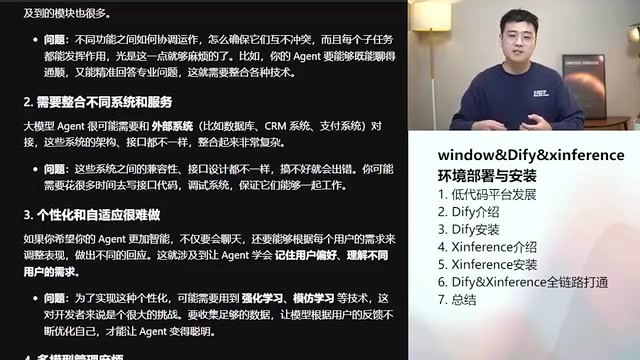
Traditionally, developing an AI Agent—especially something like an intelligent customer service application—requires coordinating multiple modules such as knowledge base queries, context understanding, and personalized recommendations. Each module needs its own interface, compatibility debugging, and integration with external databases, payment systems, and other services. Developers often get stuck in a loop of "write an interface—debug—write another interface," resulting in a huge amount of code that is hard to maintain.
Model management is another major challenge: multiple models need unified scheduling, monitoring, and updating, and once a model is iterated, it may affect every business that references it. These practical problems gave rise to low-code platforms, which greatly lower the development barrier through visual drag-and-drop and prebuilt modules.
AI Agent refers to a software entity that can perceive its environment, make autonomous decisions, and execute actions to achieve a goal. In the context of this article, it usually refers to an application driven by a large language model that can call external tools (such as knowledge bases and APIs) to complete a specific task (such as customer service dialogue). Unlike traditional programs, the core of an AI Agent lies in "autonomy" and "tool-use capability," and its development involves prompt engineering, context management, tool orchestration, and other steps, making it highly complex—which is exactly what low-code platforms try to simplify.
Core Advantages of the Dify Low-Code Platform
1. Visual Development That Anyone Can Pick Up
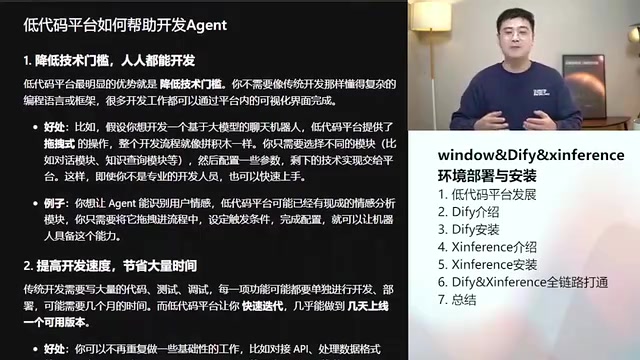
Dify abstracts the process of building an AI Agent into "building-block" operations. You simply drag modules and configure parameters on the interface to quickly build applications such as chatbots and sentiment analysis. For example, when building a customer service bot, you just drag in the "knowledge base query" and "dialogue generation" modules and connect them, and it runs. For non-technical people, this means a demo you can present within an hour, whereas traditional development might take a week.
Visual drag-and-drop development is a method of building applications in a "building-block" fashion through a graphical interface. It encapsulates functionality as draggable modules (such as "knowledge base query" and "dialogue generation"), and developers only need to connect modules and configure parameters without writing low-level code. This paradigm lowers the barrier of programming languages and frameworks, enabling business people to participate in application building, though complex logic may still require code extensions.
2. Prebuilt Integrations That Accelerate System Connectivity
The platform comes with a large number of built-in connectors that support rapid integration with external services such as CRM, ERP, and payment systems. Developers no longer need to hand-write custom interfaces for each system; they simply select and configure connections in the interface, and data synchronization and API calls are handled automatically. This greatly simplifies the automation of business processes such as order processing and inventory management.
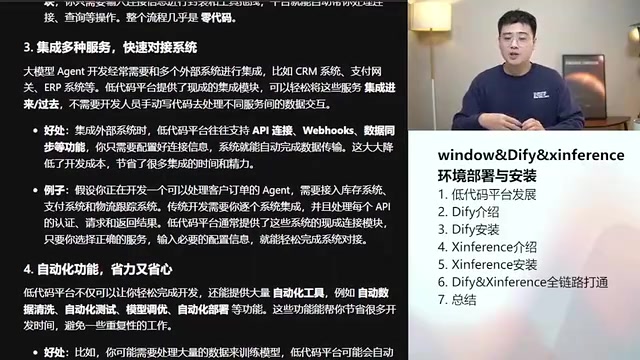
Connector refers to a prebuilt component in a low-code platform used to connect to external systems. It encapsulates the protocols and authentication details for communicating with a specific service (such as CRM, ERP, or payment systems), so developers only need to select and fill in the configuration (such as API address and key) in the interface to achieve data read/write and business calls. Connectors greatly reduce the workload of hand-writing interfaces, but their flexibility and customization capabilities are usually lower than custom development.
3. Automated Tuning and Elastic Scaling
Dify provides automated parameter tuning that can automatically optimize model parameters based on user feedback. When growing user numbers slow down responses, you can quickly scale up by dragging to duplicate model instances and increasing concurrency, without refactoring code. This elasticity lets the system keep pace with market iteration.
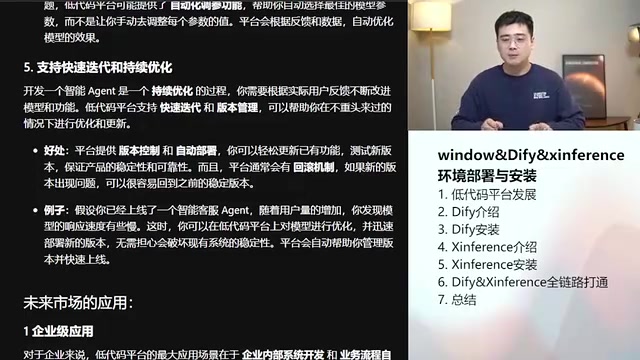
Automated parameter tuning refers to the platform automatically adjusting model or application parameters (such as temperature and retrieval thresholds) based on runtime data (such as user feedback and accuracy metrics) to optimize results. Elastic scaling refers to the system dynamically increasing or decreasing resources (such as model instances and concurrency) based on load to cope with traffic fluctuations. Combined, the two enable applications to continuously optimize and remain stable without frequent manual intervention or code refactoring.
Enterprise Applications and Future Prospects
Low-code platforms have enormous potential in enterprise internal system development. Mid-sized systems for departments such as HR and finance used to take months to develop; now business managers can build basic processes through drag-and-drop and then combine them with automation tools for intelligent parsing. For startups, low-code platforms make it possible for individuals or small teams to build an MVP within weeks and quickly validate market ideas.
The education and training industry can also benefit: quickly adjusting course content, managing student records, and building personalized Q&A systems. As AI and low-code converge, every industry will be able to enjoy intelligent applications at a lower cost in the future.
Conclusion
As a representative low-code AI platform, Dify is turning AI Agent development from "painful" to "simple" through visualization, integration, and automation. Deployment in a Windows environment is the first step for beginners, and subsequent hands-on practice will go deeper step by step. Whether you are a developer or a business person, mastering low-code tools will significantly boost your efficiency and help you avoid detours.
One-line Summary
Dify, a low-code platform, lowers the barrier to AI Agent development through visualization, integration, and automation.
Paragraph Summary
This article introduces the deployment of the Dify low-code platform in a Windows environment and the basics of AI Agent development. It first points out the pain points of traditional AI Agent development, such as complex interfaces and difficult model management, and then explains the value of low-code platforms. It goes on to detail Dify's three core advantages: visual drag-and-drop development that lets non-technical people get started quickly; prebuilt connectors that accelerate integration with systems such as CRM and ERP; and automated tuning plus elastic scaling that ensure system optimization and capacity expansion. Finally, it looks ahead to the application potential of low-code in enterprise internal systems, startup MVPs, and education and training, emphasizing that it can significantly improve development efficiency.
Related articles

Chain of Thought Isn't Just for AI: How Humans Can Use CoT to Improve Thinking Quality
Chain of Thought isn't just a prompt trick for large models. Starting from a Hacker News discussion, this article analyzes why CoT works for human thinking too, breaks down actionable ways to transfer it, and highlights the key differences between human CoT and machine CoT.
Cloudflare Teams Up with OpenAI: Closi…
Cloudflare Teams Up with OpenAI: Closing the Loop from Vulnerability Discovery to Defense with AI
Cloudflare uses OpenAI Daybreak to investigate security vulnerabilities and generate reviewable remediation plans, while developers use Codex to boost coding efficiency and quality.

Orca Multi-Agent Orchestration in Practice: A Guide to Parallel Collaboration with Claude and Codex
Orca is Stable AI's free open-source agent workbench supporting 34 agents like Claude Code and Codex in parallel. Learn its Git worktree isolation, multi-model orchestration, and mobile management.