Dify + RAG in Practice: Building a Game-Specific AI Assistant from Scratch

Build a game AI assistant using Dify's low-code RAG platform — no coding experience required.
This article uses building a Delta Force game assistant as a hands-on case study to introduce RAG (Retrieval-Augmented Generation) using Dify, a low-code LLMOps platform. It covers core concepts like vector embedding and chunking, compares Dify with Coze on private deployment, and outlines a four-step learning path for beginners to go from zero to a fully deployed AI knowledge base assistant.
For many people just getting started with AI application development, terms like "AI Agent" and "RAG knowledge base" can sound intimidatingly complex — but in practice, the biggest obstacle is often the code itself. This article uses a fun, hands-on case study — building a dedicated AI assistant for the game Delta Force — as an entry point to walk you through building a localized RAG knowledge base using Dify, a low-code platform. Even with zero prior experience, you'll be able to quickly grasp the core concepts and complete the full workflow.
Why Choose Dify Instead of Writing Code Directly
If you're an experienced LLM engineer, there's nothing wrong with using a framework like LangChain to build RAG applications from scratch. But for beginners, code is often the biggest roadblock — faced with LangChain's syntax, it's easy to get lost in the details, with all your attention consumed by syntax instead of the actual logic behind RAG.
It's worth knowing that LangChain is one of the most widely used LLM application development frameworks today. Created by Harrison Chase in 2022, it provides core abstractions like Chain, Agent, Memory, and Tool to help developers build LLM applications in a modular way. However, LangChain has a steep learning curve, and its frequent API changes (from v0.1 to v0.2 and then to LangChain Expression Language) often confuse beginners. Low-code platforms like Dify don't replace LangChain — they wrap its underlying capabilities into a visual interface, making them far more accessible to product managers, operations staff, and learners who want to quickly validate ideas. For scenarios requiring highly customized logic, using LangChain or LlamaIndex directly still offers more flexibility.
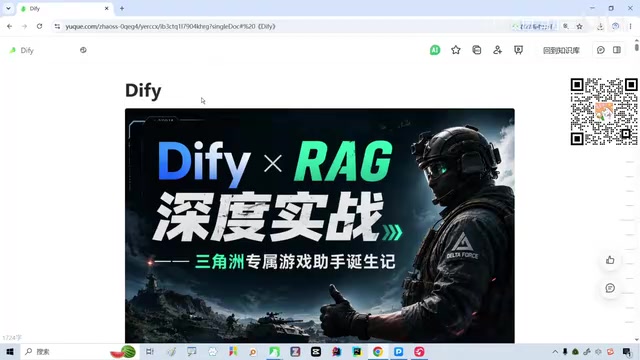
Dify is an open-source LLMOps platform developed by LangGenius, officially released in 2023, and has since accumulated tens of thousands of stars on GitHub. Built on a Python backend and React frontend, it natively integrates parts of LangChain while also providing its own custom Workflow Engine. Dify supports connecting to mainstream model services including OpenAI, Anthropic, Azure OpenAI, and local Ollama instances. It also comes with built-in adapter layers for vector databases like Weaviate and Qdrant, eliminating the need to manually configure complex vector storage. Dify's visual interface lets you build AI agents through drag-and-drop — making it extremely beginner-friendly. Its core features cover chat assistants, Agents, text generation, workflows, and more, enabling truly zero-code construction of complete AI applications.

It's worth emphasizing: getting started with tools doesn't mean giving up on understanding the underlying principles. The right learning path is: use Dify to run through the full workflow first, build an intuitive understanding of RAG, and then circle back to study the corresponding code implementations. This way, you won't get bogged down in syntax details, nor will you stay at the surface level of "knowing what" without "knowing why."
What Is a RAG Knowledge Base
The core of this hands-on project is RAG (Retrieval-Augmented Generation) — what people commonly refer to as a "knowledge base" feature. RAG is a technical paradigm formally introduced in 2020 by the Meta AI research team in the paper Retrieval-Augmented Generation for Knowledge-Intensive NLP Tasks. Its core idea is to decouple and coordinate two modules — "information retrieval" and "text generation" — to fundamentally address the problems of knowledge cutoffs and hallucinations in large language models. The core problem it solves: LLMs have inherent knowledge boundaries and cannot access your private, domain-specific information — such as detailed guides, equipment data, or map mechanics for a particular game.

RAG works by organizing your proprietary knowledge into documents and importing them into a knowledge base. When a user asks a question, the system first retrieves relevant content from the knowledge base, then feeds that content along with the question into the LLM, allowing the model to answer based on real source material. Technically, RAG typically involves key steps such as document chunking, vector embedding, vector database storage, and similarity search (e.g., cosine similarity). The retrieved results are then injected into the prompt as context, guiding the model to generate more accurate responses. This transforms a general-purpose LLM into a dedicated game assistant with expert knowledge of every detail in Delta Force.
In enterprise settings, RAG's value is even more pronounced — securely connecting to internal knowledge bases so AI assistants can answer employee FAQs, retrieve policies and procedures, and support day-to-day operations, significantly boosting team efficiency.
Dify vs. Coze: Private Deployment Is the Key Differentiator
When Dify comes up, many people compare it to Coze. Both can handle AI application orchestration, but they differ fundamentally on data security.
Coze is primarily cloud-hosted, with all data processed centrally by the platform. That's fine for personal projects, but if you're representing a company — especially in industries like finance or healthcare with strict data compliance requirements — hosting core data on a third-party cloud server carries obvious risks.
Dify's advantage lies in supporting both cloud usage and private deployment. Dify's private deployment is primarily implemented via Docker and Docker Compose. The official repository provides a complete docker-compose.yaml configuration file — a single command is all it takes to spin up the full service stack on your local machine or private server, including the API service, Worker, Web frontend, PostgreSQL database, Redis cache, and vector database. For enterprises with higher availability requirements, container orchestration via Kubernetes is also an option. Once privately deployed, all data — including knowledge base documents, user conversation logs, and model call logs — is stored in the local database and never passes through any third-party network node. This satisfies the data compliance requirements (such as GDPR and China's Cybersecurity Graded Protection 2.0) of industries like finance, healthcare, and government at the architectural level. For teams with data sovereignty and compliance needs, this is often the decisive factor in tool selection.
A Four-Step Learning Path for RAG Beginners
This tutorial is structured with a clear logic, making it an ideal first lesson for anyone starting from zero with RAG:
Step 1: Understand the Core Concepts
Start by clarifying "what an AI agent is" and "what problem a RAG knowledge base solves." Build the right mental model before diving into code. Understanding RAG's vector retrieval mechanism, the role of embedding models, and how LLMs collaborate with external knowledge bases is the foundation for deeper learning.
Step 2: Run Through the Full Workflow with Dify
Using the visual interface, create a chat assistant with an attached knowledge base through drag-and-drop. Import game guides and other materials, and experience the complete RAG loop — from document chunking and vector embedding to similarity retrieval and final answer generation.
Step 3: Deploy Locally with Private Hosting
Deploy Dify to your local environment to ensure data security and control. Use Docker Compose to spin up the complete service stack with a single command and experience the full deployment process of an enterprise-grade AI application. This is an essential step for real-world enterprise AI deployment.
Step 4: Review the Underlying Code
Once the workflow is running smoothly, explore the underlying code implementations — including how the corresponding RAG Pipeline is written in LangChain or LlamaIndex. At this point, you'll already have a holistic understanding of RAG, making the code far easier to grasp and enabling you to build truly transferable engineering skills.
Summary
Choosing the right tool is the first step to avoiding unnecessary detours as a beginner. Dify's visual, low-code approach dramatically lowers the barrier to RAG application development, making knowledge base assistants that once required extensive coding immediately accessible. Its native support for private deployment also gives it a unique competitive edge in enterprise scenarios. RAG technology itself has been widely validated in areas such as enterprise knowledge management, intelligent customer service, and document Q&A. Mastering the core principles of this paradigm is one of the key thresholds for entering the field of AI application development.
Using a game assistant as your starting point keeps learning engaging while building genuinely transferable RAG skills — perhaps one of the most practical paths into AI application development today.
Key Takeaways
Related articles

Disaster and Glory of the Apollo Program: The History We Must Revisit Before Returning to the Moon
From the fatal Apollo 1 fire to Apollo 8's daring lunar orbit to Apollo 11's successful landing—revisiting the disasters, fears, and compromises of the Apollo program and their lessons for today's return to the Moon.

Netflix Trust Exercise Turns Into Firing Trap: Where Are the Boundaries of Corporate Trust?
A Netflix employee was fired after sharing private info in a trust exercise. We analyze the risks of corporate trust exercises and how employees can protect themselves.

AMD CDNA5 Architecture Deep Dive: Technical Evolution and the AI Computing Competition Landscape
Deep analysis of AMD's CDNA5 architecture covering Chiplet packaging upgrades, HBM memory evolution, and low-precision compute optimization, examining how AMD challenges NVIDIA's AI chip dominance.