Dify Workflow Tutorial: A Complete Guide to Building AI Apps with Zero Code
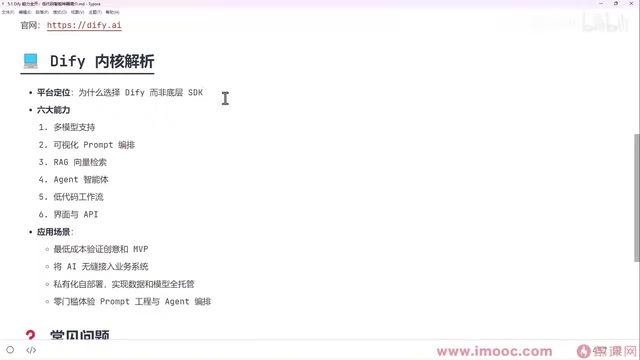
Dify is an open-source LLM app platform fusing BaaS and LLMOps, lowering the AI barrier with zero-code visual orchestration.
Based on a Bilibili tutorial for building 20+ AI apps from scratch, this article outlines Dify's positioning and capabilities. Dify combines BaaS backend capabilities with LLMOps lifecycle management and offers visual prompt orchestration so non-technical colleagues can build via drag-and-drop. Its six modules include multi-model support, visual orchestration, RAG engine, Agent framework, low-code workflows, and interface/API publishing. Unlike LangChain, Dify is a production-grade platform, not a parts library, bringing assembly and operations inside the platform. It covers rapid idea validation, AI integration, private data custody, and zero-barrier prompt/agent experiences. Local deployment supports source code and Docker Compose, or Dify Cloud.
Dify, an open-source large language model application development platform, is becoming the choice for many teams looking to quickly deploy AI capabilities. There is a category of tutorials on Bilibili dedicated to building 20+ AI applications from scratch. This article is based on the core content of such tutorials, combined with the platform's own capabilities, to outline Dify's positioning, its six core capability modules, typical application scenarios, and how it differs from pure-code frameworks, helping readers judge whether it suits their business.
What Is Dify: The Fusion of BaaS Philosophy and LLMOps
Dify is an open-source large language model application development platform that combines two approaches: Backend as a Service (BaaS) and LLMOps. BaaS provides ready-made backend service capabilities, while LLMOps focuses on the lifecycle management of model operation, monitoring, and iteration. Together, they enable developers to complete the entire process—from prompt design to workflow orchestration to publishing and deployment—within a single interface.
The platform's most direct feature is visual prompt orchestration—all nodes are edited via drag-and-drop, without writing a single line of code. For business colleagues unfamiliar with programming, the barrier to entry is significantly lowered.
BaaS (Backend as a Service) refers to providing common backend capabilities such as databases, user authentication, file storage, and message push as cloud services. Developers call them directly via APIs or consoles without building and maintaining servers themselves. In the context of LLM applications, BaaS is reflected in Dify's built-in backend components such as conversation history management, knowledge base storage, user permissions, and API gateways, so users only need to focus on prompts and business logic.
LLMOps (Large Language Model Operations) borrows from MLOps and covers the complete lifecycle of large model applications, from prompt version management, run log tracking, effect evaluation, and cost monitoring to iterative releases. Because large model outputs are non-deterministic, traditional software testing methods are difficult to apply directly. LLMOps emphasizes versioned comparison of prompt changes, sampling analysis of online conversations, and continuous optimization of recall and generation quality. Dify's integration of these two approaches is the key positioning that distinguishes it from mere prompt tools.
Breakdown of the Six Core Capability Modules
Multi-Model Support and Visual Orchestration
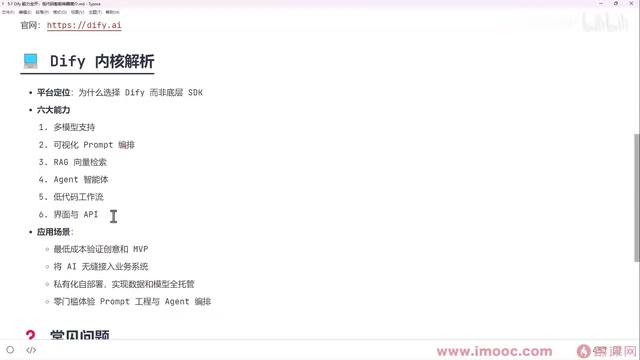
Dify natively connects to most mainstream large language model platforms on the market. Internationally, these include OpenAI, Gemini, Anthropic, and others; domestically, it covers platforms such as DeepSeekAd, Qwen, and SiliconFlow. This multi-model support means teams can flexibly switch models based on task type and cost budget without being locked into a single vendor.
Combined with visual prompt orchestration, users can directly adjust prompt structure, insert variables, and preview results in the interface, turning a debugging process that originally required repeated code changes into visual operations.
RAG Engine, Agent Framework, and Low-Code Workflows
A high-quality RAG (Retrieval-Augmented Generation) engine is another key capability of Dify. It has built-in vector retrieval; after enterprises or individuals upload documents, recall efficiency is higher, making it suitable for building Q&A applications based on private knowledge bases.
The Agent framework uses a "role + goal + constraints" definition approach, allowing users to quickly describe the behavioral boundaries of an agent without starting from a low-level state machine. Low-code workflows are a major highlight of the platform—supporting cross-model and cross-tool orchestration of business processes, connecting multiple nodes into a complete chain with one click.
RAG (Retrieval-Augmented Generation) works by first retrieving the most relevant snippets from an external knowledge base before letting the large model answer, then inserting them as context into the prompt so the model responds based on real materials. This significantly mitigates the "hallucination" and outdated knowledge problems of large models and also enables the use of enterprise private documents. A RAG system typically includes document parsing and splitting, vectorization (Embedding), vector store storage, similarity recall, re-ranking, and final generation. Dify's built-in RAG engine productizes these steps; users only need to upload documents to get a Q&A-ready knowledge base without building their own vector database and retrieval pipeline.
Agent refers to a form of large model application that can autonomously plan steps, invoke tools, and adjust actions based on results. Unlike fixed-process workflows, an Agent decides "what to do next" at runtime; common capabilities include tool invocation, multi-turn reflection, and task decomposition. Dify lowers the definition barrier with a declarative "role + goal + constraints" description, allowing users to constrain an agent's behavioral boundaries without writing state machine code.
Out-of-the-Box Interface and API
In addition to drag-and-drop orchestration within the platform, Dify also provides its own API interfaces. Once a workflow or chat assistant is ready, it can be published and called via external code for batch processing. This means non-technical colleagues can handle the building while the technical team handles integration—a clear division of labor.
Why Choose Dify Over Low-Level SDKs
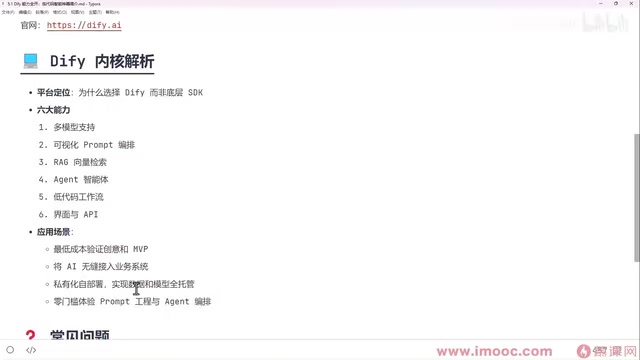
The problem with using SDKs directly is that they are usually tied to a specific programming language—whether JavaScript or Python—creating a barrier for ordinary colleagues or pure business users who don't code. Dify's low-code path makes it possible to complete business workflows without writing any code at all, which is the core reason it is recommended.
The tutorial offers a vivid analogy: pure-code open-source projects like LangChain are more like a parts library—you need to assemble, connect, and maintain everything yourself to achieve any functionality; Dify is a production-grade platform with visualization, operations, model management, and multi-model integration already built in, so users can directly develop agent workflows ready for production. The essential difference is that the former leaves assembly and operations to the developer, while the latter brings most infrastructure work inside the platform.
LangChain is a popular open-source framework for developing large model applications. It provides a large number of composable modules such as chained calls, memory management, tool integration, and retrievers, and supports Python and JavaScript. Its advantages are flexibility and a rich ecosystem, allowing developers to finely control every step of logic; the cost is that you need to write code yourself, handle dependency versions, build vector stores, and manage deployment and operations—unfriendly to non-programmers.
Comparing LangChain to a "parts library" and Dify to a "production-grade platform" highlights the essential difference in abstraction level: the former provides programmable building blocks, with assembly, debugging, deployment, and monitoring all the developer's responsibility; the latter brings visual orchestration, model integration, log monitoring, and multi-model management inside the platform, letting users replace coding with configuration. The two are not mutually exclusive—some of Dify's internal capabilities can also work with code frameworks, and technical teams can still do deep integration via APIs. The key to choosing lies in whether the team has the manpower to continuously write and maintain code, and the required level of fine-grained process control.
Typical Application Scenarios
Low-cost idea validation: When you encounter an idea at work that needs validation, you can use Dify to quickly build a prototype at the lowest cost, then decide whether to invest more resources after validation.
Seamless AI integration into business systems: After building a workflow or agent, integrate it with existing business systems via API to embed AI capabilities into original processes.
Private deployment for full data custody: Enterprises with high data sensitivity requirements, such as those in healthcare and finance, often want internal data to remain only within the company. Dify supports private self-deployment, in which case the project cost itself is zero—the enterprise only bears hardware costs and large model invocation fees. If the enterprise deploys the corresponding large model internally and does not need to access external APIs, data is fully privatized.
Zero-barrier experience with prompt engineering and agent orchestration: Business colleagues who don't understand code can click and drag nodes and draw connections in the interface to complete their own workflow building.
Two Paths for Local Private Deployment
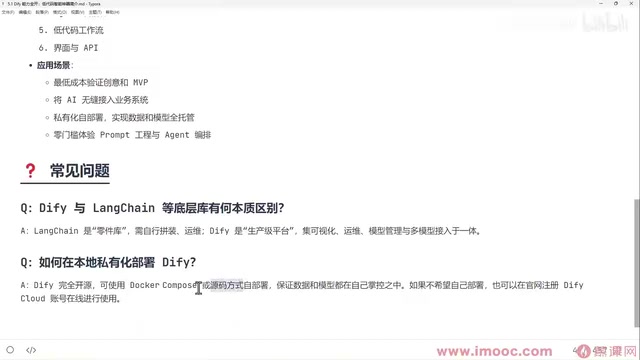
Dify is an open-source project; the source code can be downloaded, and a cloud version is also available. For local deployment, you can choose either the source code method or Docker Compose; if you don't want to deploy it yourself, you can also register a Dify Cloud account on the official Dify website to use it online. The two methods are freely selectable, and you can switch according to actual needs during learning.
Final Thoughts
Dify's most representative feature is that developing agents typically requires no coding at all. For people who don't understand programming but understand the business, this means requirements can be directly turned into runnable workflows. Its multi-model support, RAG engine, and API publishing capabilities also give technical teams enough room for deep integration. Understanding this positioning is more valuable than memorizing a list of specific features.
One-line Summary
Dify is an open-source LLM application development platform fusing BaaS and LLMOps, lowering the AI application barrier with zero-code visual orchestration.
Paragraph Summary
Based on a Bilibili tutorial for building 20+ AI applications from scratch, this article systematically outlines Dify's positioning and capabilities. Dify combines BaaS's ready-made backend capabilities with LLMOps's model lifecycle management and provides visual prompt orchestration, enabling non-technical colleagues to build via drag-and-drop. Its six core capability modules include multi-model support, visual orchestration, RAG engine, Agent framework, low-code workflows, and interface/API publishing. Compared with pure-code frameworks like LangChain, Dify is more like a production-grade platform than a parts library, bringing assembly and operations responsibilities inside the platform. Typical scenarios cover rapid idea validation, AI integration into business systems, private data custody, and zero-barrier prompt/agent experiences. Local deployment supports source code and Docker Compose, or you can use Dify Cloud directly.
Related articles

Gemini 4 Hydrogen Released: A 2.5x Faster Everyday AI Model
Google releases Gemini 4 Hydrogen, claiming 2.5x the speed of Gemini 3.8 Flash, with four-tier thinking control, a million-token context, and Orchestrator multi-model collaboration. API pricing is $1.50 per million input tokens.

Gemini 4 Hydrogen Hands-On: Google's Fastest and Cheapest AI Model
Hands-on with Gemini 4 Hydrogen: the fastest, cheapest model in the Gemini 4 family. We break down the Carbon/Argon/Hydrogen split, API pricing traps, free-tier limits, and the cost trade-offs of four thinking levels—with a real bug-debugging demo.

Gemini 4 Hydrogen vs Sonnet Comparison Test: Uses Only 1% of Weekly Quota, Performance on Par
Hands-on test: Gemini 4 Hydrogen vs Sonnet on the same CRUD task—Hydrogen used only 1% weekly quota with comparable performance and better UI details, while Anthropic's model used 7%. Developer says daily tasks don't require expensive models.