Directus Launches Monospace: A Unified API Governance Layer for Apps, People, and AI Agents

Monospace gives enterprises a unified governed API layer for apps, humans, and AI agents over legacy data.
Monospace is a new product from the Directus team that acts as a unified governance layer between enterprise data and all its consumers — developers, business teams, and AI agents alike. It connects directly to any data source, introspects the database schema in real time, and generates live read-write interfaces without copying or migrating data. All access, whether from humans or agents, is governed by a single granular permission model — addressing the emerging challenge of AI agents autonomously operating within enterprise data environments. The product topped Product Hunt on launch day and sits at the convergence of legacy data integration and AI governance trends, though real-world performance and cross-source coverage remain to be proven.
What Problem Monospace Is Solving
Enterprise data is often scattered across legacy databases built decades ago, SaaS systems, and a variety of other data sources. These systems were never designed with modern application development in mind — let alone for consumption by AI agents. When developers, business teams, and AI agents all need access to the same data, the typical approach involves copying, migrating, and building yet another middleware layer. This creates data consistency risks and fragments permission management beyond recognition.
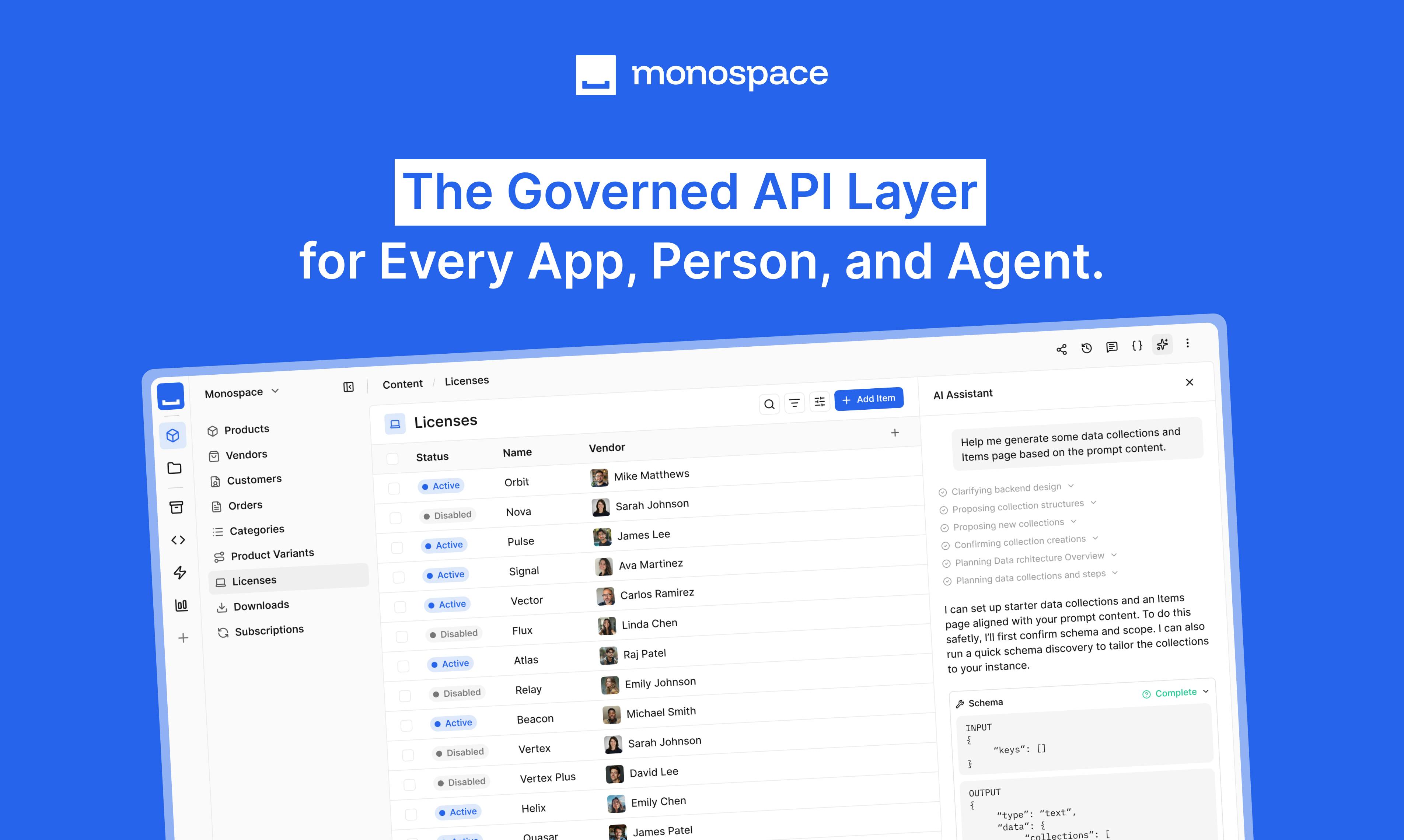
Monospace, a new product from the Directus team, aims to insert a "governance layer" between enterprise data and everyone who needs to use it. Its positioning is clear: The governed API layer for every app, person, and agent. After launching on Product Hunt, the product quickly topped the day's leaderboard with 232 upvotes and 53 comments, ranking #1.
Core Design: Generate Interfaces Directly — No Data Migration Required
The most noteworthy idea behind Monospace is that data is never copied or migrated. It connects directly to any data source and generates usable interfaces on top of the data as it already exists, by introspecting the database's schema and query structure in real time.
This means legacy databases that were "never designed for AI or modern applications" can be accessed directly — without being rebuilt or migrated. For large organizations burdened with sprawling legacy systems, this is a practically grounded entry point. The cost and risk of rebuilding data architecture is often the single biggest obstacle in digital transformation initiatives.
Read-Write Access, Not Just Read-Only
Unlike many data aggregation tools that only offer read-only queries, Monospace emphasizes live, read-write access. Developers, business teams, and AI agents can all read from and write to the connected data sources — not just passively query them.
A note on real-time introspection: Introspection refers to a system's ability to dynamically read a database's structural information at runtime — table names, field types, indexes, foreign key relationships, and so on — without requiring manual configuration upfront. Traditional API development typically requires developers to hand-write data models and endpoints one by one. Introspection allows a tool to automatically "understand" the current state of a database and generate corresponding query interfaces. The engineering challenge here is significant: when dealing with production databases containing hundreds of tables, complex views, or stored procedures, introspection speed and accuracy can degrade considerably. Different database dialects (MySQL, PostgreSQL, Oracle, etc.) also express schema information differently, compounding the difficulty of unified handling. Monospace claims to accomplish this across any data source — the robustness of its actual engineering implementation is one of the key metrics by which the product's maturity should be evaluated.
A Unified, Granular Permission Model
The true "governance" value of Monospace lies in its permission system. All access — whether from human users, applications, or AI agents — follows the same granular permission model.
This is especially critical now that AI agents are flooding into enterprise workflows at scale. When AI agents begin autonomously reading from and writing to enterprise data, the absence of unified controls over "who can access what and do what" can quickly become a security and compliance black hole. By placing people, applications, and agents under the same permission framework, Monospace effectively creates a unified access gateway for the AI era — rather than maintaining separate rule sets for each type of consumer.
A note on granular permissions: Granular permissions, in contrast to coarse-grained role-based access (e.g., a simple "admin/user" binary), enable precise control down to the level of "a specific user can read/write/delete a specific field in a specific table, when a specific condition is met." This capability is especially important in AI agent scenarios: an AI agent may need to read customer order data to generate a report, but should never have the authority to modify financial records. If permission boundaries are vague, an AI autonomously executing multi-step tasks can easily produce "unauthorized write" operations that are difficult to trace. Bringing people, applications, and AI agents under one permission framework also means audit logs can be centrally maintained, making it easier to trace the origin and intent of any data access after the fact — a capability with direct practical value in increasingly compliance-driven enterprise environments.
Why This Direction Deserves Attention
Monospace comes from the Directus team, which has long been known for its open-source data platform and its focus on "turning any database into a ready-to-use backend." The Makers list runs to more than twenty contributors, signaling that this is a well-resourced product effort.
From an industry perspective, Monospace sits squarely at the intersection of two converging trends: the long-standing enterprise challenge of connecting to legacy data, and the emerging governance demands created by AI agents as a new class of data consumers. Past API gateways and data platforms were largely designed around humans and applications. Products that explicitly treat AI agents as first-class citizens in a governance layer are still in their early stages.
Open Questions
That said, product descriptions alone leave several questions unanswered: How does real-time schema introspection perform against very large, structurally complex production databases? What impact does live read-write access have on source database load and transactional consistency? And how complete is the unified permission model's actual coverage across heterogeneous data sources? These are questions that only real-world deployments can answer.
Background on Directus: Directus is an open-source project founded in 2012 whose core product is a "Headless CMS + Data Platform" — a philosophy directly in line with Monospace. Its approach: wrap any SQL database in a permission-managed REST/GraphQL API without altering the underlying data structure. This background means the Monospace team brings over a decade of engineering experience in database introspection, dynamic interface generation, and permission modeling — they are not starting from scratch. Within the Directus ecosystem, a large base of enterprise users already rely on it to manage legacy databases; Monospace can be seen as a natural extension of that capability into the AI agent era, while also targeting a broader audience that never used Directus before. Understanding this context helps clarify that Monospace is not a purely conceptual product, but a directional extension grounded in real technical foundations.
Summary
Monospace takes an old problem — enterprise data that is scattered and difficult to access securely in a unified way — and reframes it in the new context of rising AI agents. No data copying, real-time interface generation, and unified permission governance are its three key answers. For teams looking to let developers, business stakeholders, and AI agents safely share the same enterprise data, this is a direction worth watching closely.
Related articles

Amphibious Transforming Drone: Beyond 100x Power Savings, What Are the Real Needs?
Is the amphibious transforming drone just a gimmick? Starting from the 100x power difference of the M4 Morphobot, explore real application scenarios and thesis topic ideas, analyzing boundary conditions where pure drones and pure ground robots both fail.

Warhound Raises $200 Million: Genetically Engineered "War Dogs" Paired with Anduril Gear
Warhound raises $200M, backed by Ben Lamm and Palmer Luckey, to genetically engineer dogs for military and law enforcement use and equip them with Anduril gear. This article analyzes its technology direction, funding logic, and ethical controversy.

Claude API Comes to Google Cloud: IAM Integration and SDK Access Guide
Anthropic hosts the full Claude API on Google Cloud with IAM-controlled permissions and unified billing. This guide covers the Vertex AI and Anthropic-hosted entry points, IAM role configuration, and SDK access.