DistroKid Quietly Removes Songs: The AI Music Controversy Behind UMG's Lawsuit
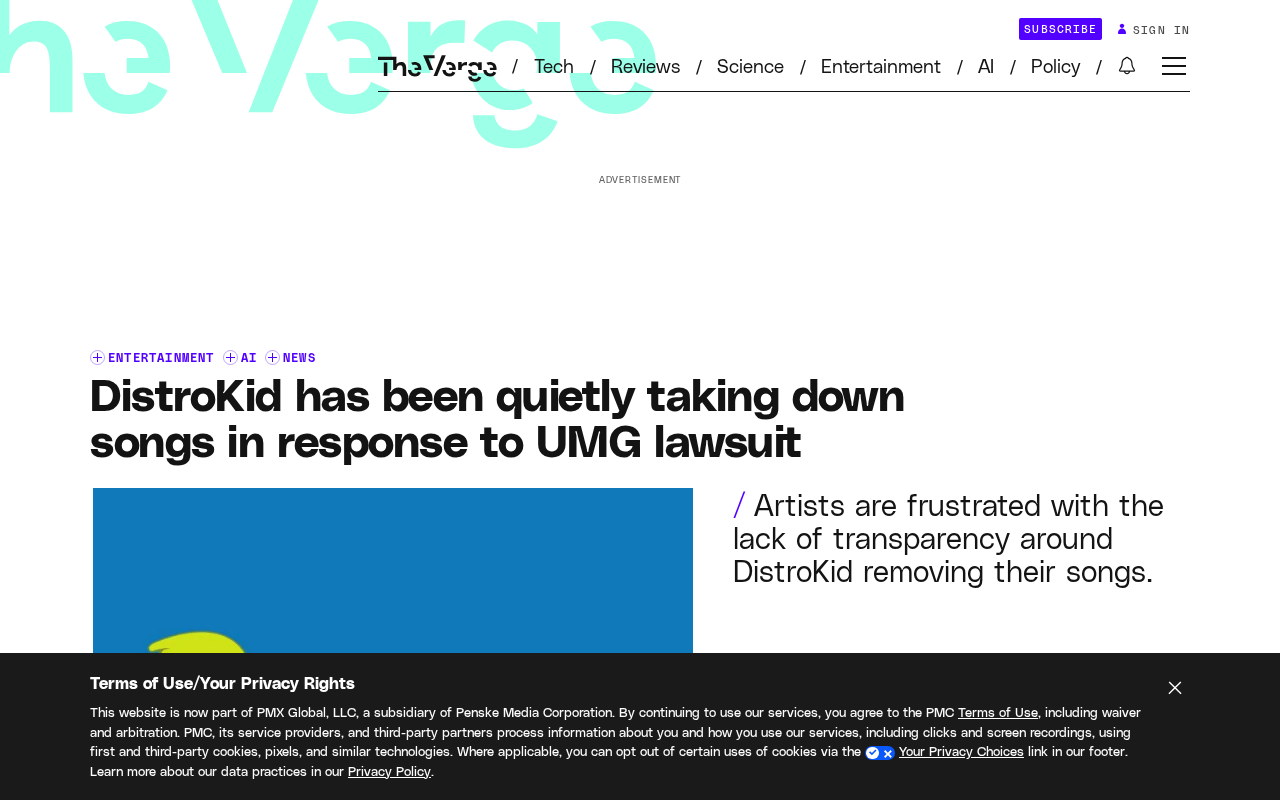
UMG's AI copyright lawsuit pressured DistroKid into mass song removals, blindsiding independent musicians.
Music distribution platform DistroKid recently removed large numbers of songs without notifying creators, later confirming the action was a direct response to a lawsuit from Universal Music Group (UMG). UMG accused DistroKid of running an "AI-slop pipeline" that floods platforms with low-quality AI-generated music, diluting royalties and infringing copyrights. The incident exposes a deepening conflict between major labels and distribution platforms in the AI era, and serves as a stark warning to independent musicians about the risks of relying on a single platform.
How It Started: Artists Wake Up to Vanished Music
Recently, a wave of independent musicians took to social media to voice their frustration after music distribution platform DistroKid removed their uploaded tracks without any prior notice. For creators who rely on the platform to get their music onto Spotify, Apple Music, and other streaming services, this came as a sudden and devastating professional shock.
As the backlash grew online, DistroKid confirmed to The Verge that the removals were not arbitrary platform decisions — they were a direct response to legal claims from Universal Music Group (UMG). In other words, this is a chain reaction playing out within a much larger legal battle, with everyday creators caught in the crossfire.
The Core Accusation: UMG's "AI-Slop Pipeline" Claim
The root of the conflict traces back to a lawsuit filed by Universal Music Group. In its complaint, UMG directly accused DistroKid of building what it called an "AI-slop pipeline" — implying that the platform has been mass-distributing AI-generated music that is low-quality and potentially infringing on copyrights.
The term "AI-slop" is notably pointed. "Slop" originally referred to waste food fed to pigs, and has more recently been adopted to describe the flood of low-value, AI-generated content polluting the internet. UMG's use of the term frames DistroKid as an enabler of a degraded AI music ecosystem — and uses that framing as legal leverage.
For the major labels, AI-generated content represents both a new battleground for copyright protection and a direct financial threat: as vast quantities of AI music flood streaming platforms, the royalty pool gets diluted, cutting into the exposure and earnings of legitimate artists.
DistroKid is one of the world's most widely used independent music distribution platforms. Founded in 2013, it operates on an annual subscription model (starting at around $22/year), allowing creators to distribute unlimited tracks to dozens of streaming platforms — including Spotify, Apple Music, and Amazon Music — while keeping 100% of royalties. Its low-barrier, low-cost model has made it the go-to tool for independent musicians. But that same accessibility means relatively relaxed content vetting, which is exactly the vulnerability UMG's lawsuit targets. In 2018, an entity affiliated with Spotify's parent company acquired a stake in DistroKid — a deep entanglement with the streaming ecosystem that has become a particularly sensitive factor in this legal dispute.
The Platform's Dilemma: Legal Compliance vs. Creator Trust
DistroKid's decision to proactively remove content is essentially a defensive move made under litigation pressure. The platform must balance responding to UMG's legal claims against maintaining the trust of its creator community — and right now, that balance has been badly disrupted.
What has drawn the most criticism isn't the takedowns themselves, but the fact that they happened without any notice. Many artists only discovered their work was gone after it had already disappeared, with no advance warning and no clear explanation of how to appeal. For independent musicians who depend on DistroKid as a primary income source, this lack of transparency has shaken the most fundamental trust between platform and creator.
A Deeper Industry Signal: AI Music Enters Regulatory Choppy Waters
This incident reflects a deep anxiety running through the entire music industry in the age of AI. As the barriers to AI music generation continue to fall, anyone can churn out "songs" in bulk and upload them to distribution platforms — a direct assault on the content moats that major labels have built over decades.
UMG, one of the world's largest record labels, has taken an aggressive stance on AI copyright issues in recent years, having already launched legal action against multiple AI music generation companies. Turning its sights on a distribution channel like DistroKid signals that the enforcement front is expanding from the "generation side" to the "distribution side" — if it's hard to stop content from being made, cut it off at the point of circulation.
For DistroKid and similar platforms, the future may require building more rigorous content review mechanisms to identify AI-generated content and potentially infringing works. But that raises a fresh dilemma: how do you screen effectively without catching legitimate creators in the net? Mass takedowns are clearly not a sustainable solution.
UMG's hardline stance in the AI copyright space has specific legal and commercial foundations. In 2024, UMG pressured Spotify to strip AI-generated "functional music" (such as sleep aids and meditation backgrounds) from royalty calculations, to prevent such content from diluting earnings for human artists. Previously, UMG sued multiple tech companies over AI training data, arguing that using its copyrighted music to train models without authorization constitutes infringement. On the distribution side, platforms like Spotify now see roughly 100,000 new songs uploaded daily, a significant proportion of which are believed to originate from AI tools or content farms — massively diluting the streaming royalty pool. This is the direct motivation behind major labels expanding their enforcement targets from generation tools to distribution channels.
What This Means for Independent Musicians
This dispute serves as a wake-up call for independent creators everywhere. Over-relying on a single distribution platform means handing control of your career to a third party — and the moment that platform adjusts course due to legal or policy pressures, your work can be affected at any time.
Creators need to rethink their content distribution strategies: consider multi-channel backups, retain original proof of copyright for your work, and keep a close eye on changes to platform terms of service. Until the boundaries between AI and copyright are clearly established, these kinds of sudden, platform-level disruptions are likely to keep happening.
As of now, the lawsuit is still ongoing, and the full scope of DistroKid's takedowns and its next steps remain unclear. How this ultimately resolves may well become a defining reference point for compliance practices across the AI music distribution industry.
Related articles
uGAP: An AI Platform Unifying 100+ African Geospatial Datasets
uGAP is an African geospatial AI platform by a University of Cape Town team, unifying 120+ African datasets with a Python SDK for discovery, processing, and model training, already used in cyclone flood mapping.

Cursor Can Now Control Your Computer: AI Agents Can Drive Desktop Apps for Testing
Cursor adds desktop control: AI agents can drive desktop apps like the iOS Simulator to test their own features. We analyze the impact on dev workflows, possible technical approaches, and reliability concerns.

Vibecoding a Custom Inference Engine: High Hopes, Harsh Reality
A Reddit developer shares the real experience of vibecoding a custom inference engine: running GGUF Q4 models in the browser with WebGL2 and GLSL, only to fall into tokenizer debugging hell. This article analyzes the engineering challenges of browser-side LLM inference and why cloning llama.cpp is the more rational choice.