Dllog: A Fresh Approach to Debug Logging That Only Replays on Failure
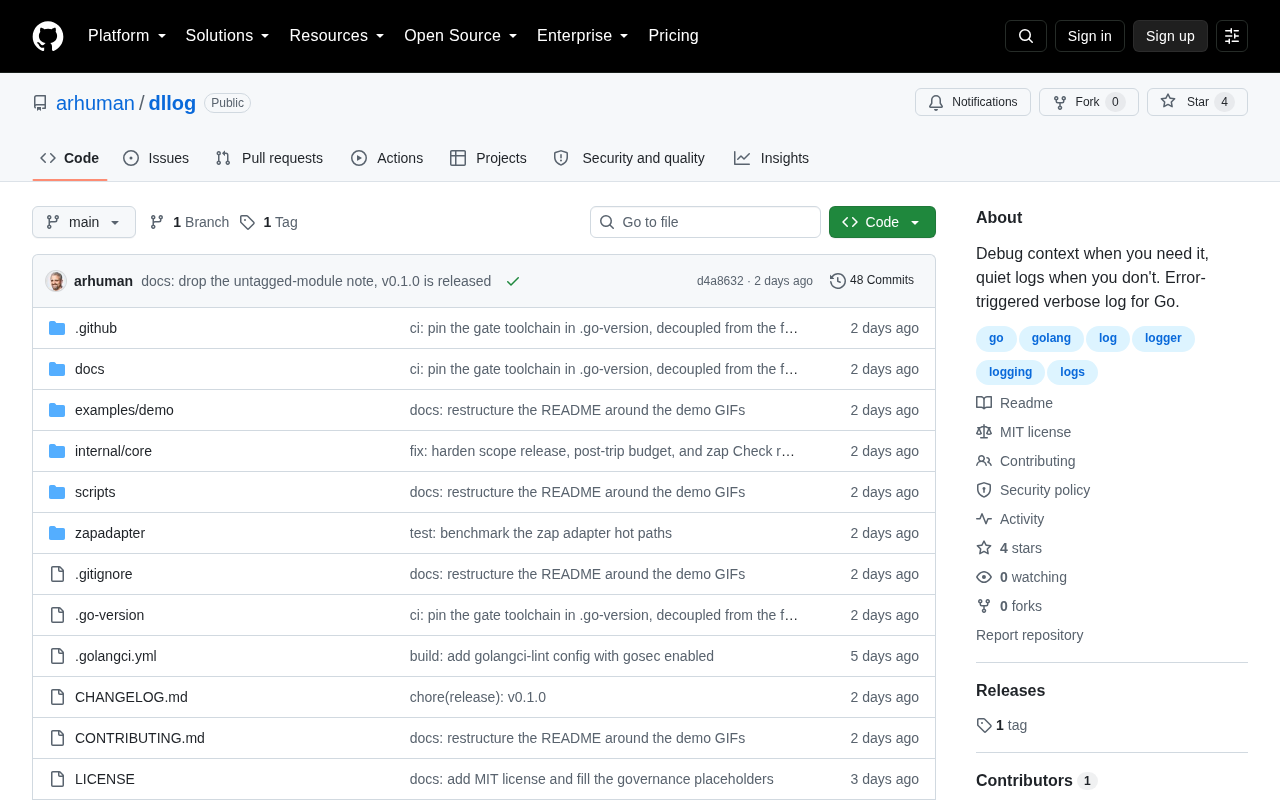
Dllog buffers debug logs in memory and only outputs them when an operation fails, breaking the all-or-nothing logging dilemma.
Dllog addresses a classic logging pain point: developers must either enable verbose logs and pay the performance and storage cost, or disable them and sacrifice observability. Dllog's solution is to buffer debug logs in memory, discard them on success, and replay the full context only on failure. This "deferred persistence" pattern delivers rich troubleshooting detail when it matters while eliminating overhead on the happy path. It works best for high-success-rate services with clear operation boundaries; limitations include memory pressure, difficulty tracking cross-operation issues, and complexity in defining failure boundaries. The project is still early-stage with limited community validation, and its primary value today is as a design pattern rather than a production-ready tool.
Starting with a Common Pain Point
Every developer has been there: a production service throws an error, but the logs contain nothing more than a bare error message with no context to trace the root cause. Want more detail? You'd have to set the log level to DEBUG in production — but that floods your disk with logs during normal operation, drags down performance, and drives up storage and retrieval costs.
A project called Dllog, which surfaced on the developer community Hacker News, proposes a new solution to this tension. Its core idea can be summed up in one sentence: don't write verbose logs during normal operation — only replay the full debug logs when an operation fails.
Dllog's Core Idea
The dilemma with traditional logging systems is an "all or nothing" choice — either enable verbose logging and absorb the performance and storage costs, or disable it and sacrifice observability. Dllog attempts to break out of this binary.
The basic mechanism works like this: as an operation executes, debug-level log entries are held in an in-memory buffer rather than immediately written to persistent storage. When the operation completes successfully, those buffered debug logs are simply discarded. Only when the operation fails does it "replay" and output the full accumulated debug context.
The elegance of this design is that it gives developers the complete details they need for troubleshooting at the moment of failure, while eliminating logging overhead on the happy path. In other words, you pay the observability cost for failures, not for every request.
Why This Idea Is Worth Noticing
From the perspective of observability's evolution, this kind of "verbose on demand" approach is not entirely new. Concepts like sampled logging and error-first tracing, which have been widely discussed in the industry in recent years, are all fundamentally answering the same question: how do you strike a balance between cost and information richness?
Dllog places that balance point at the operation boundary — using the success or failure of a single operation as the switch that determines whether logs are kept. This is especially well-suited for scenarios with clear start-and-end boundaries, such as request-response services, batch processing jobs, and transactional operations.
In the observability space, the existing practice closest to Dllog's approach is tail-based sampling — used in distributed tracing systems like Jaeger and Tempo, where a collector buffers all spans for a request and only decides whether to retain them once the entire trace is complete. This mirrors Dllog's "deferred persistence decision" exactly. The difference is that Dllog brings this mechanism down to the single-process logging layer, with no need for distributed collection infrastructure. Another related concept is ring buffer logging, common in systems software like the Linux kernel (dmesg): logs are continuously written into a fixed-size in-memory ring buffer and only flushed to disk when a specific condition is triggered. Dllog is essentially this idea combined with operation outcome judgment, making the trigger condition more semantically aligned with business logic. Understanding these two prior concepts helps in evaluating Dllog's portability across different tech stacks and assessing alternative approaches.
Applicable Scenarios and Potential Limitations
This kind of tool is best suited for operations that succeed most of the time and fail only occasionally. Since the vast majority of debug logs are discarded, only the detailed context for a small number of failure cases is ever written to disk — making the cost-to-benefit ratio very favorable.
That said, there are trade-offs to consider:
- Memory overhead: Debug logs must reside in memory for the duration of the operation. For long-running operations or those that generate a high volume of logs, the buffer can create memory pressure.
- Difficulty tracing cross-operation issues: If a problem doesn't manifest as a clear failure of a single operation — such as slow performance degradation or intermittent anomalies — the "replay only on failure" model may miss important clues.
- Defining failure boundaries: What counts as a "failure" needs to be explicitly agreed upon by the developer. How to handle exceptions, timeouts, and business logic errors each needs to be thought through carefully during integration.
The concept of an "operation boundary" maps differently depending on the programming paradigm: in a synchronous request-response model, it typically corresponds to the lifecycle of a single HTTP request or RPC call; in asynchronous or event-driven architectures, it might be a message consumption cycle or a saga transaction; in batch processing, it corresponds to handling a single record or chunk. Dllog's effectiveness depends heavily on the developer's ability to clearly mark the "start" and "end/outcome" of each operation in code. For nested operations — where a sub-operation fails but the parent catches and continues — the ownership and replay strategy for logs requires additional design. Without it, there's a risk of silent failures where "failures are swallowed and their logs discarded along with them." This is a point worth testing carefully during integration.
An Early-Stage Project
To be clear, Dllog is currently an early-stage project that was just published on Hacker News as a "Show HN" post, with very limited community traction at the time of posting (single-digit upvotes, no comments yet). This means its maturity, ecosystem support, and real-world validation all remain to be proven over time.
For engineers who follow the evolution of observability tooling, Dllog's value lies more in the design pattern it offers — deferring the log persistence decision until after the operation outcome is known. Even if you never use the tool directly, this "deferred decision" pattern can serve as inspiration for building your own logging middleware.
Summary
Dllog addresses a long-standing tension in logging systems with a simple and pragmatic idea: let verbose logs appear only when they're truly needed. It's not a universal solution, but for services with clear operation boundaries that want low overhead with high observability, it's a direction worth watching. Whether it's worth adopting depends on whether your system fits its core assumption — that most operations succeed, and that when they fail, you need the full picture.
Related articles

R&D Is Forking: The Coming Battle Between Token-Abundant and Token-Starved Research
R&D is splitting into token-abundant and token-starved research. Top AI labs are pulling ahead—here's what it means for universities and the future of science.

Atlas World Model Explained: How Next View Prediction Unifies Generation and Reconstruction
The Atlas world model uses Next View Prediction as its core to unify pixel-level generation and reconstruction, offering a new approach to spatial intelligence.
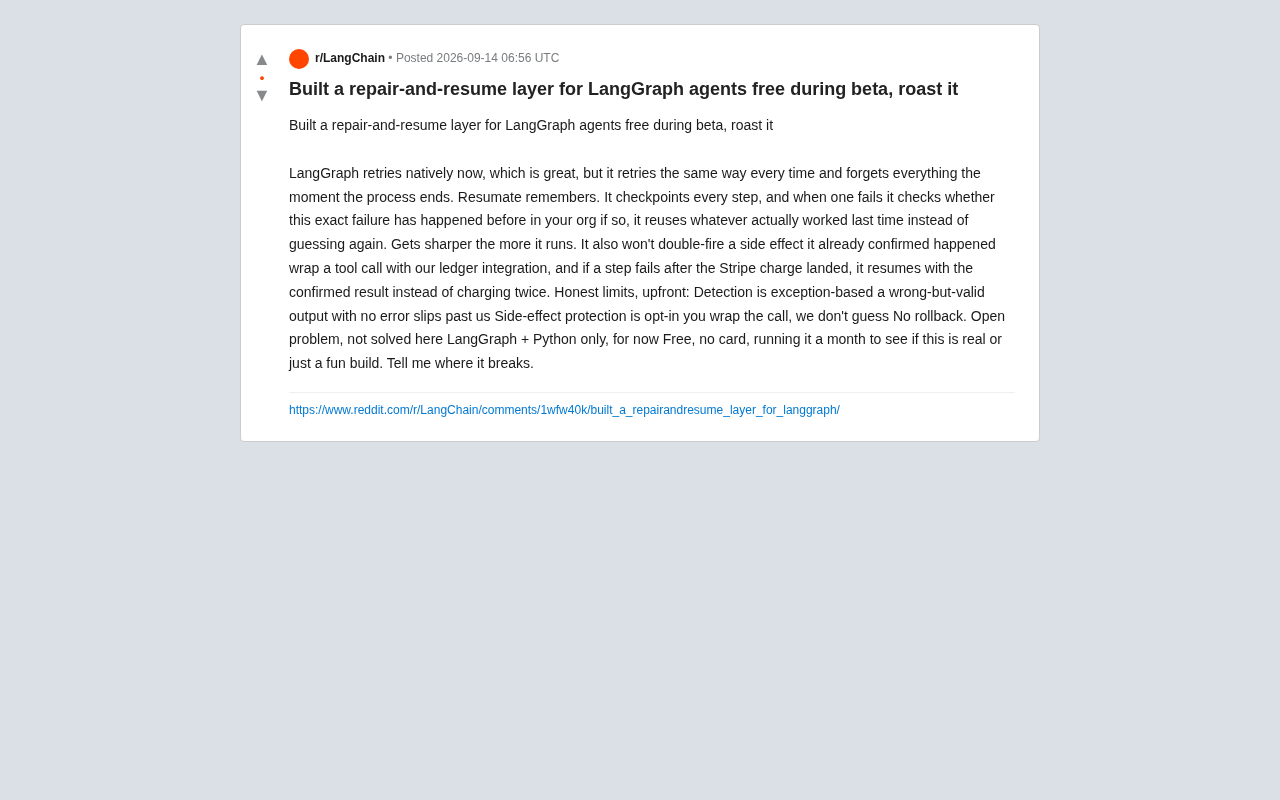
Resumate: A Deep Dive into the Repair-and-Resume Layer for LangGraph Agents
Resumate adds memory-aware checkpointing and idempotent side-effect protection to LangGraph agents, preventing issues like duplicate Stripe charges on retry.