Do AI Agents Actually Understand Computer Architecture? AutoTuring Reveals the Gap Between 'Understanding' and 'Search'

AutoTuring quantifies whether AI hardware agents truly understand architecture or just search blindly.
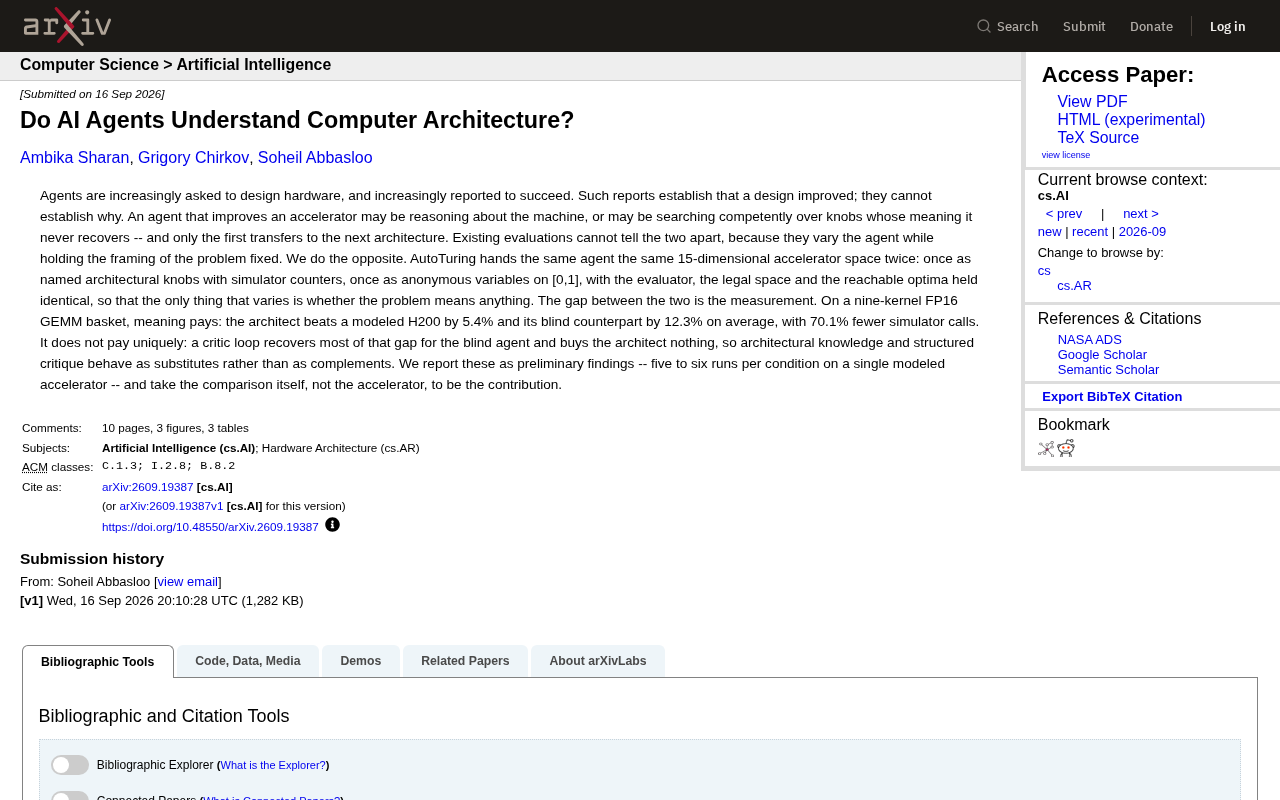
An arXiv paper introduces AutoTuring, a framework that exposes a blind spot in AI hardware design evaluation: existing methods show that designs improve, but can't tell whether the AI actually understands the architecture or is just blindly searching. AutoTuring fixes the agent and presents the same 15-dimensional accelerator design space in two forms — named architectural knobs vs. anonymous variables — using the performance gap to quantify the value of understanding. Architect Mode outperforms Blind Mode by 12.3% and requires 70.1% fewer simulator calls. However, adding a structured critic loop to the blind agent recovers most of that gap, suggesting domain knowledge and self-critique are substitutes, not complements. The authors emphasize that the methodology itself — not the specific numbers — is the core contribution.
A Overlooked Question: AI Improves Hardware, But Does It Really Understand It?
AI agents are increasingly being used in hardware design, with a steady stream of reports claiming impressive results. But a recent arXiv paper asks a sharp question: these success stories can only prove that designs got better — not why they got better.
This hides a critical distinction. An agent that improves an accelerator might genuinely be reasoning about the machine — understanding the physical meaning and causal relationships behind each parameter. Or it might simply be conducting an efficient blind search over a set of knobs it never truly understood. The difference matters enormously: only the former transfers to the next architecture. If an agent is just getting lucky with parameter tuning, all the "experience" it accumulated becomes worthless the moment you switch to a new hardware platform.
The problem is that existing evaluation methods can't distinguish between these two cases. They typically vary the agent while keeping the problem framing constant — like giving different students the same exam with a known answer framework. You can't tell who truly understands and who is just pattern-matching.
AutoTuring's Clever Design: Presenting the Same Problem in Two Different Forms
The AutoTuring framework proposed in this paper takes the opposite approach: fix the agent, and vary the problem framing.
Specifically, the same 15-dimensional accelerator design space is presented to the same agent twice:
- First (Architect Mode): The dimensions are presented as named architectural knobs with simulator counters attached. The agent can see what each parameter physically represents.
- Second (Blind Mode): The same dimensions are disguised as anonymous variables on a [0,1] interval. The agent has no idea what it's actually tuning.
Crucially, the evaluator, the feasible space, and the achievable optimum are identical in both modes. The only variable that changes is whether the problem is meaningful to the agent. The performance gap between the two modes is precisely what the researchers set out to measure — the value of understanding.
The elegance of this design lies in how it transforms a hard-to-quantify philosophical question — "does AI understand architecture?" — into a measurable controlled experiment. The gap itself is the answer.
The "15-dimensional accelerator design space" refers to a combination of 15 key tunable parameters in a hardware accelerator (such as a deep learning inference chip) — things like on-chip cache size, datapath bit width, pipeline depth, and memory bandwidth allocation. Each dimension involves concrete physical and engineering trade-offs: increasing cache size, for example, improves data reuse but consumes more silicon area and power. Named architectural knobs mean the agent sees labels like
L2_cache_size=256KBand can reason about causality using simulator-reported performance counters (e.g., cache hit rate, memory access latency). In anonymous mode, the same parameters appear only as semantics-free floating-point values like x₁=0.37, x₂=0.81 — reducing the problem to pure black-box function optimization.
Results: Understanding Helps, But It's Not Irreplaceable
The researchers ran experiments on a nine-core FP16 GEMM (half-precision general matrix multiplication) benchmark suite and arrived at several thought-provoking findings.
Understanding Delivers Real Gains
In Architect Mode, the agent significantly outperformed its blind counterpart:
- Architect Mode beat a modeled H200 accelerator by an average of 5.4%;
- It beat the Blind Mode version by an average of 12.3%;
- And it required 70.1% fewer simulator calls.
In other words, when the agent understands the architectural meaning of parameters, it not only finds better designs but reaches its goals with far less exploration. Meaning pays.
But the Advantage Isn't Unique
The story doesn't end there. The researchers found that adding a critic loop to the blind agent — a structured self-reflection and self-critique mechanism — allowed it to recover most of the performance gap. Interestingly, applying the same critic loop to Architect Mode yielded almost no additional benefit.
This points to an important insight: architectural knowledge and structured critique are substitutes, not complements. Making an AI truly understand architecture and making an AI capable of structured self-reflection are, to a significant degree, two interchangeable paths toward better hardware design. You don't need both.
A critic loop is a mechanism that allows an AI agent to perform structured self-review of its own outputs, commonly used in LLM-based agent systems. The basic flow is: the agent generates a design proposal, then the same model (or another role instance) raises explicit critiques — identifying which parameter choices may be suboptimal or which constraints might be violated — and the agent revises accordingly. This shares conceptual similarities with the actor-critic architecture in reinforcement learning, but typically operates entirely within language space without requiring additional training signals. The finding that critic loops can close the performance gap caused by missing domain knowledge suggests that structured self-reflection can partially simulate expert heuristic judgment — an important clue about the nature of LLM reasoning capabilities.
GEMM (General Matrix Multiply) is the core computational primitive in deep learning; convolution, attention, and most other operations can ultimately be reduced to matrix multiplication at the hardware level. FP16 refers to half-precision floating-point format, which uses half the memory bandwidth and storage of FP32 (single-precision) and is widely used in modern AI training and inference. The H200 is NVIDIA's high-end GPU for AI computing; using it as a reference baseline means the paper is measuring agent-designed results against industry-leading commercial hardware — giving the "5.4% improvement" figure a concrete engineering reference point.
How to Read This Research: The Methodology Matters More Than the Numbers
The authors themselves are deliberately restrained about their conclusions, explicitly labeling these as preliminary findings: each condition was run only five to six times, validated on a single modeled accelerator. The sample sizes are small, and the generalizability of the conclusions awaits verification at larger scale.
More importantly, the authors make clear that their real contribution is not the accelerator — it's the comparative methodology itself.
This is especially valuable in the current context of AI capability evaluation. As AI agents are deployed on increasingly complex professional tasks — chip design, scientific research, software engineering — we urgently need tools that can distinguish "genuine understanding" from "efficient search." In many scenarios, an agent that only searches and an agent that truly understands may be nearly indistinguishable on a single task. The difference only surfaces when transferring to a new task or new architecture.
The intuition behind AutoTuring — fix the agent, vary the problem semantics, measure the gap — provides a replicable paradigm for evaluating the transferability and depth of understanding in AI systems. That may matter more in the long run than any specific performance percentage in the paper.
Implications for AI Agent Development
This research points in several directions worth careful thought. For engineers building AI agents, if the goal is transferable capability, improving single-task performance alone may not be enough — experiments need to be specifically designed to verify whether an agent has built genuine causal understanding of a domain.
At the same time, the finding that "critic loops can substitute for domain knowledge" has practical value: in scenarios where injecting sufficient domain knowledge into an agent is difficult, a well-designed self-critique mechanism may achieve comparable results. This offers an alternative path for agent design under resource constraints.
Of course, given the limited experimental scale, these conclusions should be treated as directional signals rather than definitive answers. But the core question this paper raises — whether AI agents are truly understanding or merely searching — will continue to resonate throughout the field of AI capability evaluation.
Related articles
Three Stages of AI LLM Testing: A Practical Guide from Core Concepts to API Calls
A learning path for testers covering LLM fundamentals, prompt engineering, OpenAI SDK calls, API Key vs Token differences, streaming output, RAG, and Agent systems.
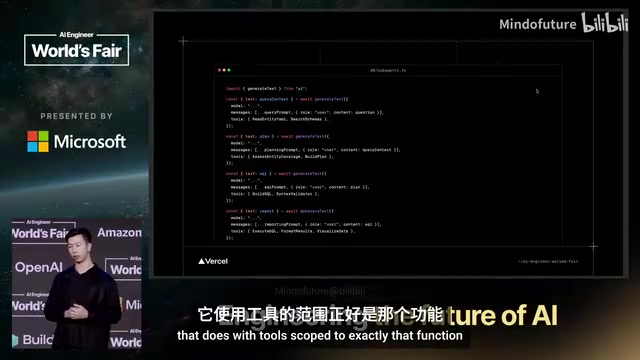
Vercel's Chief of Software Looks Back: The Evolution of Agent Building — From Multi-Agent Chains to File System Agents
Vercel's Chief of Software Andrew recaps the agent-building journey at AI Engineer: from giant prompts to multi-agent chains, monolithic memory, file system agents, and the open-source EVE framework.
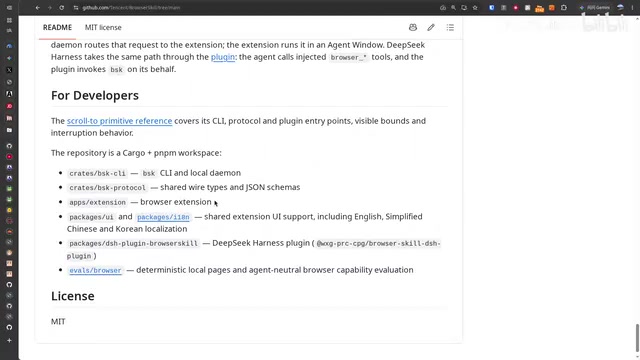
Tencent's Open-Source BSK in Action: Letting AI Take Over Your Already-Logged-In Browser
Tencent's open-source BSK (Browser Skill Kit) lets AI take over your real, logged-in Chrome via WebSocket. We break down the architecture, setup, and three key pitfalls from real-world testing.