Do AI Agents Need an Entirely New Security Model? Why Traditional Approaches Fall Short

Traditional access controls can't handle AI agents' probabilistic behavior — a new security paradigm is needed.
AI agent behavior is dynamically determined by task goals, read content, available tools, past actions, and model interpretation — fundamentally overturning the predictability assumption of traditional software. Current approaches layer permission controls on top of existing tools, but this static ACL model only restricts individual tool access and cannot defend against "dangerous combinations of legitimate permissions." Prompt injection exploits this blind spot by embedding instructions in external content the agent reads — without ever touching a permission boundary. The article outlines four directions for a purpose-built security model: intent-level constraints, trust tiering for data and instructions, real-time behavior chain monitoring, and minimized rollback-capable operations.
When Traditional Security Models Meet AI Agents
A discussion gaining traction on Reddit is hitting a nerve in the AI engineering community: are we still trying to constrain AI Agents using the security mindset built for traditional software?
The defining characteristic of traditional software is predictable behavior. Given the same input, a program follows the same logic path and produces output within a controlled range. That's precisely why our security models are built on clear boundaries — access control, input validation, sandboxing. These mechanisms fundamentally constrain a system whose behavior we already know.
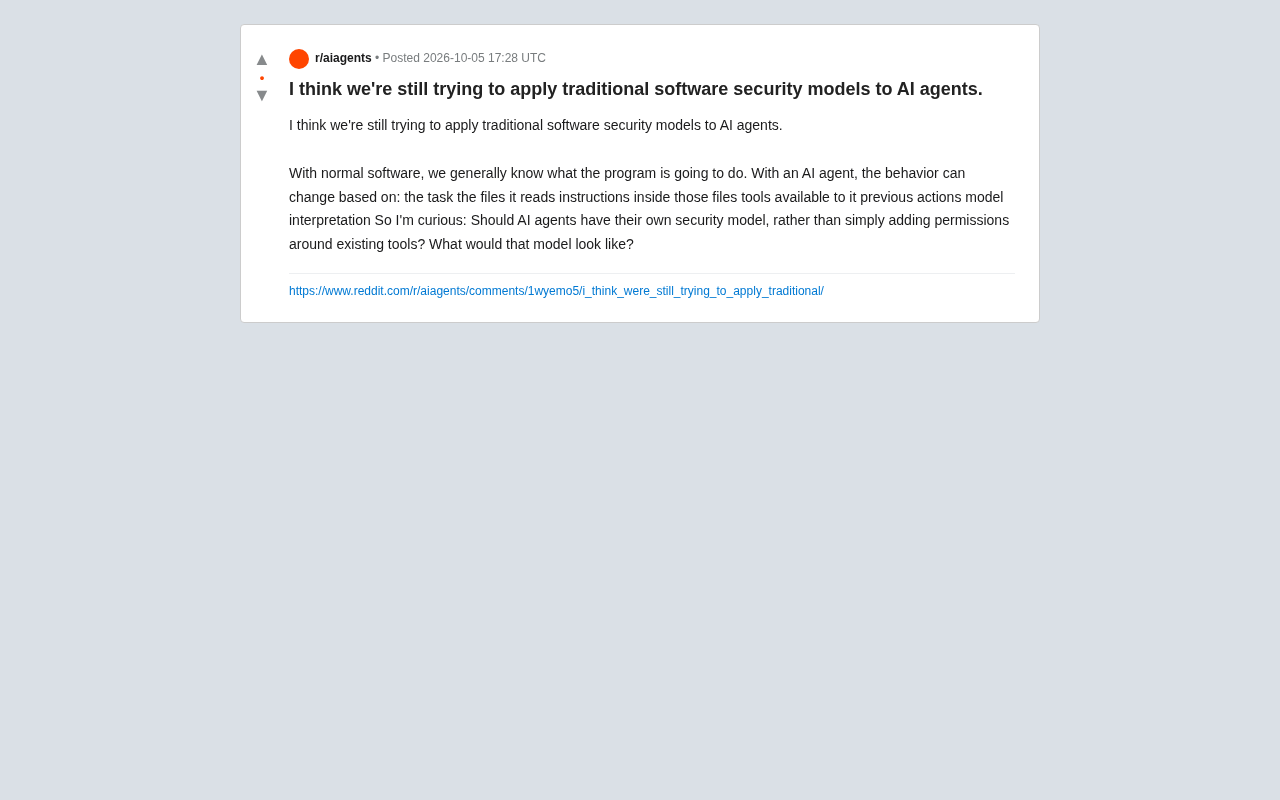
AI agents break that premise entirely. Their behavior isn't determined by fixed code paths, but shaped by a combination of dynamic factors. The original post nailed the variables: the assigned task, the files read, hidden instructions embedded in those files, the tools available, actions previously taken, and how the model itself interprets the context.
Why "Adding Permissions" Isn't Enough
The prevailing approach is to layer permission controls on top of existing tools — restricting which files an agent can access, which APIs it can call, which system commands it can execute. At its core, this is just applying traditional access control lists (ACLs) to AI.
The problem is that this static permission model assumes "risk comes from the tools themselves," when in reality, the risk from AI agents often comes from the combination and evolution of behaviors. An agent might hold perfectly legitimate individual permissions, yet chain them together into a dangerous operation simply because it read a maliciously crafted file.
This is the core logic behind Prompt Injection attacks: an attacker doesn't need to breach any permission boundary. They just need to embed instructions in a file, webpage, or email that the agent will read — and the agent's behavior is hijacked. Traditional security models are nearly powerless here, because from a permissions standpoint, the agent "did nothing wrong."
Three Challenges Posed by Behavioral Uncertainty
Context as attack surface: For traditional programs, data is just data. But for an AI agent, anything it reads can potentially be interpreted as an instruction. The boundary between data and commands is completely blurred — a situation traditional security models have never had to face.
Dynamic composition of permissions: The safety of individual permissions doesn't guarantee the safety of their combination. An agent can chain together multiple tool calls within a single task in ways that are nearly impossible for humans to anticipate.
Uncontrollable model interpretation: The same input can yield different judgments from the model depending on context. This probabilistic behavior renders deterministic whitelist/blacklist rules meaningless.
What a Purpose-Built Security Model Might Look Like
The original post raised the key question: should AI agents have their own security model, rather than simply wrapping permissions around existing tools? While the post didn't offer answers, the question itself points toward several directions worth exploring.
Intent-level constraints. Rather than only controlling "which tools can be called," establish guardrails at the level of task intent. Before executing an action, an agent should verify whether that action deviates from the original task objective — triggering an interrupt the moment the behavior diverges from initial intent.
Trust tiering for data and instructions. Since context can carry malicious instructions, content from different sources needs to be assigned different trust levels. Direct instructions from users, information from internally trusted documents, and content from external webpages should all carry different "instruction execution weights" — content from low-trust sources should not be treated as executable commands.
Real-time monitoring of behavior chains. Compared to static permission approvals, runtime behavior auditing may be far more critical. Logging the agent's complete decision chain and intercepting anomalous tool-call combinations in real time lets security mechanisms evolve alongside behavior rather than being frozen at the initial configuration.
Minimization and rollback. Every operation should follow the principle of least privilege and be reversible wherever possible. When the unpredictability of agent behavior can't be fully eliminated, reducing the blast radius of any single mistake becomes the pragmatic choice.
Several early-stage implementations across academia and industry offer reference points for these directions. Guardrails frameworks (such as NVIDIA NeMo Guardrails and Guardrails AI) attempt to insert rule-checking layers before and after model output, but currently focus more on content filtering than behavioral intent verification. The Least-Privilege Agent concept, borrowed from OS security, is reflected in Anthropic's Model Card, which proposes a "limited action space" design principle — recommending that agents be given the narrowest possible set of tools needed to complete a task. On interpretable behavior logging, frameworks like LangChain offer basic tool-call chain tracing, but remain far from true real-time anomaly interception. The trust-tiering idea closely aligns with W3C's research direction on Data Provenance — attaching verifiable source metadata to content is one potential path to engineering a trust model into practice. These efforts suggest the contours of a purpose-built security paradigm are forming, but no widely accepted complete solution exists yet.
The Real Value of This Discussion
What makes this Reddit thread worth paying attention to isn't that it provides answers — it's that it raises a framework-level question the industry has long overlooked. As AI agents accelerate into production environments — from coding assistants to automated operations, from customer service systems to data analytics — the lag in security models is becoming a real-world risk.
Traditional software security is built on determinism, while the essence of AI agents is probabilistic and autonomous. Using tools designed to constrain deterministic systems to manage a system that interprets and decides autonomously will inevitably leave structural gaps.
What the industry may need isn't a patch on existing security mechanisms, but a paradigm redesigned from the ground up around the nature of agent behavior. That paradigm must acknowledge behavioral uncertainty and build its defenses around intent verification, trust tiering, and runtime monitoring. Before AI agents are deployed at scale, the sooner this question is taken seriously, the better.
Background: Prompt Injection Explained
Prompt Injection is fundamentally an input-hijacking attack targeting large language models, and it comes in two forms. Direct injection occurs when an attacker inputs malicious instructions directly in the conversation, overriding the system's preset behavioral rules. Indirect injection is more covert: the attacker embeds instructions in external content that the agent will proactively read — such as a footer in a PDF report, white text on a webpage, or a hidden field in an email. When the agent processes this content, the malicious instructions enter the model's context alongside normal data and get executed.
In 2023, researchers demonstrated that by embedding invisible text in a webpage, they could successfully cause a ChatGPT instance equipped with browsing tools to leak a user's conversation history. Indirect injection poses a particularly serious threat to autonomous agents, because agents actively explore external environments — naturally expanding the "delivery surface" where attackers can plant malicious content.
Related articles

JobRunner MCP Server: AI Agents Can Now Fix Failed Java Jobs
JobRunner launches an open-source MCP server enabling AI agents to view cluster status, diagnose failures, and recover Java jobs—incident response from any cloud coding environment or existing agent.

MLAI Digital Launches 9 Security Agents: MCP Server Safeguards the Full Lifecycle of Agentic AI
MLAI Digital launches Security MCP Server with nine built-in specialized security agents covering vulnerability discovery, attack simulation, prompt injection detection, API and infrastructure assessment, and accelerated remediation—embedding security validation across the full Agentic AI lifecycle from development to production.

Running Isaac Lab on H100 GPUs: Exploring Better Approaches
Exploring optimization methods for running Isaac Lab on NVIDIA H100 GPUs, including MIG configuration, mixed precision, TensorRT acceleration, and community experience to improve robotics simulation and reinforcement learning efficiency.