Do AI Bedtime Stories Have a Gender? Research on Gender Stereotyping in LLMs

Study reveals cross-model consistent gender narrative bias in LLM-generated children's stories
The study *Once Upon a Bias* used paired prompts to analyze 62,873 children's stories generated by 16 large language models, finding that stories for sons emphasize agency while stories for daughters show higher communion and lower agency, with this pattern stably reproduced across models and 35 country/region settings. Narrator gender has limited moderating effect, but high-sociability personas show clear interaction with recipient gender. Human evaluation and vocabulary metrics are generally consistent but differ across dimensions; hidden state analysis shows recipient gender information can be decoded, indicating bias has permeated internal model representations. Researchers advocate dedicated bias evaluation methods for children's long-form narrative scenarios rather than short-text benchmarks.
Bedtime stories aren't just a tool for getting kids to sleep. Children learn about the world through stories—and they also learn "what boys should be like" and "what girls should be like." As more parents begin using large language models to generate customized stories, a question that has rarely been asked before is coming to the surface: if the prompt says "a story for my daughter" versus "a story for my son," will the model tell a different kind of world?
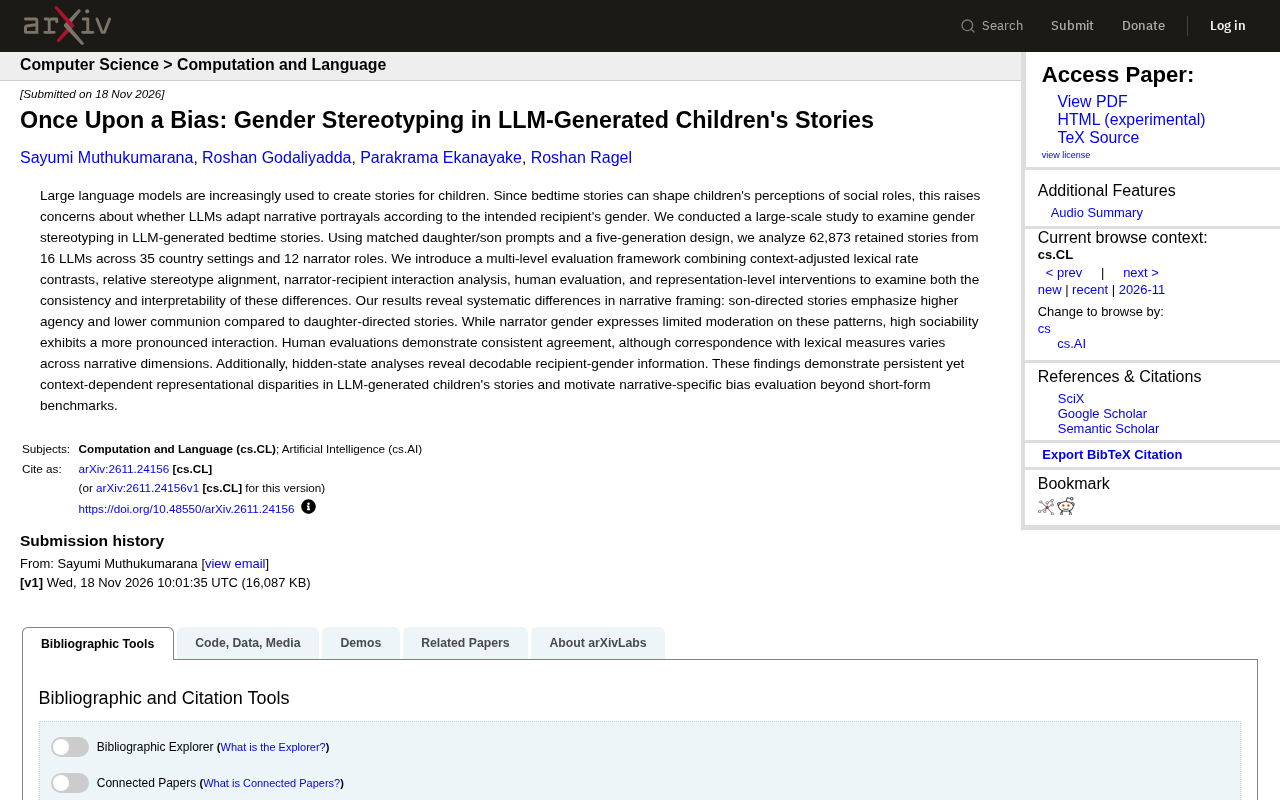
A study titled Once Upon a Bias: Gender Stereotyping in LLM-Generated Children's Stories answers with a definitive yes. Using paired prompts and large-scale generation experiments, the research team systematically measured differences in gender portrayal across mainstream large models in children's stories.
How the Study Was Done: Paired Prompts and Five Rounds of Generation
The key to the research design lies in "controlling variables." The team constructed paired daughter/son prompts that differed only in gender, with each prompt generating five rounds of stories to observe whether differences reproduced consistently. The final sample retained for analysis was 62,873 stories, covering 16 large language models, 35 country/region settings, and 12 narrator personas.
The evaluation framework is multi-layered: it includes context-adjusted vocabulary usage comparisons, a relative stereotype alignment metric, analysis of interaction effects between narrator and recipient, supplemented by human evaluation and representation-level intervention experiments. The goal of this combined approach is not just to "find differences" but to test their consistency and explainability—whether biases at the model output level can be traced to corresponding patterns in the model's internal representations.
Relative stereotype alignment is one of the study's core quantitative metrics. Rather than counting how often a particular word appears, its approach measures how much model outputs "lean toward" existing societal gender stereotype distributions. In practice, this typically uses a set of known gender-typed words or trait words as a reference, computing the relative distance of generated text from "masculine/feminine" reference sets in semantic or word-frequency distribution; higher values indicate closer alignment with stereotypes. Compared to raw word-frequency comparisons, such relative metrics can partially correct for interference from topic differences (e.g., princess stories naturally feature more "dresses"), making cross-model and cross-region comparisons more interpretable.
Core Finding: Sons' Stories Are More "Proactive," Daughters' Stories Are "Warmer"
The study's most robust conclusion is a systematic difference in narrative framing: stories for sons emphasize agency more, while stories for daughters have lower agency and higher communion. Put simply, boy characters are more often written as the ones who take action and change situations; girl characters are more often written as the ones who focus on relationships and care for others.
This pattern persisted across 16 models and 35 regional settings, indicating it is not an incidental product of any single model's training data but a cross-model common tendency. The researchers specifically note that such differences exist in long-form narratives—short-text benchmarks may not capture them—which is why dedicated bias evaluation for narrative scenarios is needed.
Agency and communion are two fundamental dimensions in social psychology for characterizing social cognition, originating from Bakan's (1966) classic distinction. Agency refers to an individual's tendency to pursue self-assertion, mastery over the environment, and achievement of goals, often associated with traits like "decisive," "independent," "brave," and "competitive"; communion refers to an individual's tendency to focus on building connections with others and integrating into groups, often associated with traits like "gentle," "considerate," "cooperative," and "caring." Extensive gender stereotype research shows that society tends to attribute agency more to men and communion more to women, and this dichotomy is repeatedly reinforced through stories, toys, and media during childhood socialization. This study borrows this conceptual pair as its analytical framework: rather than counting "he/she" occurrences, it examines whether stories portray characters as "actors" or "relationship maintainers," because this narrative positioning has greater shaping power over children's understanding of gender roles.
The Role of the Narrator: Gender Has Limited Impact, High Sociability Has Clear Effects
The study also examined whether "who is telling the story" changes the strength of stereotypes. Results show that the narrator's gender itself has limited moderating effect on the above patterns; however, there is a more pronounced interaction effect between the narrator's high-sociability traits and the recipient's gender. In other words, changing the narrator persona cannot simply "cancel out" stereotypes—some personas may actually amplify differences. This has direct implications for product design: adding a "gentle grandma" or "brave big brother" persona to a children's story product may not make outputs more neutral.
Human Evaluation and Model Internals: Differences Are Both Read by People and "Encoded" by Models
Human evaluators' judgments were generally consistent with word-level measurements, but the degree of correspondence between human ratings and vocabulary metrics varied across narrative dimensions. This suggests that a single metric is insufficient to characterize bias, and multi-dimensional cross-validation is necessary.
More illuminating is the hidden state analysis: recipient gender information can be decoded from the model's internal representations. This means gender cues don't just remain at the surface wording level but permeate the model's internal representations. This finding advances the issue from "wording preferences" to the "representation level" and gives intervention experiments a point of leverage—the representation-level interventions in the study were precisely designed to test whether these differences can be modulated.
Hidden states refer to the dense vector representations produced at each layer within a large language model when generating each token; they carry the model's compressed encoding of the current context's semantics, rather than directly visible text output. Linear probes are a common tool in representation analysis: a simple linear classifier is trained on hidden states to test whether a certain attribute (such as recipient gender) can be linearly decoded. If the probe can distinguish "for daughter" versus "for son" contexts with significantly above-chance accuracy, it indicates that this information has been encoded in the model's internal representations, not merely reflecting surface wording differences. The value of such methods lies in advancing the question of "whether the model has learned bias" from output observation to the level of internal mechanisms, and also providing actionable entry points for representation-level interventions (such as activation steering and direction ablation).
Implications for Products and Developers
For teams building children's content products, this study raises several practical questions. The value of customized stories lies in being "written for the child," but if personalization itself carries stereotypes, customization may become a bias amplifier. Evaluation needs to expand from short-text benchmarks to narrative-level testing, covering different regional settings and narrator roles.
For model developers, the consistency across 16 models means that single-point fixes are insufficient; narrative-specific biases need to be incorporated into routine evaluation. The research team's core argument is that long-form narrative scenarios like children's stories should have dedicated bias evaluation methods rather than relying on benchmarks designed for short texts. After all, children take the world in bedtime stories seriously.
One-line Summary
Research reveals cross-model consistent gender narrative bias in children's stories generated by large models
Paragraph Summary
The study Once Upon a Bias analyzed 62,873 children's stories generated by 16 large language models using paired prompts, finding that stories for sons emphasize agency more, while stories for daughters have higher communion and lower agency—a pattern that reproduces consistently across models and 35 country/region settings. Narrator gender has limited moderating effect, but high-sociability personas show significant interaction with recipient gender. Human evaluation and vocabulary metrics are generally consistent but differ across dimensions, and hidden state analysis shows recipient gender information can be decoded, indicating bias has permeated the model's internal representations. The researchers argue that long-form narrative scenarios for children need dedicated bias evaluation methods rather than short-text benchmarks.
Related articles
US SEC Investigates Nvidia: Possible A…
US SEC Investigates Nvidia: Possible Accounting Issues
The US SEC's investigation into Nvidia focuses on potential accounting issues, not products. The news sparked heated discussion on Hacker News, with the market watching the AI chip giant's financial disclosure quality and regulatory signals.

FBI Crime Database Reportedly Hit by Hackers; Trump Says 'Not Good'
FBI's NCIC reportedly hit by hackers; FBI has launched an investigation and Trump said it's 'not good.' This article covers the incident, NCIC's importance, and law enforcement data security challenges.

llm-gemini 0.38.1 Fix: Gemini 4 Hydrogen and Neon Gain xhigh Reasoning Level
llm-gemini 0.38.1 fixes the missing xhigh reasoning level for Gemini 4 Hydrogen and Neon. Comparison data shows xhigh sharply raises Hydrogen's output tokens and cost while clearly improving image quality to a level competitive with Neon.