Does a Clinical Trial Simulator Really Understand Drugs? Intervention Blind Testing Reveals the Truth

New study uses intervention-blind measurement to quantify whether clinical trial simulators truly use intervention information.
The study proposes an "intervention-blind reference" method, turning patient world models' counterfactual capability from qualitative reading into quantitative measurement. Based on 9,996 audited comparisons from 30,119 trials on ClinicalTrials.gov, a gradient boosting simulator showed interventional skill of -0.12—more accurate when intervention info was hidden, indicating reliance on spurious signals. A frontier LLM showed 0.20, with arm-swapping reversing predictions in 86% of comparisons. The blind reference isn't fully drug-blind (LLMs recover hidden drug class at 45%), so interventional skill is a conservative lower bound. Calibration-controlled error also fails under temporal shift.
Introduction: When a Simulator Is Asked "What Did the Drug Do"
Patient World Models are increasingly being proposed as simulators for clinical trials. Recent reviews have even ranked the capabilities of such models on a ladder: from temporal prediction to counterfactual reasoning. But a fundamental question remains unresolved—how do we know whether a simulator truly uses "intervention" information, or is merely fitting spurious associations in the data?
According to a new study, this question now has a measurable answer. The researchers constructed an Intervention-Blind Reference, turning the "counterfactual" rung of the ladder from something read on paper into a quantitative metric.
Counterfactual reasoning in causal inference refers to: for the same subject, how would the outcome change if it received an intervention different from the one it actually received. In the clinical trial context, a counterfactual question is "would this patient's outcome have differed if they had taken another drug." The key difference from ordinary prediction is that the model must distinguish "intervention" from "confounding signals associated with the intervention." If a model only learns spurious associations in trial design (e.g., certain drugs always co-occur with specific enrollment criteria), it may predict very accurately on observational data yet fail to answer counterfactual questions correctly. Therefore, when evaluating simulators, tests must be designed that strip away such spurious associations, rather than looking only at prediction error.
Methods: From 30,119 Trials to 9,996 Audited Comparisons
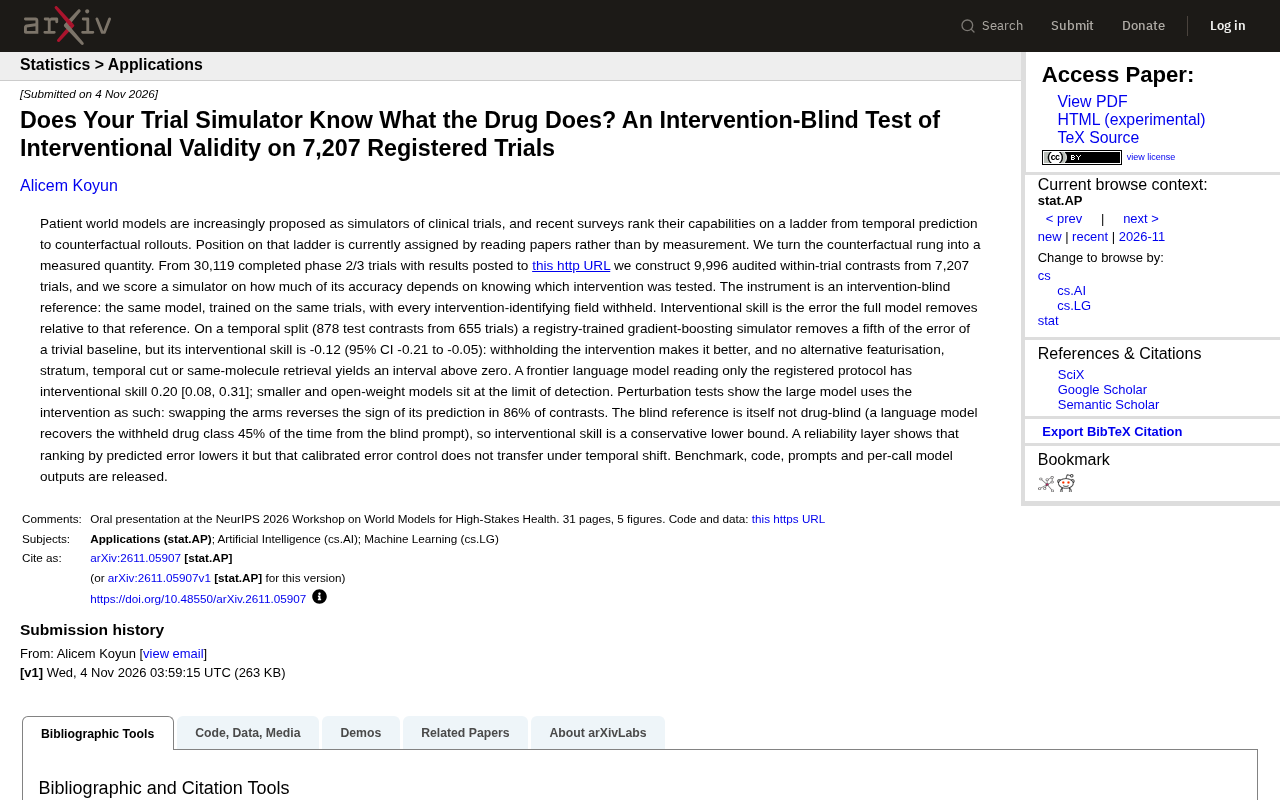
The core innovation of the study lies in designing an "intervention blind test." From 30,119 Phase 2/3 trials with posted results on ClinicalTrials.gov, the researchers constructed 9,996 audited within-trial comparisons from 7,207 trials.
The logic of the intervention-blind reference is: the same model, trained on the same trials, but with all fields that could identify the intervention hidden. Then, Interventional Skill is defined as the error the full model eliminates relative to this reference.
This approach directly tests a key question: how much of a simulator's accuracy depends on knowing "what drug was used."
Gradient Boosting is a class of ensemble learning methods that sequentially trains a series of weak learners (usually shallow decision trees), with each new tree fitting the residuals of the previous round, and the final prediction obtained by summing them. It performs robustly on tabular registry data, automatically capturing nonlinearities and interaction terms, and is therefore often used as a baseline simulator for structured clinical trial data. Its limitation: if features include proxy variables highly correlated with the intervention, the model will preferentially exploit these shortcuts rather than truly learning the causal path from intervention to outcome. This is exactly what the intervention blind test is designed to examine—whether a gradient boosting model's predictive power drops once fields that identify the intervention are removed.
Core Finding: Why Is the Gradient Boosting Model More Accurate When "Blind"?
On a temporally split test set (878 comparisons from 655 trials), a gradient boosting simulator trained on registry data eliminated about one-fifth of the error of a simple baseline. But its interventional skill value was -0.12 (95% CI -0.21 to -0.05).
What does this mean? Hiding intervention information actually made the model perform better. The study further tested alternative featurization, stratification, temporal cuts, and same-molecule retrieval; none of these settings produced a confidence interval above zero.
This finding directly challenges the validity assumption of conventional simulators: if a model predicts more accurately without knowing the drug, then its so-called "counterfactual reasoning" is likely just exploiting spurious signals in trial design rather than genuinely understanding intervention effects.
95% confidence interval (95% CI) is an interval used in frequentist statistics to express estimation uncertainty: if sampling were repeated many times, about 95% of such intervals would cover the true parameter. In interventional skill assessment, if the entire confidence interval lies below zero, there is statistical evidence that the model is more accurate after intervention information is hidden; if the interval crosses zero, the possibility of "zero interventional skill" cannot be ruled out. The study reports -0.12 (95% CI -0.21 to -0.05) for the gradient boosting model, i.e., the interval is entirely below zero; while the language model is 0.20 [0.08, 0.31], with the interval entirely above zero. Judging whether an interval crosses zero is more informative about whether an effect is reliable than looking at a point estimate alone.
Comparison with LLMs: Frontier Models Show Genuine Interventional Skill
In sharp contrast to the gradient boosting model, a frontier language model that reads only the registry protocol showed an interventional skill of 0.20 [0.08, 0.31]. Smaller and open-weight models hovered near the detection limit.
Perturbation tests further confirmed that the large model is indeed "using" intervention information: in 86% of comparisons, swapping trial arms reversed the sign of its prediction. This indicates the model is not merely memorizing but is sensitive to the direction of the intervention.
But the study also candidly acknowledges a limitation: the blind reference itself is not fully "drug-blind." A language model could recover the hidden drug class from blind prompts with 45% accuracy. Therefore, the interventional skill value is in fact a conservative lower bound.
Calibration measures the agreement between a model's predicted probabilities and the actual frequency of events: if a model assigns a 70% risk to a group of patients, about 70% of them should actually experience the outcome for calibration to be good. Calibration differs from discrimination (e.g., AUC), which concerns only ranking. In clinical trial simulation, even if a model ranks well, large calibration deviations will distort absolute risk estimates. The study's finding that "calibration-controlled error does not transfer under temporal shift" means that a model well calibrated on early data may drift systematically in calibration when facing later protocol changes and evolving standard of care, thereby overestimating its future reliability.
Reliability Layer: Calibration-Controlled Error Fails Under Temporal Shift
The study also introduced a reliability layer and found that sorting by prediction error can reduce error, but calibration-controlled error does not transfer under temporal shift. This suggests that a simulator's performance in static evaluation may overestimate its reliability on future data.
Significance and Implications: Simulator Evaluation Needs "Measurement," Not "Reading"
The methodological contribution of this study is to shift simulator capability evaluation from "reading papers" to "doing measurements." For the application of AI in clinical research, this means:
- Any model claiming to simulate clinical trials should undergo intervention blind testing;
- High predictive accuracy does not equal high interventional understanding; the two may diverge;
- Language models show greater potential than conventional gradient boosting models in exploiting intervention information, but scale remains a key factor.
The research team has released the benchmark, code, prompts, and model outputs for each call, providing a foundation for reproducible follow-up research. For practitioners interested in AI for Science, this is a methodological framework worth exploring in depth.
One-line Summary
A new study uses intervention-blind measurement to quantify whether clinical trial simulators truly use intervention information.
Paragraph Summary
The study proposes an "intervention-blind reference" method that turns the counterfactual capability of patient world models from qualitative reading into quantitative measurement. Based on 9,996 audited comparisons constructed from 30,119 trials on ClinicalTrials.gov, a gradient boosting simulator showed an interventional skill of -0.12—i.e., it was more accurate when intervention information was hidden, indicating reliance on spurious signals rather than interventional understanding. In contrast, a frontier language model showed an interventional skill of 0.20, and swapping trial arms reversed the sign of its prediction in 86% of comparisons. The blind reference is not fully drug-blind; a language model recovered the hidden drug class with 45% accuracy, so interventional skill is a conservative lower bound. The study also found that calibration-controlled error does not transfer under temporal shift, so static evaluation may overestimate future reliability.
Related articles

Snapchat Opens AI Assistant Lens Building: Supports Claude Code and Cursor
Snapchat lets Lens creators describe AR filters in natural language, with AI assistants like Claude Code and Cursor handling the full build process, greatly lowering the AR creation barrier.

Is the Planck Length the Smallest Distance? Why Physicists Are Skeptical
The Planck length is often called the smallest distance in the universe, but science videos point out this claim has never been experimentally confirmed. This article explains the origins of the Planck length, the obstacles of microscope thought experiments, and what it really tells us—the scale at which quantum gravity becomes unavoidable, not spacetime pixels.

AI Agents Drive Spend Management: Payhawk Raises $280M
Payhawk raises $280M at a $2B valuation. The 2018-founded enterprise finance platform uses AI agents to track and manage expenses and procurement. This article analyzes its product evolution, valuation signals, and impact on the spend management space.