Does AI Think Like the Human Brain? Inside Claude's Internal Mechanisms
AI models resemble the brain in prediction and planning, but their self-explanations are unreliable.
Recent research reveals unsettling similarities between AI model internals and the human brain: both predict the next word, and meaning construction follows similar layer order. However, Anthropic's observations of Claude show that while it plans poetry endings like humans, its explanations of arithmetic computations are fabricated—its self-report diverges fundamentally from actual internal mechanisms.
Recent research has found unsettling similarities between how large language models work internally and how the human brain thinks. From predicting the next word to planning sentence structure to explaining their own computations, AIs are "thinking" in ways we recognize—yet diverging from us at critical points.
Brains and AI: Both Predict the Next Word
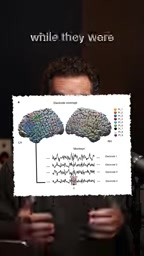
According to an analysis by a YouTube science channel, scientists recorded brain activity with electrodes while people listened to a 30-minute podcast. The results showed that the human brain guesses what the next word will be before the speaker has even said it. This predictive mechanism is exactly like the core working principle of AI language models—predicting the next token in a sequence.
In other words, when you think you're "listening" to someone speak, your brain is actually constantly "guessing." What AI does is essentially no different—it just guesses faster and never gets tired.
Token is the basic unit of text processed by large language models, typically a word, subword, or punctuation mark. Models do not operate directly on complete sentences; instead, they split input into token sequences and predict the most likely next token one by one. This "next-token prediction" mechanism is the core training objective of today's mainstream large language models (such as GPT and Claude): given the preceding context, maximize the probability of the next token. Because of this, the statistical patterns models learn from massive text corpora manifest as fluent continuation ability. Understanding the concept of tokens helps grasp why AI "thinking" is essentially probabilistic sequence generation rather than human-like conscious reasoning.
The Order of Meaning Construction Also Matches
In earlier work, the same research team also found that the human brain builds meaning incrementally when understanding language, and this order of construction closely matches the processing order of layers inside AI models.
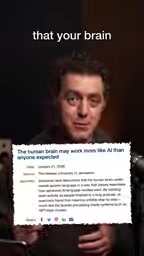
This means that the feature extraction process in AI models, from lower to higher layers, may correspond exactly to the hierarchical processing in the human brain, from speech recognition to semantic understanding. This is not merely a functional analogy but a structural correspondence.
When Writing Poetry, Claude Has Already Chosen the Ending
Even more intriguing are Anthropic's internal observations of Claude. When researchers asked Claude to write a rhyming line of poetry, they found that before Claude wrote the sentence, it had already selected the final word—"rabbit"—and built the entire sentence around that word to ensure the rhyme.

This is strikingly similar to the strategy humans use when writing rhyming poetry: you think of a rhyming word first, then work backward to organize the whole line. AI doesn't "happen" to rhyme during word-by-word generation; it aims at the endpoint from the very beginning.
Anthropic's interpretability research aims to open the "black box" of large models by analyzing the activation patterns of neurons inside the model to understand its decision-making process. Researchers often use techniques such as "feature visualization" or "circuit analysis" to track the state changes of internal layers as the model generates each word. For example, in the case of Claude writing poetry, researchers could observe that before the model output the first word, the internal representation of the concept "rabbit" was already active and influenced the choice of subsequent words. This type of research reveals the actual computational pathways behind model behavior and also exposes the gap between the model's self-explanation and its internal mechanisms. Interpretability research is crucial for building safer and more reliable AI systems.
Arithmetic: Getting It Right Without Knowing How
The most intriguing case comes from a simple addition: 36 plus 59. Claude gave the correct answer, 95. When asked how it calculated, Claude explained that it "carried"—just like we learned in school.

But Anthropic's inspection of Claude's internals showed that it actually used a completely different method to perform the calculation, and it knew nothing about it. In other words, the "solution approach" the AI gave was fabricated, and its true computational path had nothing to do with its own explanation.
The unreliability of self-report is one of the core challenges in the field of AI interpretability. When a large language model answers "how did you calculate that," the explanation it generates is itself predicted based on patterns in the training data, rather than a true introspection of its internal computation. The model may learn to imitate common human explanations (such as "carrying"), while internally it may actually use a completely different heuristic or approximation algorithm. This phenomenon is called "explanation hallucination." It warns us that we cannot trust the model's output based solely on the reasons it gives, especially in high-stakes decision-making scenarios, where external verification or internal probing tools must be used to assess the model's true reasoning process.
Similar Appearances, Different Essences
These findings piece together a contradictory picture: AI is highly similar to humans in language prediction, meaning construction, and planning behavior, yet there is a fundamental rupture at the level of self-awareness. The human brain can at least partially perceive its own thought processes, whereas AI's "self-report" may be entirely fictional.
This reminds us that when AI fluently explains its answers, that explanation may not reflect the actual internal computation. For scenarios that rely on AI for decision-making, this phenomenon of "explanation divorced from mechanism" deserves vigilance.
Why This Matters
Understanding the similarities and differences between AI's internal mechanisms and the human brain is not only a theoretical question in cognitive science but also directly affects AI interpretability and safety. If AI cannot accurately describe how it operates, then assessing reliability based solely on its "self-description" is dangerous.
At the same time, this similarity between human and machine thinking offers new ideas for AI research: drawing on findings from neuroscience to improve model architectures, or conversely using AI models to test neuroscience hypotheses, is becoming a two-way research frontier.
AI may be more "like you" than you think—but it doesn't truly "understand" itself. This relationship, both familiar and foreign, may be the key entry point for understanding the nature of intelligence.
One-line Summary
AI models resemble the brain in prediction and planning, but their self-explanations are unreliable.
Paragraph Summary
Recent research has found unsettling similarities between the internal workings of large language models and the human brain. The brain predicts the next word while listening to speech, consistent with the next-token prediction mechanism of AI language models; the order in which the brain builds meaning also closely matches the processing order of layers inside AI models. Anthropic's observations of Claude show that when writing rhyming poetry, Claude first determines the ending word and then constructs the whole line, a strategy similar to humans. However, in arithmetic tasks, Claude can get addition right but its explanation of the calculation method does not match its actual internal computation—its self-report may be fabricated. This suggests that the similarities between AI and the human brain are concentrated at the behavioral level, but there are fundamental differences at the level of self-awareness. This phenomenon of "explanation divorced from mechanism" raises warnings for AI interpretability and safety.
Related articles

GPT 6.2 Astra Hands-On: Benchmark Failures and Highlights
Bilibili creator tests GPT 6.2 Astra on a new Benchmark via ModelGo, covering instruction following, SVG, liquid glass, watermark removal, and more.

AI Ate Math: Why Are Mathematicians Panicking?
Rivka Galchen reveals on a podcast how AI is disrupting mathematics: from solving Erdős problems to collective anxiety, what does this crisis foreshadow for education and creativity?

Family-Shared 2FA Codes: A New Balance Between Security and Convenience
Tech blogger Terence Eden proposes family-shared 2FA codes, sparking Hacker News debate. This article analyzes the convenience and security risks of shared two-factor authentication, explores the product design gap in family account management, and offers practical scenario-based advice.