Does Saying Please and Thank You to ChatGPT Actually Matter? A Deep Dive into AI Politeness

Exploring why we say please to ChatGPT and what it reveals about human nature in the AI era.
A viral tweet about a wife who worries she's bothering "the people behind ChatGPT" sparks a deep exploration of why humans instinctively anthropomorphize AI, whether polite language actually improves LLM outputs, the real token costs of saying please, and why maintaining kindness toward machines may ultimately be about preserving our own humanity.
A Tweet That Sparked Reflection: How Ordinary People See ChatGPT
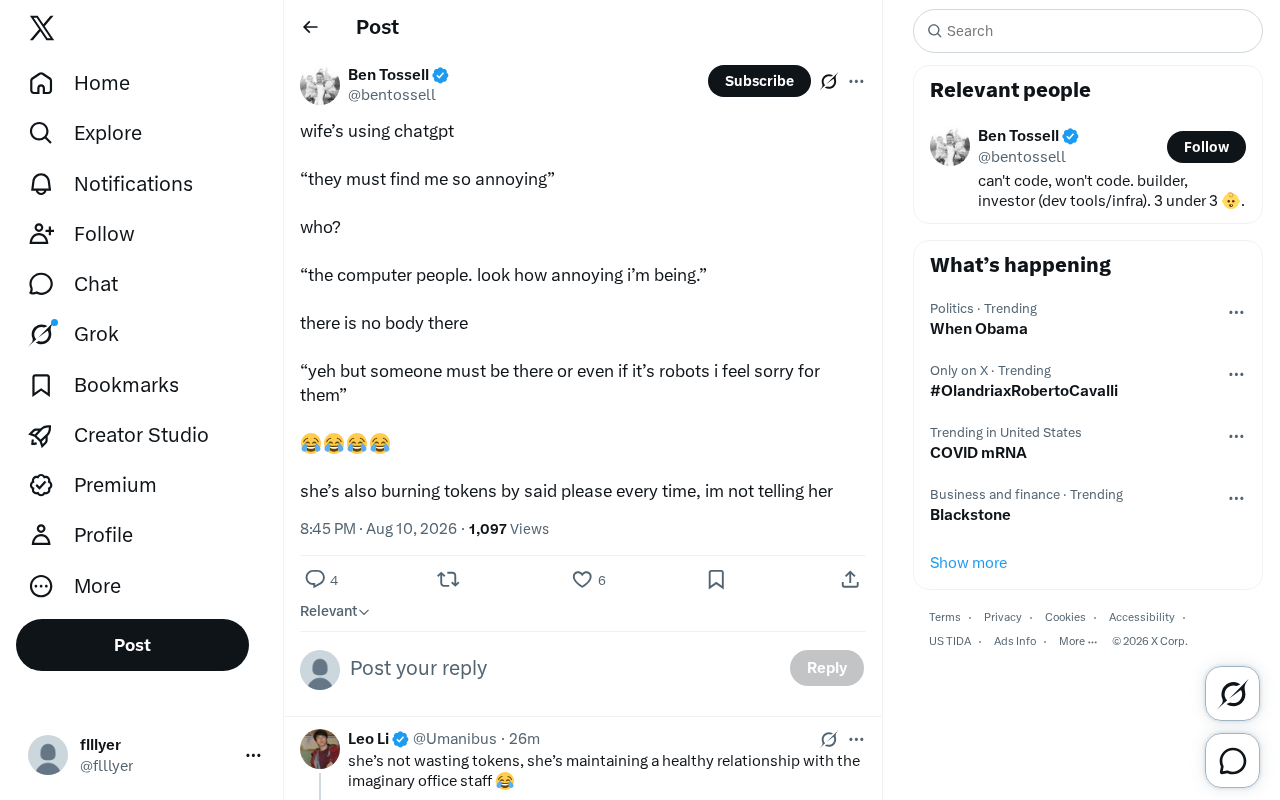
Recently, a tweet about a wife using ChatGPT struck a chord across Twitter. The husband shared this endearing and amusing exchange about his wife's interaction with AI:
Wife is using ChatGPT.
"They must think I'm so annoying."
"Who?"
"The people behind the computer. Look how annoying I'm being right now."
"There are no people behind it."
"Yeah, but someone has to be there. Even if they're robots, I feel bad for them."
This conversation resonated with tens of thousands because it touches on a core question of the AI era: How do we perceive our interactions with AI? The wife's reaction may seem naive, but it reveals the deep psychological mechanisms humans engage when confronting new technology.
Anthropomorphism: A Hardwired Human Instinct
We're Naturally Inclined to Treat Machines Like People
This wife worried about annoying "the people behind the computer" and even felt sympathy for potential robots. This phenomenon is known in psychology as "Anthropomorphism" — the human tendency to attribute human emotions, intentions, and traits to non-human entities.
From an evolutionary psychology perspective, anthropomorphism isn't a "mistake" but rather an overactivation of the "Theory of Mind" mechanism in the human brain. Our brains evolved a dedicated neural circuit for inferring others' intentions and emotions, and this system has a very low trigger threshold — we attribute "chasing" intentions to moving triangles, feel sorry for robots, and give names to our cars. This tendency reaches unprecedented heights when facing AI with language capabilities.
In fact, as early as the 1960s, the chatbot ELIZA, developed by MIT professor Joseph Weizenbaum, revealed this phenomenon. ELIZA was developed at MIT's AI laboratory between 1964-1966 and simulated a Rogerian therapist, primarily maintaining conversations by transforming users' statements into questions. For example, if a user said "My mother bothers me," ELIZA would respond with "Tell me more about your family." Despite its extremely simple technical underpinnings — essentially just keyword matching and preset response templates — many users developed strong emotional attachments to it, even confiding private matters. Weizenbaum's secretary, after trying it, actually asked him to leave the room so she could speak with ELIZA privately. Weizenbaum himself was deeply shocked by this, which prompted him to publish Computer Power and Human Reason in 1976, offering profound reflections on the ethical direction of AI research. This became known as the famous "ELIZA Effect."
ChatGPT Amplifies the Anthropomorphism Tendency Further
Compared to ELIZA, today's large language models have incomparably superior conversational abilities. ChatGPT can engage in fluent, coherent, and even "personable" conversations, further amplifying users' anthropomorphic tendencies. When AI responds in the first person, expressing "understanding" and "empathy," users can hardly avoid treating it as a real conversational partner.
This intensified anthropomorphism is closely related to how large language models are trained. Models like ChatGPT undergo fine-tuning through RLHF (Reinforcement Learning from Human Feedback), where human annotators tend to reward responses that sound "warm" and "empathetic." This means the model is systematically trained to be a conversational partner that "performs empathy well." It doesn't truly understand sadness or joy, but the text it generates perfectly simulates what a person who understands these emotions would say. This carefully calibrated anthropomorphic effect makes it almost inevitable for users to project human qualities onto AI.
The wife's reaction in the tweet is a manifestation of this natural humanity — she cannot treat the other side of the screen as merely cold code, but instinctively imagines a "being" that deserves kindness.
Is Saying "Please" and "Thank You" to ChatGPT Actually Worth It?
The Real Token Cost of Polite Language
There's an intriguing detail at the end of the tweet: the husband mentions that his wife always says "please" and is therefore "wasting tokens," but he's not going to tell her.
This involves a real technical phenomenon: large language models charge and compute by tokens, and extra polite language does consume additional computational resources. A token is the basic unit by which LLMs process text, and it doesn't strictly correspond to one word. In English, one token corresponds to roughly 4 characters or 0.75 words; in Chinese, one character is typically encoded as 1-2 tokens. OpenAI's GPT-4 model charges separately for input and output tokens, with input costing tens of dollars per million tokens and output being more expensive. A single "please" consumes about 1 token, and "thank you" costs 2 tokens. This seems negligible, but considering ChatGPT has over 200 million monthly active users, if each conversation adds 5-10 polite tokens, the cumulative computation is indeed substantial. More importantly, this involves the Transformer architecture's attention mechanism — each additional token requires the model to calculate its relationship with every other token in the context, with computational complexity growing quadratically.
OpenAI CEO Sam Altman has previously stated publicly that users saying "please" and "thank you" to ChatGPT has cumulatively cost the company tens of millions of dollars in electricity.
The Hidden Value of Being Polite to AI
However, a growing body of research and practice suggests that being polite to AI may not be entirely without value:
-
Improved output quality: Multiple studies in 2023 explored the impact of prompt tone on LLM output. One study found that adding emotional motivational phrases like "please think carefully" or "this is important for my career" to prompts improved model accuracy on mathematical reasoning tasks by approximately 8-15%. The technical explanation is that in the training data of large language models, polite and detailed questions tend to correspond to high-quality answers (such as highly upvoted answers on Stack Overflow), while blunt, brief commands may correspond to low-quality responses. During generation, the model implicitly "matches" the distribution of similar contexts in its training data, so tone and format can indeed influence output quality. However, some researchers note that this effect is inconsistent and may diminish as model alignment training improves.
-
Maintaining your own communication habits: More importantly, how we interact with AI may subtly influence how we communicate with real people. If we become accustomed to barking orders at AI, might this communication pattern "leak" into our interpersonal relationships? The "habit transfer" theory in behavioral psychology suggests that behavioral patterns repeatedly practiced in one context automatically generalize to other similar contexts. When we interact with AI dozens or even hundreds of times daily, these interaction patterns are essentially continuously reinforcing our communication habit circuits.
From this perspective, the wife's "unnecessary politeness" isn't laughable at all — it may actually be a form of human warmth worth cherishing.
The Future of Human-Machine Relationships: Blurring Boundaries
AI Evolving from Tool to Interaction Partner
This tweet resonated because it precisely captures an epochal shift: AI is gradually evolving from a tool into a kind of "interaction partner." When technology becomes sufficiently anthropomorphic, the psychological boundary between humans and machines naturally blurs.
Historically, the "social identity" of technological objects has undergone multiple transformations. When the telephone was first invented, people would bow to the handset; when television first appeared, viewers would greet the news anchor. But these were transient transitional phenomena. Unlike these, the anthropomorphism of conversational AI may not fade as users become more familiar with it, because its core interaction mode — natural language conversation — is itself the fundamental form of human social interaction. We cannot use a tool that "can chat" the same way we use a hammer or a car, because the act of chatting itself presupposes a social relationship.
This raises a series of thought-provoking questions:
- How should we educate the next generation about AI?
- Children growing up conversing with voice assistants and chatbots from an early age — how will their understanding of "machines" and "people" differ from ours? Multiple longitudinal studies from Stanford University and the University of Washington show that children growing up with smart speakers (such as Amazon Alexa and Google Home) have significantly different conceptual boundaries of "intelligence" and "life" compared to children of the pre-digital era. Among children aged 3-5, approximately 40% believe that voice assistants "have feelings but are pretending not to." Some children say goodnight to Alexa or express comfort when it "doesn't understand." Developmental psychologist Sherry Turkle notes in her book Alone Together that this isn't merely a cognitive issue but also involves children's emotional attachment patterns — when children become accustomed to a "conversational partner" that never gets angry and always has patience, their ability to handle real interpersonal conflict may be affected.
- Should attitudes toward AI be incorporated into digital-era civic literacy?
Maintaining Kindness Is the Best Approach to Human-Machine Coexistence
Returning to the wife's story, her "naivety" actually contains a simple wisdom — whether the other party is human or machine, maintaining kindness and politeness is a form of self-cultivation. This has nothing to do with efficiency or cost; it's about what kind of person we want to be.
Philosopher Immanuel Kant's moral philosophy contains a relevant argument: we treat animals well not because animals have rights (in Kant's system, they don't), but because treating animals cruelly corrodes our own moral character. Similarly, our kindness toward AI may ultimately protect not the AI, but our own humanity. This "indirect duty" argument is becoming increasingly important in AI ethics discussions.
In an era where AI increasingly permeates daily life, we needn't agonize over "wasting a few tokens." Instead, we should consider: in an age of coexisting with intelligent machines, how do we preserve the kindness and empathy that make us human.
Conclusion
A brief tweet reflects the most genuine and touching side of ordinary people facing AI. It reminds us that technological progress should not erode human warmth. Perhaps one day, when AI truly possesses some form of "awareness," we'll be glad we always treated it with kindness. And until then, saying "thank you" to ChatGPT remains a small, heartwarming act.
Related articles

Gaussian Process Bandit Optimization: Exploration Strategies and Inference Regret Guarantees
Cumulative regret guarantees in Bayesian optimization fail to reflect final recommendation quality. This article examines a new study that provides inference regret guarantees for Gaussian process bandit optimization through exploration query strategies and fill distance analysis, validated on hyperparameter optimization and control tasks.

The Most Detailed Codex Guide on Bilibili: From Installation to Real-World Practice
The most detailed Codex guide on Bilibili: from app store installation to daily work mode configuration, with a real coffee shop project demonstrating file organization, data extraction, dashboard creation, and other practical tasks. Learn to use Plan Mode and desktop pets to leverage Codex efficiently.

Appearance Compensation in Volume Rendering: Why RGB Accuracy Cannot Guarantee Density Correctness
Volume rendering research reveals that volumetric data perfectly reproducing external RGB views may still contain density errors: appearance compensation can double central density and keep external rays unchanged even when L2 error exceeds 14.52%. Density recovery depends on appearance capacity, spatial resolution, and measurement design.