Does Volla Phone Work with AT&T? A Deep Dive into US Carrier Compatibility

Volla Phone faces major AT&T compatibility hurdles due to band mismatches, VoLTE gaps, and US 3G shutdown.
This article examines whether the German-made Volla Phone running Ubuntu Touch can work on AT&T and other US carriers. It covers the fundamental challenges including European vs. US LTE band differences, the 2022 US 3G shutdown's impact on devices lacking VoLTE, and Ubuntu Touch's limited carrier software support. Practical advice includes a pre-purchase checklist and alternative recommendations like GrapheneOS on Pixel devices for users seeking privacy without sacrificing US carrier compatibility.
A Privacy User's Dilemma
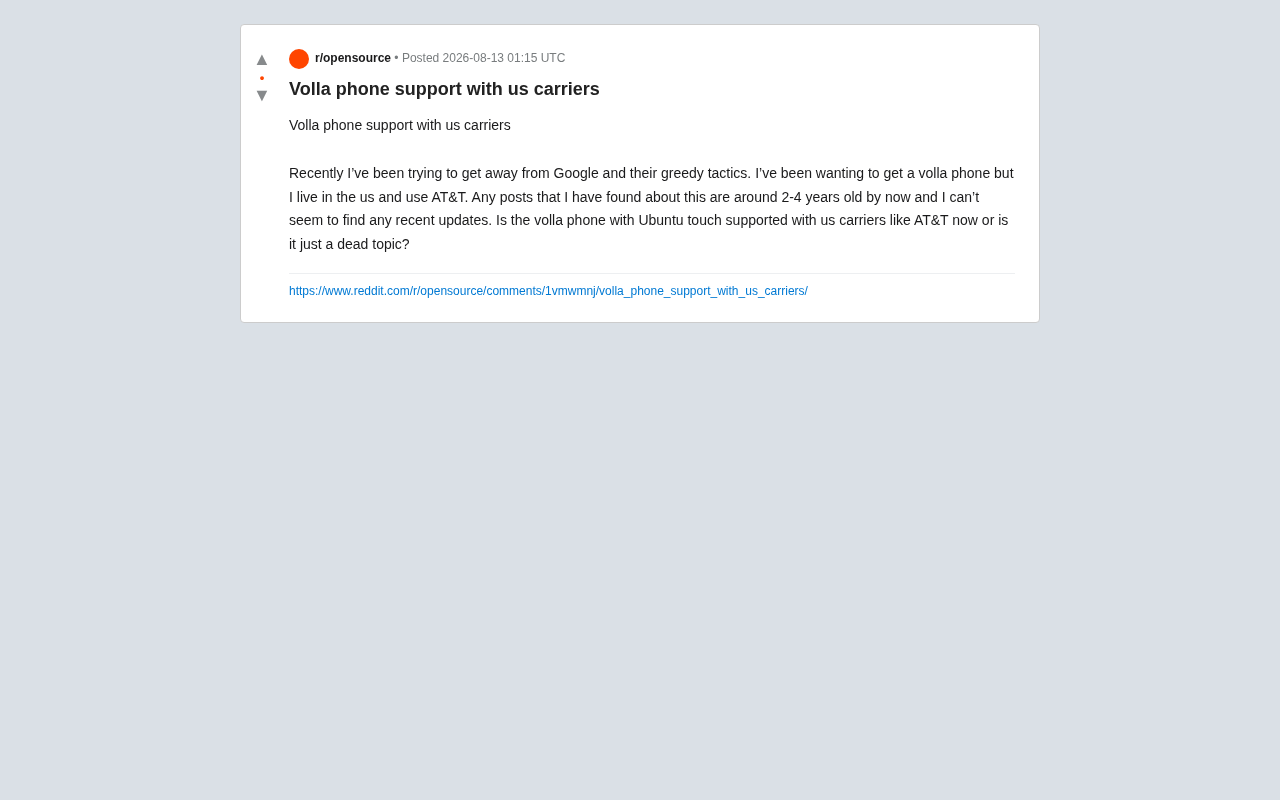
Recently on Reddit, a US-based user raised a highly representative question: they wanted to break free from Google's ecosystem and switch to the privacy-focused Volla Phone (running Ubuntu Touch), but they use AT&T's network and could only find discussions from 2 to 4 years ago online, lacking any up-to-date information. Their core question was: Does the Volla Phone running Ubuntu Touch now support US carriers like AT&T?
This question may seem niche, but it reflects a much larger reality: for users pursuing data sovereignty and privacy protection, the road away from mainstream ecosystems is still riddled with hardware compatibility pitfalls.
Why Does Volla Phone Have US Carrier Compatibility Issues?
About Volla Phone: A German Privacy Handset
Volla Phone was developed by Hallo Welt Systeme GmbH, based in Halle, Germany, and first appeared through Kickstarter crowdfunding in 2019. The company's design philosophy centers on "digital minimalism" — reducing app dependency and giving users back control over their attention and data. Volla phones offer a dual-system choice: their proprietary Volla OS (based on AOSP with Google services removed) and Ubuntu Touch. On the hardware side, they use MediaTek processors — a choice that reduces costs but also means less flexibility in open-source driver support and global band coverage compared to Qualcomm solutions. As of 2024, Volla has released multiple product generations, including the Volla Phone X23 and Volla Phone Quintus.
Europe vs. US Band Differences: Inherent Hardware Limitations
Volla Phone is a product from a German company, designed primarily for the European market. There are significant differences in mobile network band allocations between Europe and North America. The LTE and 5G bands used by US carriers (especially AT&T and T-Mobile) don't fully overlap with those common in Europe.
To understand the technical root of this problem, you need to grasp the global fragmentation of LTE bands. LTE networks worldwide use over 40 different bands, each corresponding to a specific radio frequency range. These bands are defined by the 3GPP standards organization, but different countries' regulatory bodies have different spectrum auction and allocation strategies, resulting in the same carrier using different bands in different countries. For example, Band 12 (700MHz) and Band 14 (FirstNet public safety band, also in the 700MHz range) are key low-frequency bands that AT&T uses for broad coverage in the US — low-frequency signals penetrate buildings better and cover wider areas, making them crucial for indoor reception and rural areas. European carriers rely more heavily on Band 20 (800MHz) and Band 3 (1800MHz). A phone's modem chip has its supported band combination fixed at the factory and cannot add new band support through software updates.
If a phone's modem doesn't support the critical bands needed by US carriers at the hardware level (such as Band 12 and Band 14 that AT&T relies on), then even if the system boots and runs, you may experience unstable signal, inability to access VoLTE voice calls, or even complete failure to register on the network.
The Cascading Effects of US 3G Shutdown
The "2-4 year old posts" the user mentioned coincide precisely with a critical technological turning point. Major US carriers shut down their 3G networks around 2022, transitioning entirely to VoLTE (Voice over LTE).
Here's the specific timeline: AT&T shut down its 3G network in February 2022; T-Mobile phased out Sprint's 3G CDMA network in March 2022 and T-Mobile's own 3G UMTS network in July 2022; Verizon completed its 3G CDMA shutdown on December 31, 2022. In the 3G era, voice calls were handled through circuit switching (CS), and devices that didn't support VoLTE could "fall back" (CSFB, Circuit Switched Fallback) to 3G/2G networks for calls. After the 3G shutdown, this fallback path was completely severed, turning devices without VoLTE support into data-only terminals that can browse the internet but can't make phone calls. This change had a massive impact on niche phones and IoT devices, forcing millions of older devices into obsolescence.
This means any device that doesn't support VoLTE or hasn't been certified on a carrier's VoLTE whitelist will lose voice calling capability — even if data connectivity still works. This is exactly why earlier discussions about Volla are "outdated": solutions that barely worked back then may have completely stopped functioning after the 3G shutdown.
Ubuntu Touch's VoLTE Software Adaptation Challenges
About Ubuntu Touch: A Community-Maintained Open Source Mobile OS
Ubuntu Touch is a mobile operating system project initiated by Canonical in 2013, built on Ubuntu Linux, aiming to provide an open-source alternative for smartphones and tablets. After Canonical abandoned the project in 2017, the community development team UBports took over maintenance and continues to this day. The system uses the unique Lomiri (formerly Unity8) interface, supporting gesture navigation and Convergence mode, where a phone connected to an external display can function as a desktop environment. Currently, UBports maintains official ports for about 20 devices, but compared to Android and iOS's billions of users, Ubuntu Touch has only tens of thousands to perhaps a hundred thousand active users, directly impacting its ecosystem maturity and carrier adaptation resources.
OS-Level Carrier Support Status
Beyond hardware bands, Ubuntu Touch as a niche open-source mobile operating system faces software adaptation challenges for carrier network features. VoLTE implementation depends not only on hardware but also requires OS-level IMS (IP Multimedia Subsystem) support.
VoLTE (Voice over LTE) is the technology that migrates voice calls from traditional circuit-switched networks to the LTE data network, implemented on the IMS architecture. Compared to traditional calls, VoLTE provides higher voice quality (HD Voice), faster call setup times, and the ability to maintain data connections during calls. However, VoLTE implementation is far more complex than ordinary data connectivity: it requires precise IMS registration, SIP signaling negotiation, and QoS (Quality of Service) parameter configuration between the device and the carrier's core network. US carriers employ strict device whitelist systems — only devices whose IMEIs have been tested and certified in carrier laboratories are allowed to register for VoLTE service. While this mechanism was designed to ensure call quality and emergency calling (e.g., 911) reliability, it objectively serves as a barrier for niche devices entering the US market.
Compared to Android's mature Carrier Config mechanism, Ubuntu Touch's support in this area is much weaker. The UBports community (Ubuntu Touch's maintainer) has been working to improve VoLTE support, but coverage and stability still can't compare to mainstream systems. This means that even if hardware bands match, whether the software layer can smoothly handle calls and texts remains an unknown.
The Real-World Limitations of Community-Driven Development
Both Volla and UBports are small-scale community/independent vendor projects that lack the resources to individually test every global carrier combination. Therefore, official sources can rarely make definitive promises like "supports AT&T," and users often have to rely on real-world testing feedback from other community members — which is precisely the information this Reddit user couldn't find.
Practical Advice for US Users Before Buying a Volla Phone
Essential Pre-Purchase Checklist
For users in the US considering a Volla or similar privacy phone, complete the following checks before ordering:
- Verify LTE bands: Look up the specific LTE/5G band list for your target model and compare them one by one with AT&T's band requirements, paying special attention to Bands 2, 4, 5, 12, 14, 66, etc. Tools like frequencycheck.com can automate this comparison.
- Confirm VoLTE support status: Search UBports forums and the Volla community for the latest VoLTE progress and confirm whether your model is listed as compatible.
- Check carrier whitelists: Review AT&T's officially published compatible device list (AT&T typically provides this through an IMEI check tool) to confirm whether the target device is accepted.
- Accept feature trade-offs: Even if data works, be mentally prepared for potentially unstable voice calling. Some users rely on VoIP apps (such as Signal or Telegram's voice calling features) as backup alternatives to traditional calls.
More Practical De-Googled Privacy Alternatives
If you lack confidence in Volla's carrier compatibility, privacy-seeking users have other more mature options.
GrapheneOS is currently one of the most recommended privacy alternatives. It's a security and privacy-focused open-source mobile operating system built on AOSP, designed exclusively for Google Pixel devices. The reason for choosing Pixel as the only supported hardware is: Pixel devices allow re-locking the Bootloader (ensuring boot chain security), feature the Titan M security chip, and Google provides long-term low-level firmware updates. GrapheneOS adds memory safety hardening, enhanced permission sandboxing, sensor and network access controls on top of AOSP, while providing a compatibility layer (Sandboxed Google Play) that allows users to run Google services in an isolated sandbox — satisfying certain apps' dependencies while preventing Google services from gaining system-level privileges. Since Pixel devices are designed for the US market, their band coverage and carrier certification fully support all US carriers including AT&T, T-Mobile, and Verizon.
Flashing a de-Googled system onto a Google Pixel device that supports GrapheneOS often achieves a high level of privacy protection while retaining full carrier compatibility. The adaptation maturity of such solutions in the US market is typically far superior to niche European hardware. Other notable options include CalyxOS (also Pixel-based, but with built-in microG as an open-source alternative to Google services) and /e/OS (supporting a broader range of device models, maintained by the Murena Foundation).
Conclusion: Balancing Privacy Ideals with Network Reality
This user's confusion fundamentally reflects the tension between privacy ideals and network reality. Breaking free from Google's ecosystem is a commendable goal, but the complexity of mobile communications dictates that device selection can't focus solely on how "clean" the system is — you must also thoroughly consider local carrier compatibility.
Before making a purchase decision, spending extra time confirming the latest real-world testing information in active communities is far more reliable than relying on outdated posts from years ago. In the niche field of privacy phones, "the latest community feedback" is often the most valuable basis for decision-making.
Key Takeaways
Related articles

Claude Autonomously Designs Proteins with 35% Success Rate, Far Exceeding Human Expert Performance
Anthropic's Claude achieves 35% wet-lab success rate in autonomous protein design, far surpassing the 10-15% human expert average, signaling AI's move toward real scientific productivity.

Perplexity Discover's Multilingual Support Suddenly Disappears — Why Are International Users Upset?
Perplexity Discover's multilingual news feature suddenly dropped non-English support, frustrating international users. We analyze possible causes and the broader challenges of AI product internationalization.

GitHub Daily · August 20: Mojo Tops the Charts & The Local-First Open Source Rebellion
GitHub Trending Aug 20: Mojo tops charts for AI compute stack ambitions, OpenLogi surges 1225 stars with local-first philosophy, and privacy rebellion dominates.