Doing a PhD in the AI Era vs. Pre-AI Era: How ML PhDs Choose

Reddit debates whether ML PhDs should be done before AI chatbots or now; the key is critical tool use.
The article reviews a Reddit r/MachineLearning discussion on "doing a PhD in the pre-AI era vs. the AI era." Supporters of the pre-AI era argue that "painful learning" such as manual derivation and line-by-line debugging is necessary for deep intuition and independent problem-solving, and that AI tools may let researchers skip necessary stages, leading to shallow understanding and paper homogenization. Supporters of the AI era stress that AI tools greatly improve literature screening and code debugging efficiency, let researchers reach the innovation stage faster, and that collaborating with AI is a must-have skill. The discussion ultimately shifts from "when to do a PhD" to "how to do a PhD": the key is critical tool use, independent thinking, deep understanding, and a balance between efficiency and depth.
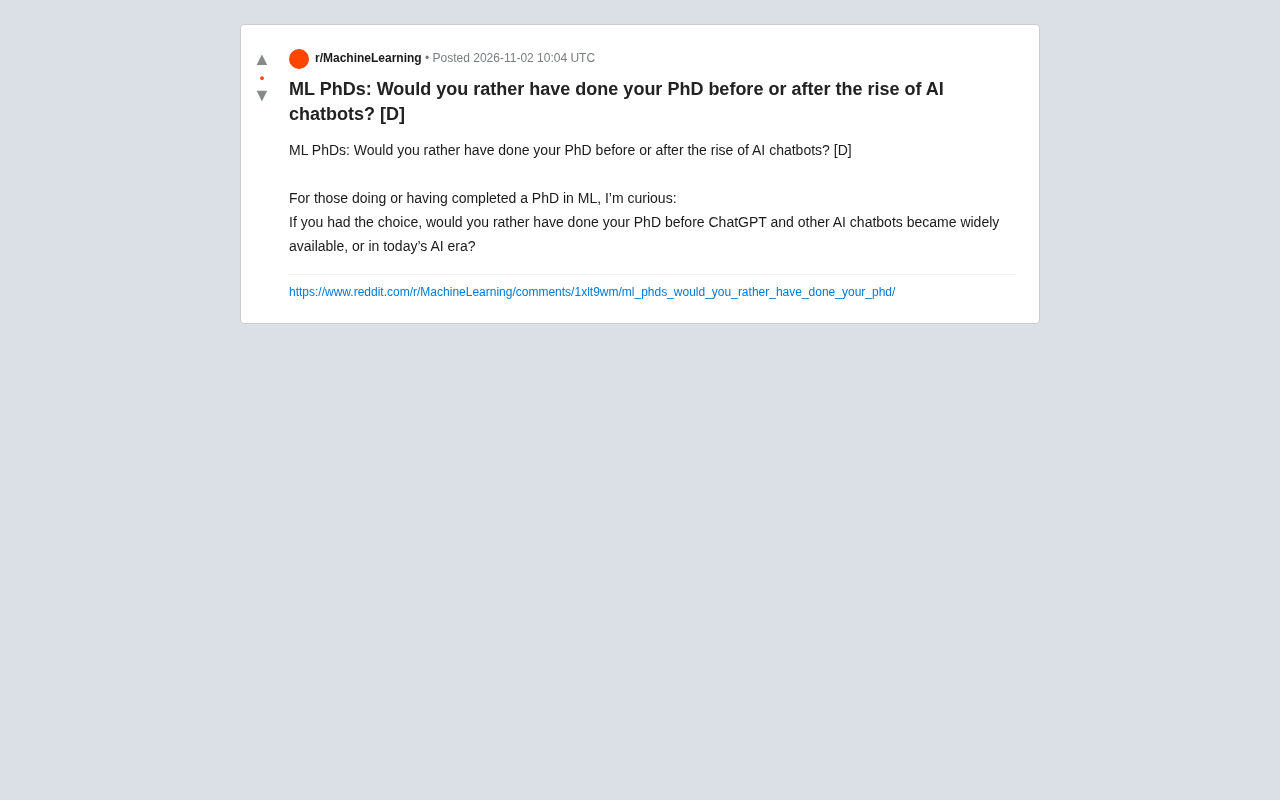
A thought-provoking discussion recently appeared on the Reddit community r/MachineLearning: if given the choice, would machine learning (ML) PhD students prefer to have completed their doctoral studies before AI chatbots like ChatGPT became widespread, or to do a PhD in today's AI era? The question sparked heated debate in the community and touches on a core contradiction of academic research in the AI age.
The Core Question: Have AI Tools Changed the Nature of PhD Research?
For researchers pursuing or having completed an ML PhD, this choice is really a reflection on how AI tools are reshaping the research paradigm. Before AI chatbots were widely available, researchers had to manually complete large amounts of literature review, code debugging, and experiment design. The process was arduous, but every step forced researchers to deeply understand the essence of the problem. Today, large language models can rapidly generate code, summarize papers, and even propose experimental ideas. Research efficiency has improved significantly, but this also brings new concerns: will researchers become overly reliant on these tools and thereby weaken their core abilities?
The discussion in the community shows clear divisions. Some believe that doing a PhD in the AI era means being able to use powerful tools to accelerate research progress and devote more energy to truly creative problems; others worry that AI tools may let PhD students skip the necessary "painful learning" stage, resulting in an insufficiently solid understanding of fundamental principles.
An In-Depth Analysis of Two Positions
The Case for "Doing a PhD in the Pre-AI Era"
According to the Reddit discussion, researchers holding this position emphasize that doing a PhD without AI chatbots is harder, but it is precisely this difficulty that shapes independent problem-solving ability. They point out that manually deriving formulas, debugging code line by line, and repeatedly reading original papers are necessary conditions for forming deep intuition. Although code and explanations generated by AI tools are convenient, they often lack a traceable chain of reasoning, and long-term reliance may make researchers' understanding of underlying mechanisms shallow.
In addition, some argue that the academic evaluation system of the pre-AI era focused more on the depth of researchers' own thinking, while the spread of AI tools may lower the threshold for paper writing and experiment design, intensifying homogenization of academic output.
The term "painful learning" can be traced back to the "desirable difficulties" theory in educational psychology: moderate cognitive friction—such as deriving formulas from scratch or troubleshooting errors line by line—forces learners to engage in deep encoding, thereby forming more robust and transferable knowledge representations. In ML research, this friction often corresponds to understanding underlying mechanisms such as gradient propagation, numerical stability, and regularization. AI chatbots are good at giving plausible answers, but their reasoning chains are implicit and not always reliable. If learners skip the trial-and-error process, they tend to remain at the level of "can use" rather than "understand the principles," and lack judgment when encountering out-of-distribution problems or when they need to debug the model's internal behavior. This is the cognitive mechanism behind some discussants' concern about "shallow understanding."
The Case for "Doing a PhD in the AI Era"
Another group of researchers believes that the spread of AI tools is precisely a boon for academic research. They point out that the ML field is developing extremely fast and the volume of literature is exploding. Using AI tools for literature screening and preliminary analysis can save substantial time and allow researchers to enter the core innovation stage faster. One PhD student participating in the discussion mentioned that AI chatbots' help with debugging code and explaining complex concepts significantly reduced frustration during research and made the research rhythm smoother.
They also emphasize that future ML researchers should learn to work collaboratively with AI tools anyway. Becoming familiar with this collaboration model during the PhD stage is actually early adaptation to career development. Refusing to use AI tools is equivalent to voluntarily giving up an efficiency advantage.
The explosive growth of ML literature can be seen in concrete numbers: the cs.LG section of arXiv adds thousands of new preprints each month, and submissions to top conferences such as NeurIPS, ICML, and ICLR have grown severalfold over the past decade. It is no longer possible for a single researcher to read all papers in a relevant field. The problem of "information overload" in computational linguistics is particularly prominent here, so using large language models for retrieval, clustering, and preliminary screening is in practice a necessary strategy for allocating limited attention to high-value literature. This also echoes the research paradigm of "human-AI collaboration": future researchers are more like commanders, responsible for proposing hypotheses and verification, while delegating tasks such as pattern recognition and code drafting to models, with review at key checkpoints.
The Deeper Challenge of PhD Training in the AI Era
This discussion reflects a deeper question: what is the core goal of doctoral education? If the purpose of PhD training is to cultivate the ability to independently pose and solve problems, then AI tools are only means, and the key lies in how to use them. Some researchers in the community proposed that the real question is not "when to do a PhD" but "how to do a PhD"—regardless of the era, proactive thinking, critical use of tools, and respect for fundamental principles are the essence of PhD training.
One detail: some discussants mentioned that the spread of AI chatbots has also changed the interaction pattern between advisors and students. Students can obtain preliminary answers faster, and the advisor's role may shift more from "knowledge transmitter" to "direction guide" and "quality gatekeeper." This shift imposes new requirements on the PhD training system.
Implications for Those Who Follow
For those considering whether to pursue an ML PhD, this discussion provides valuable reference. AI tools have irreversibly changed the research environment. Rather than dwelling on "what it would be like to have done a PhD a few years earlier," it is better to think about how to fully leverage the advantages of tools today while deliberately preserving the steps that require deep thinking. The consensus in the community is: tools can accelerate the research process, but they cannot replace researchers' independent judgment and persistent questioning of problems.
From a broader perspective, the challenge of doing a PhD in the AI era is not the tools themselves, but whether researchers can find a balance between efficiency and depth. Although this Reddit discussion did not provide a unified answer, participants' candid sharing based on their own experiences offers rich first-hand perspectives for understanding the impact of AI on academic training.
One-line Summary
Reddit hotly debates whether ML PhDs should have been done before AI chatbots became widespread or in the present, with the core issue being how to use tools critically.
Paragraph Summary
The article reviews the discussion in the Reddit r/MachineLearning community about "doing a PhD in the pre-AI era or the AI era." Supporters of the pre-AI era believe that "painful learning" processes such as manual derivation and line-by-line debugging are necessary for forming deep intuition and independent problem-solving ability, and that AI tools may let researchers skip necessary stages, leading to shallow understanding and exacerbating paper homogenization. Supporters of the AI era emphasize that AI tools can greatly improve the efficiency of literature screening and code debugging, allow researchers to enter the innovation stage faster, and that collaborating with AI is itself an essential skill for future researchers. The discussion ultimately shifts the focus from "when to do a PhD" to "how to do a PhD": the key is to use tools critically, maintain independent thinking and deep understanding, and find a balance between efficiency and depth.
Related articles

AI Can Read Neural Network Weights Directly: Do Models Already Exceed Expectations?
A Reddit developer experiment shows language models can directly read neural network weights and infer their function. Astra, Opus 5.5, and Muse Spark 1.3 all passed the test, sparking discussion on model generalization and training sources.

India's Microdrama Market Explodes: EloElo Secures $80M Investment from NBCUniversal
EloElo secures $80M from NBCUniversal to boost StoryTV, its microdrama platform with over 33M monthly active users, as India's microdrama market draws global capital.

Acoustic Detection of Multi-Rotor UAVs: Fusing Handcrafted Features with Pre-Trained Embeddings
Study reveals data leakage from random splits in UAV acoustic detection, proposes source-disjoint protocol with stacked ensemble of handcrafted features and YAMNet embeddings, achieving 95.29% accuracy for low-cost drone detection.