DoorDash Unveils Hexarotor Drone, Expanding Delivery Strategy from Ground to Sky

DoorDash debuts a six-rotor delivery drone, entering the aerial delivery race with a ground-first strategy.
DoorDash unveiled a hexarotor delivery drone at its annual Dash Forward 2026 event, signaling its expansion from ground logistics into airspace. The company's core strategy is "starting from the ground" — rather than building an aerial delivery system from scratch, it treats drones as a complement to its existing merchant relationships, order density, and dispatch infrastructure to reduce cold-start costs. The six-rotor design offers redundancy and stability suited for low-altitude operations over urban residential areas. This pragmatic approach gives DoorDash strategic flexibility in the face of regulatory, airspace, and community acceptance challenges, while differentiating it from purely aerial players like Amazon Prime Air and Wing.
DoorDash Takes a Major Step into Drone Delivery
DoorDash officially unveiled a six-rotor aircraft at its annual Dash Forward 2026 event, positioning the drone as the centerpiece of its new aerial delivery business. For a company that has long built its foundation on ground-based delivery networks, this move marks a structural shift in its logistics strategy — extending its reach from roads into airspace.
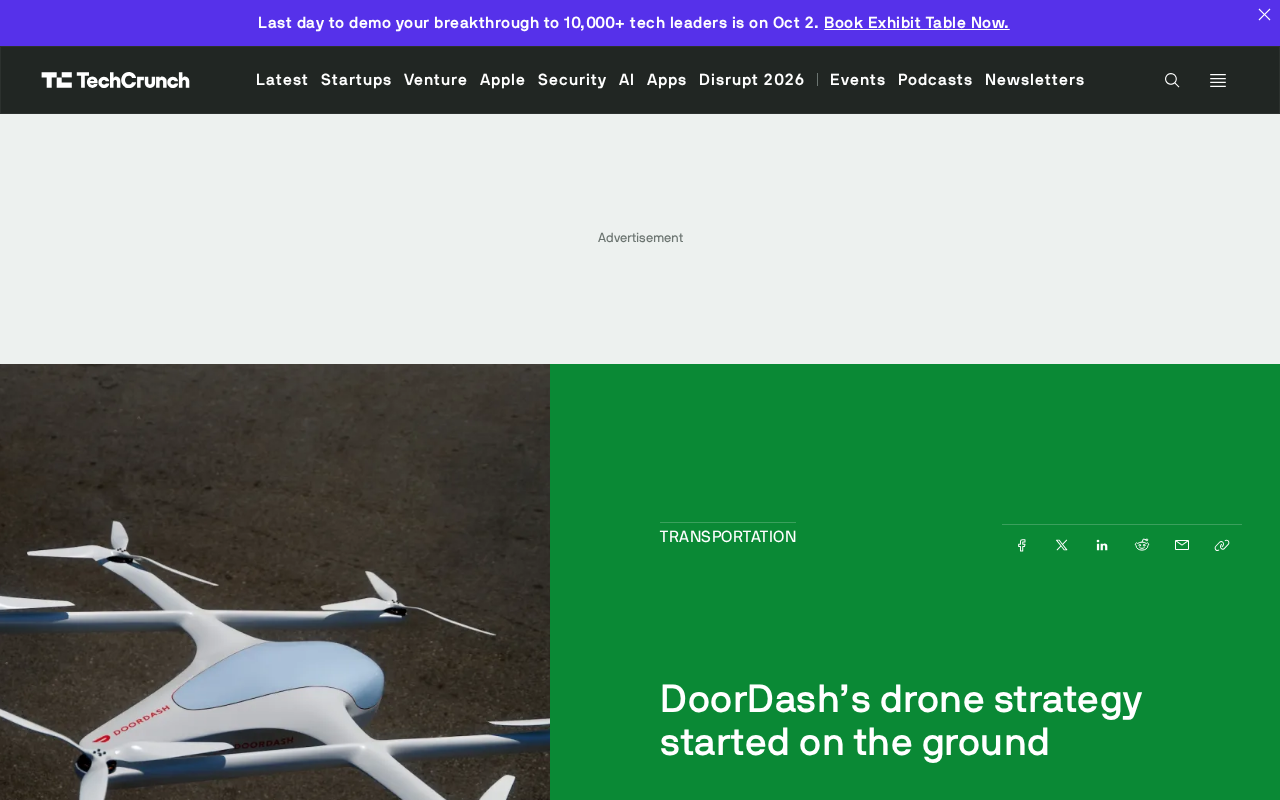
There's an important nuance embedded in the headline: DoorDash's drone strategy "starts from the ground." This means the company isn't building an entirely new aerial delivery system from scratch. Instead, it's leveraging its existing vast ground delivery capacity, merchant network, and order dispatch infrastructure, treating drones as a complement and extension of its current capabilities. This "ground-first, air-second" approach stands in sharp contrast to competitors that launched with a purely aerial delivery model.
Why a Six-Rotor Design?
Hexarotor configurations typically offer advantages in stability and redundancy. Compared to quadrotors, a six-rotor drone can maintain basic flight control even if a single motor fails — a critical safety feature for delivering food and fresh goods over urban and suburban areas. Delivery drones must frequently take off and land, hover precisely, and operate safely above residential neighborhoods, where redundant propulsion significantly reduces the risk of a crash.
Multi-rotor designs are also better suited for short-range, point-to-point "last-mile" delivery. They require minimal landing space, can take off and land vertically without a runway, and can flexibly adapt to diverse drop-off points between restaurants or merchants and customers' homes.
A Strategic Leap from Ground to Sky
DoorDash's choice to debut this aircraft at its most important annual event sends a clear signal: drones are no longer an experimental proof of concept but a formal commercial delivery option. For the on-demand delivery industry, the value of drones lies in bypassing ground traffic bottlenecks — enabling faster, more predictable delivery times over certain distances and routes.
By building its drone operations on top of a mature ground network, DoorDash can reuse existing order density, merchant relationships, and its user base, reducing the cold-start costs of the new business. This incremental strategy also better positions the company to navigate the real-world challenges of drone delivery: regulatory approvals, airspace coordination, and community acceptance.
Industry Competition and What to Watch
Drone delivery is becoming the new frontier in competition among instant retail and food delivery platforms. DoorDash's entry intensifies the race further. Key things to watch include: the drone's actual payload capacity, flight radius, which cities it will cover, and how it will coordinate with the existing network of human couriers.
Whether drone delivery can truly achieve commercial scale depends on striking the right balance between cost structure, regulatory progress, and operational efficiency. DoorDash's pragmatic "ground-first" approach may be precisely the strategic foundation it needs to navigate these uncertainties.
The drone delivery space already features multi-player competition. Amazon's Prime Air program launched in 2013 and, after multiple technical iterations, has achieved commercial operations in select cities in Texas and Arizona. Alphabet's Wing has deployed services in Australia, Finland, and the United States, making it one of the largest commercially operating drone delivery companies in the world. Zipline, initially focused on medical supply delivery, has since expanded into consumer goods. By comparison, DoorDash is not the earliest entrant — but its advantage lies in owning one of the largest food delivery networks in the United States, covering more than 3,700 cities and connecting hundreds of thousands of merchants. This ground infrastructure is a core moat that pure aerial delivery startups struggle to replicate. Beyond technology, the commercial bottlenecks for drone delivery stem largely from FAA operational certifications (such as Part 135 commercial operating licenses) and the gradual opening of beyond-visual-line-of-sight (BVLOS) flight regulations — shared industry-wide hurdles that will determine the pace of scaling for every player in the space.
Related articles

When Did Paid Childcare Become the Norm? Working Mothers and the Evolution of Childcare
When did paid childcare become the norm? This article traces the evolution from the rise of childcare centers in the 1970s–80s and the 1990s linking of federal subsidies to work requirements, to declining stigma and rising costs, and explores advocates' 25-year effort to catch up with other countries on childcare and paid parental leave.

Red Flags for Product-Market Fit: A Practical Guide from Top VCs and the Superhuman Founder
Investors from Iconiq and Sapphire Ventures and Superhuman founder Rahul Vohra share PMF red flags and practical methods, including the 40% disappointment rule, retention curves, and acquisition costs.

What Task Should AI Agents Take Over Most? Heated Reddit Discussion
Reddit discussion: Which task do you most want AI agents to take over completely? Cross-app data migration, CRM updates, and report generation top the list, but insufficient reliability and the trust gap are the biggest obstacles to automation adoption.