DRBench Pro: A Deep Research Agent Benchmark Centered on Knowledge Coverage
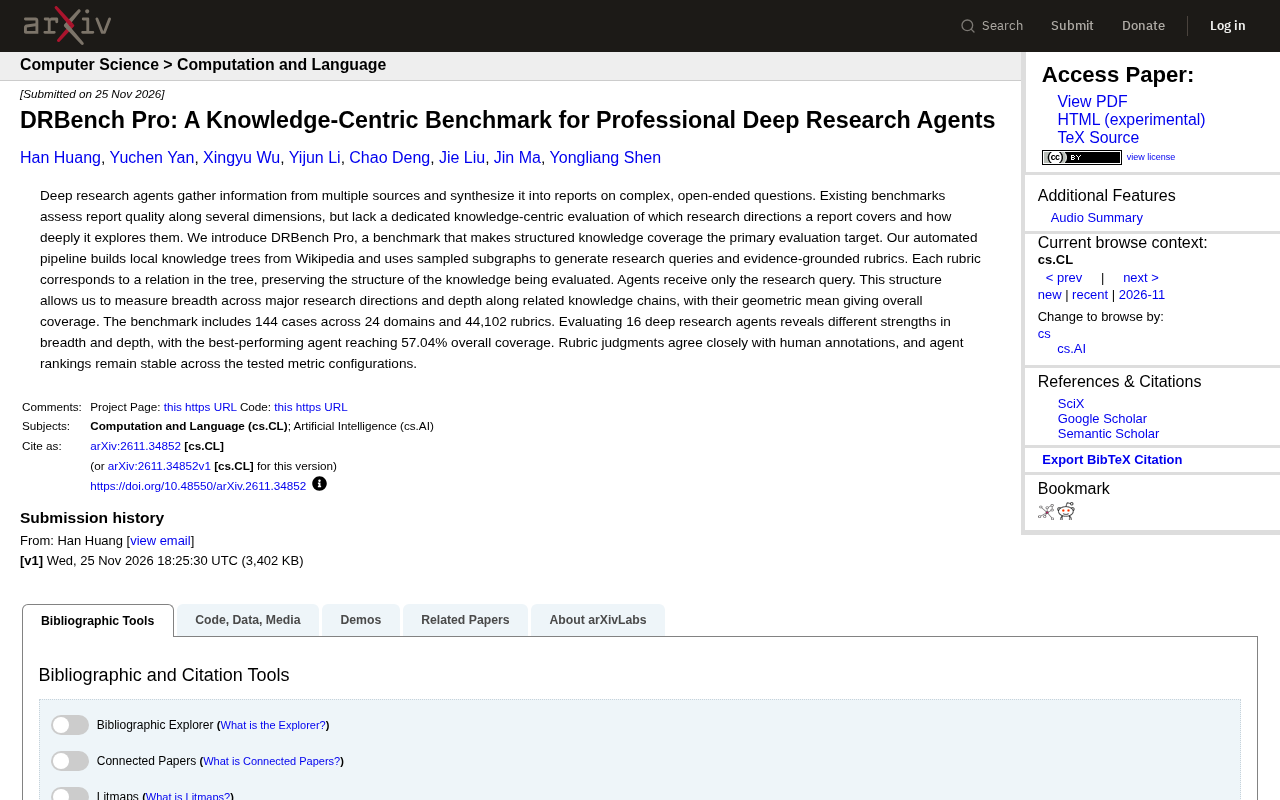
DRBench Pro is the first to center on structured knowledge coverage, evaluating deep research agents' breadth and depth.
DRBench Pro is the first deep research agent benchmark to treat structured knowledge coverage as its primary evaluation objective. It automatically builds domain knowledge trees from Wikipedia, samples subgraphs to generate research queries, and creates evidence-based rubrics tied to knowledge tree relations, measuring both breadth across major research directions and depth along knowledge chains via their geometric mean. The benchmark has 144 cases across 24 domains and 44,102 rubrics, evaluated 16 agents, with the best coverage at 57.04%. Scoring is highly consistent with human annotations and rankings are stable across metric configurations, showing reliability and revealing that agents have respective strengths in breadth and depth, guiding targeted improvements.
Deep research agents can gather information from multiple sources and synthesize reports on complex, open-ended questions. However, how to systematically evaluate these agents' performance on knowledge coverage has remained a gap in the benchmarking field. The recently proposed DRBench Pro fills this gap — it is the first to treat structured knowledge coverage as the primary evaluation objective, providing a more fine-grained measuring stick for professional deep research agents.
Why do we need knowledge-centric evaluation?
Existing benchmarks evaluate report quality across multiple dimensions, but lack dedicated consideration of "which research directions a report covers" and "how deeply each direction is explored." The authors of DRBench Pro argue that for deep research tasks, the breadth and depth of knowledge coverage are the core. The benchmark builds local knowledge trees from Wikipedia through an automated pipeline, and uses sampled subgraphs to generate research queries and evidence-based rubrics. Each rubric corresponds to a relation in the knowledge tree, thereby preserving the structure of the knowledge being evaluated. Agents receive only the research query and have no access to the knowledge tree, ensuring the objectivity of the evaluation.
Rubrics and evidence-based scoring: In benchmarking, a rubric refers to a set of fine-grained judging items, each describing a specific, verifiable requirement. Each rubric in DRBench Pro corresponds to a relation in the knowledge tree (e.g., "A is a subfield of B," "C was proposed by D") and comes with supporting evidence. During evaluation, determining whether an agent's report satisfies each item typically relies on an LLM-as-a-judge or human annotation for verification. This evidence-based design makes scoring traceable and reduces subjectivity, and it also allows coverage to be counted by item, forming quantifiable breadth and depth metrics.
Benchmark construction and design
The core innovation of DRBench Pro lies in its knowledge-tree-driven evaluation framework. The specific pipeline is as follows:
- Knowledge tree construction: Extract structured knowledge from Wikipedia to form domain knowledge trees.
- Query generation: Sample subgraphs from the knowledge tree to generate corresponding research queries, ensuring queries cover different knowledge branches.
- Rubric generation: Generate evidence-based rubrics for each query, with each rubric corresponding to a relation in the knowledge tree, enabling measurement of how deeply an agent explores a specific knowledge chain.
This design means evaluation is no longer limited to the surface quality of reports, but drills down into the degree of coverage of the knowledge structure. Breadth is measured by coverage of major research directions, while depth is assessed along related knowledge chains; the geometric mean of the two yields the overall coverage score.
Knowledge trees and sampled subgraphs: A knowledge tree is a hierarchical/graph structure that organizes domain knowledge into nodes (entities or concepts) and edges (relations). DRBench Pro extracts entries and their link relations from Wikipedia to build local knowledge trees, then samples connected subgraphs from the tree as the knowledge scope of a single case. Subgraphs ensure that queries revolve around several interrelated knowledge branches rather than a pile of isolated facts. Agents see only the natural-language research queries generated from the subgraph and cannot access the tree structure itself, so the evaluation measures their autonomous exploration and information integration capabilities rather than exploitation of the benchmark structure.
Breadth, depth, and geometric mean: Breadth refers to how many major research directions a report covers (the main branches in the subgraph), while depth refers to how many layers of relations are mined along each related knowledge chain. After normalizing both to scores between 0 and 1, the geometric mean is taken as the overall coverage score. Using the geometric mean rather than the arithmetic mean means that a near-zero value in either dimension significantly lowers the total score, requiring agents to develop in a balanced way across coverage and depth and avoiding the imbalance of being "broad but shallow" or "deep but narrow."
Scale and evaluation results
DRBench Pro contains 144 cases covering 24 domains, with a total of 44,102 rubrics. The research team evaluated 16 deep research agents and found that they have respective strengths in breadth and depth. The best-performing agent achieved an overall coverage rate of 57.04%. The rubrics are highly consistent with human annotations, and agent rankings remain stable under different metric configurations, demonstrating the reliability of the benchmark.
This result reveals the capability distribution of current agents: some excel at broadly covering multiple directions, while others dig deeper along specific knowledge chains. This fine-grained evaluation helps researchers make targeted improvements to agents.
Human consistency check: Benchmark reliability is typically verified by comparing automatic scoring with expert human annotations, using metrics such as agreement rate, Cohen's kappa, or correlation with human scores. DRBench Pro reports that its rubrics are highly consistent with human annotations, indicating that evidence-based rubrics can accurately reflect the true coverage of reports. In addition, the research team tested the stability of agent rankings under different metric configurations (e.g., different weights or aggregation methods); unchanged rankings mean that the benchmark's conclusions do not depend on specific parameter choices, enhancing the credibility and reproducibility of the results.
Implications for deep research agents
The emergence of DRBench Pro provides a clear direction for the development of deep research agents. Agents need not only to collect information but also to strategically cover key knowledge branches and explore them deeply. Future optimization can focus on knowledge tree navigation capabilities, accuracy of evidence integration, and coherence of cross-domain knowledge. As the benchmark gains adoption, we can expect to see more powerful and reliable professional research agents.
For the research community, DRBench Pro also provides a reproducible evaluation framework, driving deep research agents toward becoming more professional and trustworthy.
One-line Summary
DRBench Pro is the first to center on structured knowledge coverage, evaluating the breadth and depth of deep research agents.
Paragraph Summary
DRBench Pro is the first deep research agent benchmark that treats structured knowledge coverage as its primary evaluation objective. It automatically builds domain knowledge trees from Wikipedia, samples subgraphs to generate research queries, and generates evidence-based rubrics for each query corresponding to relations in the knowledge tree, thereby measuring both the breadth of a report's coverage of major research directions and the depth of its mining along knowledge chains, with the geometric mean of the two yielding the overall coverage score. The benchmark contains 144 cases across 24 domains and 44,102 rubrics, evaluated 16 agents, with the best overall coverage at 57.04%. Scoring is highly consistent with human annotations, and rankings are stable under different metric configurations, indicating the benchmark is reliable and revealing that agents have respective strengths in breadth and depth, providing direction for targeted improvements.
Related articles

Stop Pasting AI Prompts Repeatedly: Optimize Your Claude Code Workflow with Skill Files
Repeatedly pasting AI prompts is inefficient and wastes tokens. Learn how to package workflows into Skill files that load on demand in Claude Code, Cursor, and Codex.
Snap's MCP Gateway: Verifying Both Human and Agent Identity
Snap's MCP Gateway verifies both user and agent identity in the agent call chain, solving the failure of traditional authentication models in LLM agent scenarios. This article analyzes the necessity of dual verification, the engineering advantages of centralizing at the gateway layer, and deployment challenges such as expressing delegation relationships and handling policy conflicts.

Google Forces AI Agents to Use Its Own MCP Servers, Yet the Gmail Version Can't Send Emails
Google pushes AI agents to use its MCP servers, but Gmail MCP can't send emails, sparking Hacker News debate on ecosystem control, security, and AI agent impact.