Google Forces AI Agents to Use Its Own MCP Servers, Yet the Gmail Version Can't Send Emails
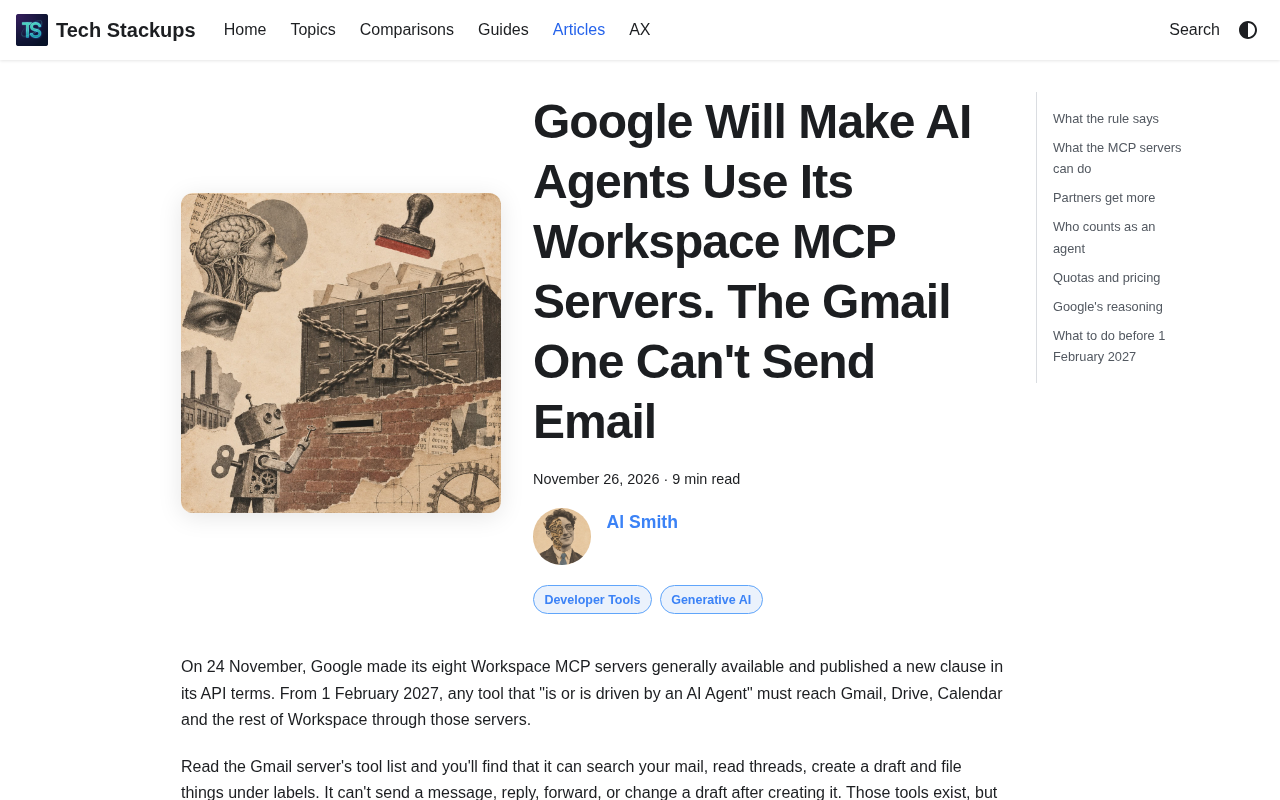
Google pushes AI agents to use its MCP servers, but Gmail MCP can't send emails, sparking security and control debate.
Google plans to route AI agent access to Gmail and Google Drive through its own MCP servers for unified permission and audit management. However, Gmail's MCP server can't send emails, sparking heated debate on Hacker News. Supporters see it as a "secure by default" measure against agent abuse; critics fear Google is using an open standard to create a de facto monopoly and limit developer flexibility. The article analyzes potential ecosystem impacts: functional fragmentation, stricter capability boundaries, and innovation constrained by platform rules. Google hasn't responded in detail yet.
Google is pushing AI agents to prioritize using its self-built MCP servers, a strategy that has sparked discussion on Hacker News. Most notably, the Gmail MCP server surprisingly lacks the ability to send emails. This seemingly contradictory design may conceal Google's deeper considerations regarding the safety and controllability of AI agents.
Google's MCP Strategy: Agents Must Use Its Own Servers
According to discussions on Hacker News, Google plans to have AI agents access various services through its MCP (Model Context Protocol) servers. MCP is an open protocol designed to standardize how AI models connect to external tools and data sources. Google's move means that AI agents built by developers will need to go through Google's MCP server layer when accessing services like Gmail and Google Drive.
This strategy aligns with Google's consistent approach to ecosystem control. Through MCP servers, Google can uniformly manage AI agents' access permissions, audit logs, and traffic, thereby striking a balance between openness and security. But the question is: will this centralized management limit developers' flexibility?
MCP (Model Context Protocol) is a protocol proposed and open-sourced by Anthropic in late 2024, aimed at providing a unified connection standard between AI models and external tools and data sources. It adopts a client-server architecture: AI applications act as clients, communicating with various MCP servers through standardized JSON-RPC interfaces, while servers encapsulate the access logic for specific resources (such as file systems, databases, and APIs). The core value of MCP lies in decoupling—models don't need to write separate integration code for each tool; developers only need to implement an MCP server once, and it can be reused by multiple compatible AI clients. Google's push for agents to prioritize its self-built MCP servers essentially uses this open protocol as an access layer while retaining control over permissions, auditing, and traffic on the server side, thereby achieving a balance between standardization and ecosystem governance.
The Gmail MCP Dilemma: Can Read but Can't Send
The most controversial point in the discussion is that Gmail's MCP server cannot send emails. This means AI agents can read emails and manage labels through MCP, but cannot directly send emails without additional authorization. For users expecting AI agents to automatically handle emails, this is clearly a significant functional gap.
Some commenters speculate that Google may be acting out of security concerns—sending emails is a high-risk operation, and if AI agents are maliciously exploited, it could lead to spam proliferation or data leaks. But opponents argue that this "crippled" design reduces practicality, and developers may have to find workarounds, which actually increases system complexity.
"Secure by Default" is a design principle in software engineering: systems should have high-risk features disabled in their initial state, requiring users or administrators to explicitly enable them. In the AI agent context, this principle is particularly important because agents can be manipulated by prompt injection, malicious instructions, or model hallucinations. Sending emails is a typical "high-impact operation"—once abused, it could cause phishing attacks, data exfiltration, or spam proliferation. Google's restriction on Gmail MCP's sending capability is precisely an application of "secure by default" to agent permission management: reading and managing labels are low-risk operations that can be enabled by default; sending emails requires additional authorization (such as OAuth scope escalation or user confirmation). This tiered authorization model is gradually becoming consensus in the industry, but the cost is reduced out-of-the-box automation experience, requiring developers to design their own authorization flows to fill the gap.
Questions and Concerns from the Developer Community
Comments on Hacker News reflect the typical attitude of the developer community: vigilance toward Google's ecosystem control. Some point out that MCP should be an open standard, but Google is exerting influence through its server implementation, potentially creating a de facto monopoly. Others argue that if Gmail MCP cannot send emails, its value is greatly diminished, and developers may turn to other solutions that support full email functionality.
On the other hand, some voices believe that Google's caution regarding security is reasonable. The stronger the autonomy of AI agents, the greater the potential risk. Restricting the email-sending function can be seen as a "secure by default" strategy, where users need explicit authorization to enable it.
Impact on the AI Agent Ecosystem
Google's move may have a chain reaction on the entire AI agent ecosystem. If other vendors follow suit, the capability boundaries of AI agents will be strictly defined by platform providers, and developers will need to innovate within platform rules. This could lead to fragmentation of AI agent functionality—different platforms offering different levels of access permissions, requiring users to adapt to various restrictions.
From a positive perspective, standardized MCP servers can reduce developers' integration costs and provide more unified identity verification and permission management. But the key question is whether Google is willing to open up the implementation details of its MCP servers and whether it will allow developers to bypass restrictions.
Currently, Google has not made a detailed response to this matter. Discussions on Hacker News continue, and developers are watching Google's next move. For those following the development of AI agents, this is a signal worth tracking: how platform providers draw the line between openness and control will determine whether AI agents can truly become productivity tools.
One-line Summary
Google pushes AI agents to use its self-built MCP servers, but Gmail MCP not supporting email sending sparks controversy over security and control.
Paragraph Summary
Google plans to have AI agents access services like Gmail and Google Drive through its self-built MCP servers to uniformly manage permissions and audit logs. However, Gmail's MCP server cannot send emails, and this functional gap has sparked heated discussion on Hacker News. Supporters view it as a "secure by default" strategy out of security considerations to prevent AI agent abuse; opponents worry that Google is leveraging open standards to exert de facto monopoly and limit developer flexibility. The article analyzes the potential impact of this strategy on the AI agent ecosystem: it may lead to functional fragmentation, with platform providers strictly defining capability boundaries, requiring developers to innovate within the rules. Google has not yet responded in detail, and the community continues to watch.
Related articles

Stop Pasting AI Prompts Repeatedly: Optimize Your Claude Code Workflow with Skill Files
Repeatedly pasting AI prompts is inefficient and wastes tokens. Learn how to package workflows into Skill files that load on demand in Claude Code, Cursor, and Codex.
Snap's MCP Gateway: Verifying Both Human and Agent Identity
Snap's MCP Gateway verifies both user and agent identity in the agent call chain, solving the failure of traditional authentication models in LLM agent scenarios. This article analyzes the necessity of dual verification, the engineering advantages of centralizing at the gateway layer, and deployment challenges such as expressing delegation relationships and handling policy conflicts.
X Launches Its First Parental Controls Feature: A New Step in Teen Account Management
X (formerly Twitter) rolls out its first parental controls, letting parents view teen usage time, set daily limits, and approve follow requests. Details, background, and challenges.