Droid vs Codex: Terminal Coding Agents Head-to-Head
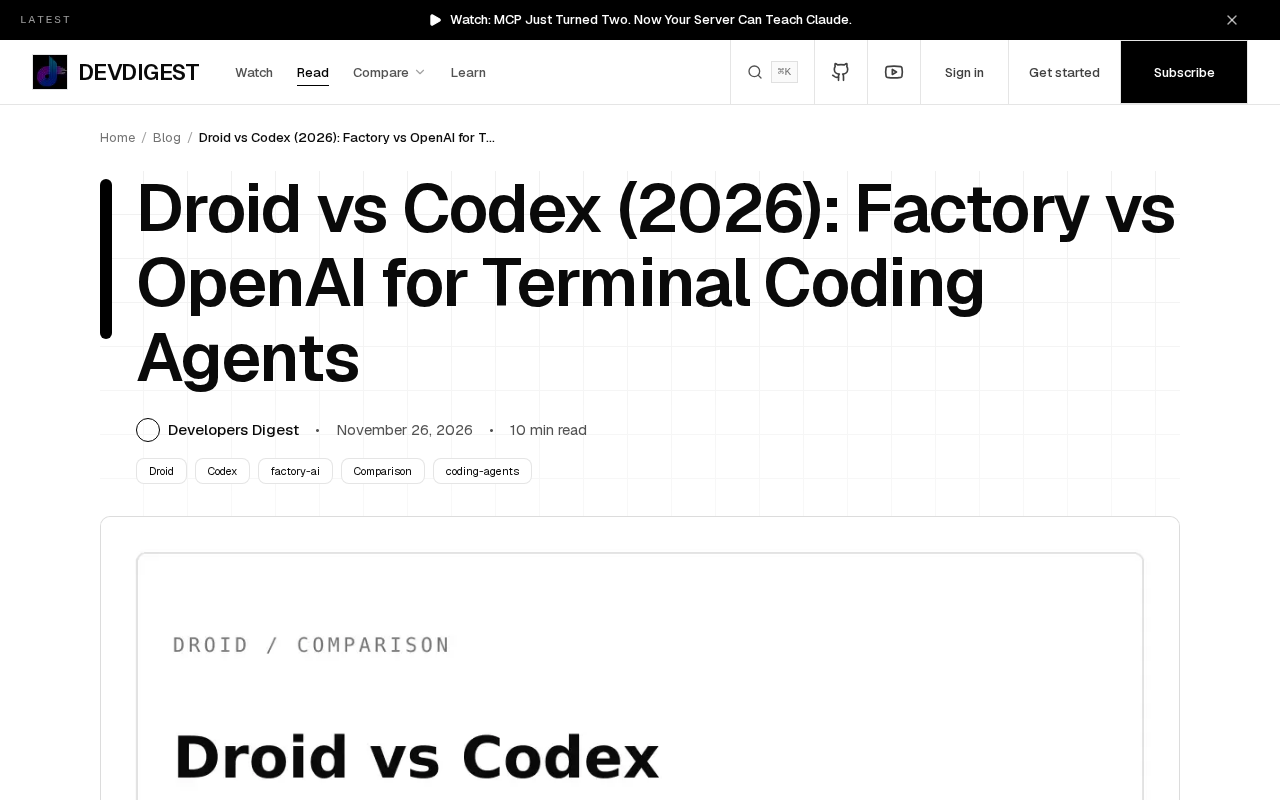
A five-dimension comparison of Factory Droid and OpenAI Codex: models, pricing, CI, multi-agent, extensibility.
Based on public comparison materials from Factory and OpenAI, this article analyzes two terminal coding agent approaches—Droid and Codex—across model support, pricing, headless CI, multi-agent collaboration, and extensibility. Droid emphasizes model-agnostic openness and deep customization; Codex offers tight OpenAI integration and out-of-the-box experience. It highlights headless CI and multi-agent work as key differentiators and gives selection advice by developer type.
A New Choice in the Terminal Agent Race
Terminal coding agents are becoming a core component of developers' workflows. Factory's Droid and OpenAI's Codex represent two fundamentally different approaches: the former sells itself on openness and multi-model support, while the latter holds its ground through the OpenAI ecosystem and closed-source integration. Drawing on publicly available comparison materials from Factory and OpenAI, this article breaks down the differences between the two across five dimensions—models, pricing, headless CI, multi-agent collaboration, and extensibility—and offers selection advice for different types of developers.
Model Support and Openness
Droid's core advantage lies in its model-agnostic architecture. Developers can switch between different underlying models within Droid without being locked into a single vendor. This design reduces the migration costs that come with model iteration and makes it easy for teams to choose more cost-effective models based on task type.
Codex, by contrast, is tightly bound to OpenAI's own model stack. The upside is high integration and a short call path; the downside is limited flexibility—once model strategy or pricing changes, users have no alternatives. For teams that have already built their workflows around OpenAI, this isn't a problem; but for teams that need multi-cloud or multi-model strategies, Droid's openness is more appealing.
Pricing and Cost Structure
The two follow different pricing logics. Droid's selling point is the cost-adjustment room that comes from selectable models—teams can choose low-cost models for lightweight tasks. Codex's pricing is directly tied to OpenAI's subscription and API system. The original article doesn't give specific price figures, but clearly lists pricing as a key differentiation dimension. For cost-sensitive teams, we recommend calculating the total cost of ownership for each option based on your own call volume rather than looking only at unit price.
Total Cost of Ownership (TCO) here includes not only model invocation fees but also subscription costs, repeated invocation overhead in CI environments, migration and adaptation costs from model switching, and the hidden costs of the team learning curve. Although a model-agnostic architecture doesn't necessarily win on unit price, it allows teams to choose models at different price points by task granularity (for example, small models for lightweight tasks and large models for complex reasoning), thereby lowering overall costs in high-volume pipeline scenarios. For a single-vendor solution, costs depend more on changes in that vendor's pricing strategy.
Headless CI and Multi-Agent Collaboration
Headless CI is the key to terminal agents truly integrating into engineering pipelines. Codex's capabilities in CI scenarios are one of its promotional highlights, making it suitable for teams already running pipelines such as GitHub Actions. Droid also covers headless mode, emphasizing orchestration in automated environments.
Multi-agent work is another watershed. The original article lists multi-agent work as a comparison dimension, meaning the two differ in how they support parallel task decomposition and collaboration. Multi-agent capability directly affects efficiency in scenarios such as complex refactoring and batch modifications, so when choosing, it's important to test against actual task types rather than just reading feature lists.
Headless Mode refers to an agent running without an interactive terminal interface, receiving instructions via configuration files, environment variables, or command-line parameters and outputting structured results, so it can be called automatically by CI/CD pipelines (such as GitHub Actions or Jenkins). It is the prerequisite for a terminal agent to go from "a tool developers use manually" to "an orchestratable step in an engineering pipeline."
Multi-agent collaboration refers to decomposing complex tasks among multiple agent instances with different responsibilities, which complete the work in parallel or in sequence—for example, one handles planning, one handles code modification, and one handles test verification. This kind of architecture places high demands on task decomposition, context passing, and conflict merging mechanisms. Therefore, in scenarios such as batch refactoring and cross-file modifications, the actual performance differences in multi-agent capability often determine efficiency more than the quality of a single agent's conversation.
Extensibility and Ecosystem
extensibility and openness are listed separately as comparison items in the original article, indicating that this is Factory's flagship differentiator. Droid's open architecture allows deeper customization and tool integration; Codex's extension path is limited by the boundaries of the OpenAI ecosystem. For teams that need to embed agents into their own toolchains, extensibility often determines long-term satisfaction more than the model itself.
Selection Advice
The original article gives clear recommendations by developer type. In summary: teams pursuing model flexibility and needing multi-agent orchestration and deep customization are better suited to Droid; developers already deeply invested in the OpenAI ecosystem and valuing out-of-the-box integration will find Codex a shorter path. This judgment is consistent with the fundamental difference between the two products in model openness.
When actually choosing, we recommend running the same set of real tasks on both platforms—especially in CI pipelines and multi-agent collaboration scenarios, where paper comparisons cannot replace hands-on testing.
One-line Summary
A five-dimension comparison of Factory Droid and OpenAI Codex across models, pricing, headless CI, multi-agent, and extensibility.
Paragraph Summary
Drawing on publicly available comparison materials from Factory and OpenAI, this article breaks down two approaches to terminal coding agents—Factory's Droid and OpenAI's Codex—across five dimensions: model support, pricing structure, headless CI, multi-agent collaboration, and extensibility. Droid's core selling points are its model-agnostic architecture, openness, and deep customization, allowing teams to switch underlying models by task and embed them into their own toolchains; Codex is tightly bound to the OpenAI model stack, with advantages in high integration, a short call path, and out-of-the-box readiness. The article points out that headless CI and multi-agent collaboration are key differentiating dimensions for integrating into engineering pipelines, and offers selection advice by developer type: choose Droid for model flexibility and multi-agent orchestration, and Codex if you're already deeply invested in the OpenAI ecosystem. Finally, it emphasizes that paper comparisons cannot replace hands-on testing—run real tasks through CI and multi-agent scenarios before deciding.
Related articles

A 19-Year-Old's Rental Horror Story: Ceiling Collapse, Bug Infestation, and the Lessons It Taught Me
At 19, my first off-campus rental brought bug infestations, no heat, a collapsed ceiling, and a ruined laptop with no renter's insurance. Here are the hard-won lessons for first-time student renters.

Veda Nurse's Cranial Nerve Exam: Why ASMR Role-Play Is Going Viral
Bilibili creator Veda's cranial nerve exam ASMR video goes viral, blending humor and sensory triggers through nurse role-play. This article analyzes its unique appeal and the audience psychology behind ASMR role-play.

LG Cinebeam AI Review: 120-Inch Giant Screen + 3000 Lumens, a New Choice for the Living Room Theater
LG Cinebeam AI projector review: 3000 ANSI lumens, 4K, 100 inches from about 8 cm and 120 inches from about 18 cm. Built-in webOS, AI Concierge voice recommendations, AI Sound Pro 11.1.2 virtual surround, and Game Optimizer—positioned for fixed living room installation, complementing the portable Cinebeam S.