DSP Framework: Supervised Play Enables Robots to Learn Dexterous Manipulation Autonomously

DSP lets robots bootstrap from a few minutes of human play to autonomously learn dexterous manipulation.
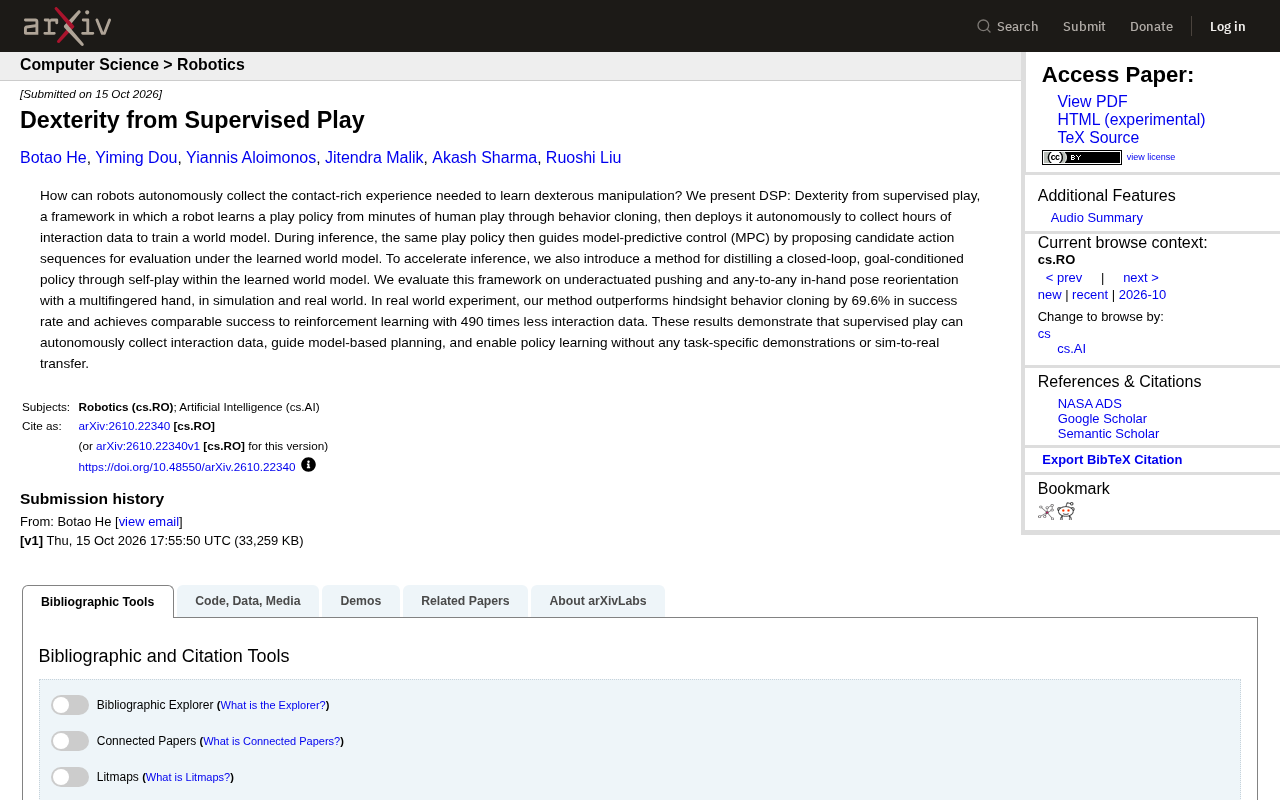
DSP proposes a middle path between human demonstrations and simulated RL: train a play policy via behavior cloning from a few minutes of human play, then let the robot autonomously collect hours of interaction data to train a world model. At inference, the play policy proposes candidate actions for MPC, evaluated by the world model; self-play distillation can also produce a fast goal-conditioned policy. On pushing and in-hand reorientation, DSP achieves 69.6% higher real-world success than hindsight behavior cloning with 490x less data, and matches RL without task demos or sim-to-real transfer.
How can robots autonomously acquire rich contact experience to learn dexterous manipulation? This has long been a challenge in robot learning. Traditional approaches either rely on large amounts of human demonstrations or require reinforcement learning with repeated trial-and-error in simulation—the former is costly, while the latter faces a severe "sim-to-real" transfer gap. A new study called DSP (Dexterity from Supervised Play) proposes a middle path: letting robots learn autonomously through "supervised play."
Core Idea: From a Few Minutes of Human Play to Hours of Autonomous Interaction
The key insight of DSP is that although a few minutes of human play data is insufficient to directly train a dexterous policy, it is enough to train a "play policy" that enables the robot to autonomously generate meaningful interactions in the environment. The research team first uses behavior cloning to train a basic play policy from a few minutes of human play data. The robot then deploys this policy to run autonomously, collecting hours of interaction data used to train a world model.
This design cleverly decouples "data collection" from "policy learning": humans only provide the initial "play seed," while the subsequent massive experience is entirely accumulated autonomously by the robot.
Behavior cloning is the most basic form of imitation learning: given a batch of "state-action" paired data, supervised learning is used to train a policy network so that it outputs actions similar to the demonstrations under similar states. It is simple to implement and stable to train, but suffers from compounding error—once the policy deviates from the demonstration distribution, errors accumulate and amplify with the number of steps. Therefore, behavior cloning typically requires covering a sufficiently broad state distribution to generalize reliably, which is precisely why DSP treats only a few minutes of human data as a "play seed" rather than the final policy.
A world model refers to a learned approximation of environment dynamics (and sometimes rewards), usually modeled in the form of "current observation + action → next observation." With a world model, an agent can roll out multiple action sequences in "imagination" and evaluate their consequences without repeated trial-and-error in the real environment, thereby converting expensive real interaction into cheap computation. The accuracy of the world model directly determines the quality of online planning, which is why DSP needs to train it first with hours of autonomous interaction data.
Inference Stage: Play Policy Guides Model Predictive Control
At inference time, the DSP framework does not directly use the play policy to execute the task. Instead, it lets the policy propose candidate action sequences for model predictive control (MPC). Among these candidates, MPC evaluates them based on the learned world model and selects the optimal action. This combination fully leverages the exploration capability of the play policy and the predictive capability of the world model.
To further accelerate inference, the research team also proposed a method: distilling a closed-loop, goal-conditioned policy inside the world model through self-play. This is equivalent to "compressing" the planning capability of the world model into a fast policy network, significantly reducing the computational overhead of online planning.
Model predictive control (MPC) is a receding-horizon optimization method: at each moment, it predicts the consequences of actions over a finite horizon based on the current state, solves for the action sequence that optimizes the objective, but only executes the first action in the sequence, then re-observes and re-plans. This "receding re-planning" mechanism naturally has feedback error-correction capability and can suppress the accumulation of model errors. When applying MPC with a learned world model, the sampling method for action candidates is crucial—random sampling is extremely inefficient in high-dimensional action spaces (such as multi-fingered hand joints), whereas DSP uses the play policy to propose candidate sequences, effectively providing the optimizer with a high-quality prior distribution.
Self-play distillation refers to letting a student policy continuously generate trajectories through interaction with the world model and self-improve, then compressing these "planning-level" behaviors into a feedforward network. The distilled goal-conditioned policy takes a goal state as input condition and can directly output actions without online optimization solving, thus greatly improving inference speed at the cost of sacrificing some planning accuracy.
Experimental Validation: Dual Testing in Simulation and the Real World
The DSP framework was evaluated on underactuated pushing and any-to-any in-hand pose reorientation with a multi-fingered hand, covering both simulation and real-world environments.
The real-world experimental results are particularly impressive: DSP's success rate is 69.6% higher than hindsight behavior cloning, and it achieves success rates comparable to reinforcement learning with 490 times less interaction data. This means that DSP not only reduces reliance on task-specific demonstrations but also greatly lowers data requirements.
More importantly, the entire pipeline requires no task-specific demonstration data and no sim-to-real transfer step. The robot starts from play, autonomously accumulates experience, and eventually learns to perform specific tasks.
Significance and Limitations
DSP demonstrates a possibility: supervised play can simultaneously accomplish three things—autonomously collecting interaction data, guiding model-based planning, and enabling policy learning without task demonstrations. This provides a practical path toward addressing the data efficiency problem in dexterous robot manipulation.
However, current evaluation is still limited to two types of tasks: pushing and in-hand reorientation. Whether the method is equally effective on more complex, longer-horizon tasks remains to be further verified. In addition, the quality of the play policy largely determines the coverage of subsequent data collection, and how to ensure the diversity of initial play remains an open question.
One-line Summary
DSP lets robots bootstrap from a few minutes of human play data and autonomously accumulate experience to learn dexterous manipulation.
Paragraph Summary
DSP (Dexterity from Supervised Play) proposes a middle path between human demonstrations and simulated reinforcement learning: first train a basic play policy via behavior cloning from a few minutes of human play data, then let the robot run autonomously in the real environment for hours to collect interaction data for training a world model. At inference time, the play policy provides candidate action sequences for model predictive control, which are evaluated and selected by the world model; a closed-loop goal-conditioned policy can also be distilled through self-play within the world model to accelerate inference. On underactuated pushing and any-to-any multi-fingered in-hand pose reorientation tasks, DSP achieves a real-world success rate 69.6% higher than hindsight behavior cloning and reaches success rates comparable to reinforcement learning with 490 times less interaction data, all without task-specific demonstrations or sim-to-real transfer.
Related articles

OpenAI Cracks Math Problems, Why Are Mathematicians Losing Sleep?
OpenAI claims to solve math problems — why are mathematicians anxious? Vergecast reveals the Eye of Sauron dilemma and the tension between AI answers and human understanding.

CSS Conditional Border-Radius Trick: Auto-Square Corners When Elements Touch the Edge
Pure CSS conditional border-radius: auto-square corners when elements touch the edge, rounded while floating. Use calc(100vw-100%) with clamp() to kill the transition band, and container query units cqi for non-fullscreen containers, plus a scrollbar offset workaround.

Google TimesFM 3.0 Hands-On: Is Zero-Shot Forecasting Good Enough?
Hands-on test of Google TimesFM 3.0: zero-shot error cut by ~25% with second-level results, but the two versions give opposite answers in business what-if planning. A deep dive into model internals, version differences, and four key production limitations.