DT-DRO: Calibrating Ambiguity Sets with Diagnostic Transport to Overcome Conservative Bias in Distributionally Robust Optimization

DT-DRO adaptively calibrates ambiguity set geometry using diagnostic transport, eliminating excessive conservatism in distributionally robust optimization.
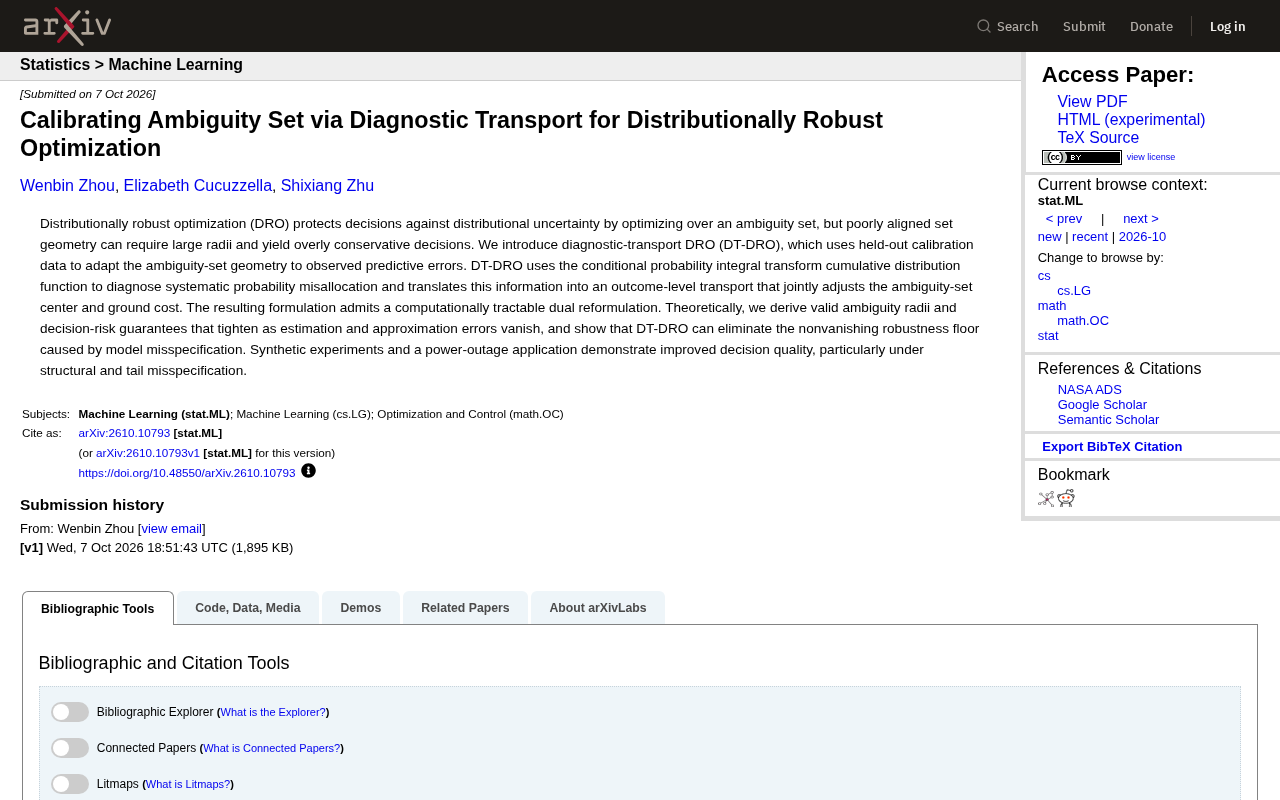
Distributionally Robust Optimization (DRO) optimizes worst-case performance over an ambiguity set to handle distributional uncertainty, but geometric misalignment between the ambiguity set and true prediction errors forces large radii and overly conservative decisions. The proposed DT-DRO framework uses held-out calibration data and conditional PIT to diagnose systematic probability misallocation, translating it into outcome-level adjustments — correcting both the ambiguity set center and ground cost function to tilt the set toward true error directions. Theoretically, DT-DRO admits a tractable dual reformulation and eliminates the nonvanishing robustness floor caused by model misspecification, with risk guarantees tightening as estimation error vanishes. Experiments on synthetic data and a power-outage application confirm superior decision quality under structural and tail misspecification.
Why Distributionally Robust Optimization Is Often "Overly Conservative"
Distributionally Robust Optimization (DRO) is a powerful approach for handling distributional uncertainty in decision-making. Its core idea is straightforward: rather than assuming the data distribution is fully known, it optimizes worst-case performance over an "ambiguity set," making decisions resilient to distributional shifts.
However, this approach has a long-standing pain point. When the geometry of the ambiguity set doesn't align with the true structure of prediction errors, a large radius is needed to cover the uncertainty. An oversized radius leads to overly conservative decisions, sacrificing performance that could otherwise be achieved. In other words, if the ambiguity set is pointed in the wrong direction, brute-force expansion only compensates at a steep cost.
A newly released arXiv paper (arXiv:2610.10793v1) proposes a new framework called Diagnostic-Transport DRO (DT-DRO), aiming to address the geometric alignment problem of ambiguity sets at its root.
The Core Idea of DT-DRO: Let Data Calibrate the Ambiguity Set
Conventional DRO typically treats the geometric structure of the ambiguity set as a fixed prior. DT-DRO's key innovation is to adaptively adjust the geometry of the ambiguity set using held-out calibration data, aligning it with the actually observed prediction errors.
Diagnosing "Probability Misallocation" with Conditional PIT
DT-DRO uses the cumulative distribution function of the conditional probability integral transform (PIT) to diagnose systematic "probability misallocation."
In plain terms, the PIT is a classic tool for checking whether a predictive distribution is well-calibrated: if the model's probabilistic predictions are accurate, PIT values should follow a uniform distribution. Any systematic deviation signals that the model has misallocated probability mass in certain regions — for instance, underestimating tail risk or shifting the overall distributional center. DT-DRO captures precisely these deviation signals and uses them as the basis for calibrating the ambiguity set.
The PIT is formally defined as follows: for a random variable $Y$ with predicted cumulative distribution function $F(y|X)$, the PIT value is defined as $U = F(Y|X)$. If the predictive distribution is perfectly accurate, $U$ follows a uniform distribution on $[0,1]$. Systematic skewness in the distribution of $U$ indicates some form of bias in the predictive distribution. Common misallocation patterns include: a global mean shift in the distribution (histogram skewed to one side), underestimated variance (PIT values concentrated in the middle), or underestimated tail probabilities (extreme values appearing more frequently than expected). In fields like meteorological forecasting and financial risk modeling, PIT plots (reliability diagrams) are standard diagnostic tools for evaluating probabilistic prediction quality. DT-DRO extends this diagnostic step beyond "judging model quality" to "quantifying and leveraging the direction of bias," allowing calibration information to directly drive geometric adjustments in the optimization process rather than serving merely as a model evaluation metric.
Translating Diagnostic Information into Outcome-Level Transport
Once probability misallocation is diagnosed, DT-DRO translates this information into an outcome-level transport that simultaneously adjusts two key elements:
- The center of the ambiguity set: correcting systematic shifts in the distributional center;
- The ground cost of the transport: adjusting the "cost weights" for deviations in different directions.
The elegance of this approach lies in the fact that it doesn't simply inflate the radius. Instead, it "tilts" the ambiguity set toward the direction of true errors, covering the uncertainty that genuinely matters with a more compact set.
Optimal Transport (OT) theory provides a mathematical framework for measuring the "distance" between two probability distributions. The central concept — the Wasserstein distance — measures the minimum cost of "transporting" one distribution into another, where the magnitude of the cost is determined by the "ground cost function" (typically a power of the Euclidean distance). In standard DRO, the Wasserstein ball-shaped ambiguity set assumes equal deviation costs in all directions, symmetrically covering uncertainty across all axes. DT-DRO's key breakthrough is that bias information obtained through PIT diagnostics can "warp" the ground cost, making directions consistent with the actual error structure cheaper and directions orthogonal to it more expensive. This effectively deforms the spherical ambiguity set into an ellipsoid aligned with the principal axes of the error distribution, covering more genuine uncertainty within the same constraint budget while avoiding wasted coverage in irrelevant directions.
Theoretical Guarantees: Eliminating the "Robustness Floor"
DT-DRO also makes significant theoretical contributions. The paper establishes several noteworthy results:
-
Tractable dual reformulation: The formalized problem admits a computationally tractable dual reformulation, meaning the method is not only theoretically sound but also practically implementable.
-
Valid ambiguity radius and decision risk guarantees: The paper derives valid ambiguity set radii and decision risk guarantees that tighten as estimation error and approximation error vanish.
-
Elimination of the nonvanishing robustness floor: This is perhaps the most significant result. Traditional methods exhibit a "nonvanishing robustness floor" under model misspecification — a lower bound on decision risk that cannot be driven down no matter how much data is available. DT-DRO proves it can eliminate this floor, breaking through the performance ceiling imposed by specification error.
This last point is especially important in practice, since real-world models almost always suffer from some degree of misspecification.
Experimental Validation: Advantages Under Tail and Structural Misspecification
The paper validates the approach through synthetic experiments and a power-outage application. Results show that DT-DRO improves decision quality, with particularly pronounced advantages under structural misspecification and tail misspecification.
This aligns with the method's design intent: tail and structural errors are precisely the regimes where conventional DRO struggles most and is most prone to excessive conservatism. Power outage applications are inherently sensitive to tail risk (extreme events), making them a compelling real-world testbed.
Implications for Decision Optimization
DT-DRO represents a noteworthy direction in DRO research: shifting from "passively expanding uncertainty boundaries" to "actively diagnosing and calibrating uncertainty geometry."
It integrates statistical calibration tools (PIT), optimal transport ideas (transport, ground cost), and the distributionally robust optimization framework — maintaining computational tractability while providing tighter theoretical guarantees. For domains such as financial risk management, energy dispatch, and supply chain optimization — where robust decisions must be made under uncertainty — this class of methods has the potential to strike a better balance between robustness and performance.
A note: this article is based solely on information from a preprint abstract. Full methodological details, experimental setups, and reproducibility remain to be assessed by consulting the complete paper.
Background
The "nonvanishing robustness floor" refers to the phenomenon where, when constructing an ambiguity set using a misspecified reference distribution, decision risk converges to a positive lower bound strictly above the true optimal risk — even as the sample size grows to infinity and estimation error vanishes. The root cause is this: if the geometry of the ambiguity set has a systematic bias relative to the true error structure, increasing data can only reduce statistical uncertainty but cannot correct this structural misalignment — the ambiguity set can never "point in" the true direction of risk. This phenomenon is particularly troublesome in practice, as practitioners often cannot tell whether a performance bottleneck stems from insufficient data or model misspecification. DT-DRO adaptively corrects the geometric structure using calibration data, so that as more calibration samples become available, the geometric bias of the ambiguity set also shrinks — theoretically guaranteeing that decision risk truly converges to the optimal value as both estimation and approximation errors vanish, completely breaking through this performance ceiling.
Related articles

ClaudeMem: An AI Agent Memory Layer That Lets Claude, ChatGPT, and Grok Share Memories
ClaudeMem provides shared memory across Claude, ChatGPT, GrokBot and other AI agents, solving context breaks in cross-model collaboration. This article breaks down its local-first architecture, installation, real-world workflows, and the creator's vision of a single orchestrator Bot.

OpenAI Codex CLI Practical Guide: The Open-Source AI Coding Agent in Your Terminal
OpenAI Codex CLI is an open-source AI coding agent that runs in your terminal. This guide covers its 2025 launch, 2026 desktop app, ChatGPT merger, and a three-step setup and workflow.

AI for Beginners Course Review: ChatGPT, Gemini, and AI Agents in Practice
A hands-on review of a complete beginner AI course covering ChatGPT, Gemini, Notebook LM, Manus, and DeepSeq, with 18,000-record dataset analysis, AI agent website building, and LLM principles and limits.