Dual-Agent Architecture Solves Medical Dialogue Synthesis: Decoupling Patient Personas from Clinical Workflows
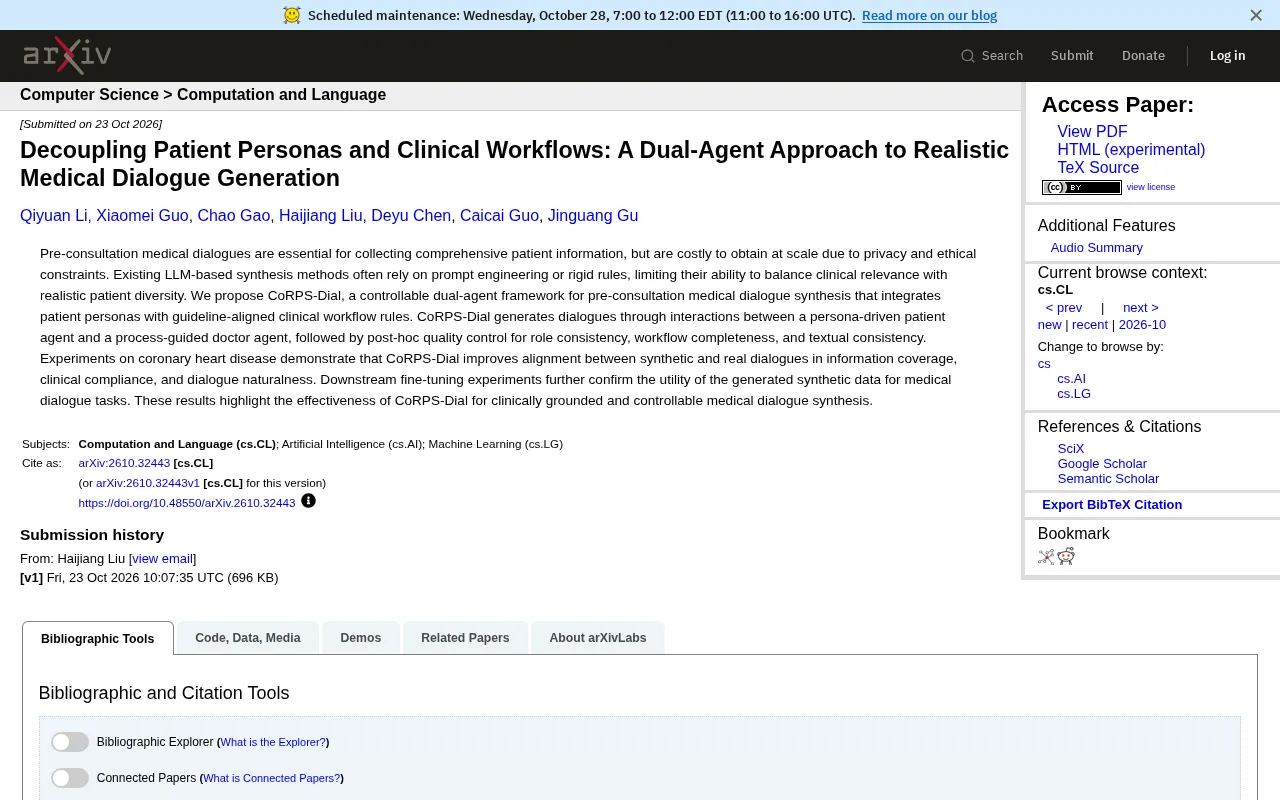
CoRPS-Dial decouples patient personas from clinical workflows with dual agents to synthesize highly compliant and diverse medical dialogues.
Medical dialogue data is hard to obtain at scale due to privacy and ethics, and existing LLM synthesis methods struggle to balance clinical compliance with patient diversity. The arXiv paper proposes CoRPS-Dial, using a dual-agent architecture to decouple these goals: a patient agent driven by structured personas, and a doctor agent following guideline-aligned clinical workflow rules. Generated dialogues pass three-fold quality control. In coronary heart disease scenarios, synthetic dialogues better approach real ones in coverage, compliance, and naturalness, with downstream fine-tuning validating practical utility. Limitations include single-department validation and expert-dependent rule construction.
Medical dialogue data is the fuel for training clinical AI, but real consultation dialogues are extremely difficult to obtain at scale due to privacy and ethical constraints. Existing LLM-based synthesis methods rely either on prompt engineering or hard-coded rules, and often trade off one goal for another between "clinical compliance" and "patient diversity." A paper from arXiv proposes the CoRPS-Dial framework, which attempts to resolve this tension with a dual-agent architecture.
Why Is Medical Dialogue Synthesis So Hard?
Pre-consultation dialogues need to satisfy two seemingly conflicting goals at once: on one hand, they must cover the complete clinical information-gathering process (chief complaint, history of present illness, past medical history, medication history, etc.); on the other hand, they must simulate the vastly different ways real patients express themselves—some ramble, some are sparing with words, some answer off-topic.
Single-agent approaches typically mix these two goals into a single prompt, resulting in dialogues that are either overly "standard patient" and unrealistic, or have patient personas that are too erratic, causing clinical information to be missing. The core insight of CoRPS-Dial is that patient personas and clinical workflows should be decoupled from the outset, carried by different agents.
CoRPS-Dial's Dual-Agent Design
Patient Agent: Persona-Driven
The patient agent is driven by a structured persona that includes the patient's background information, personality traits, expression habits, and health literacy level. The key design point is that persona parameters are independent of the clinical workflow—the same coronary heart disease workflow can be paired with an anxious elderly patient, a blunt middle-aged man, or a patient who mixes in medical jargon, thereby generating diverse dialogue samples while ensuring workflow completeness.
Doctor Agent: Workflow-Guided
The doctor agent does not rely on free-form improvisation but follows guideline-aligned clinical workflow rules. It advances the dialogue along a predefined consultation path, ensuring that key coronary heart disease–related information points are collected one by one. This hybrid approach of "workflow script + agent interaction" is more natural than pure rule templates and more controllable than pure prompt engineering.
Clinical workflow rules typically refer to structured consultation paths distilled from clinical guidelines or expert consensus—for example, in pre-consultation, modules such as chief complaint, history of present illness, past medical history, medication history, and allergy history need to be collected in sequence. Unlike free-form dialogue, workflow rules specify the key information items that must be covered under each module and allow certain branching and follow-up logic. Combining such rules with LLM agents is equivalent to using rules as the "skeleton" to ensure information completeness and using the language model as the "flesh" to enhance dialogue naturalness. This hybrid approach is increasingly common in clinical dialogue synthesis because it is more flexible than pure templates, more controllable than pure prompt engineering, and easier to audit for compliance afterward.
Post-Hoc Quality Control
Dialogues generated through dual-agent interaction also pass through a quality-control gate that checks three dimensions: role consistency (whether the patient maintains the persona throughout), workflow completeness (whether everything that should be asked was asked), and textual coherence (whether the dialogue is coherent and free of contradictions). Substandard samples are filtered out, and this post-processing layer significantly improves the usability of the synthetic data.
Role consistency in dialogue synthesis typically refers to whether an agent consistently maintains its preset persona traits—for example, tone, word-choice habits, and health literacy level do not drift. Workflow completeness measures whether all preset clinical information points have been collected, often using coverage metrics. Textual coherence focuses on whether dialogue turns are logically connected and free of self-contradiction. These three dimensions correspond respectively to "does it resemble a patient," "is it clinically appropriate," and "does the conversation flow smoothly," and are commonly used orthogonal perspectives for evaluating the quality of synthetic medical dialogues. Automated quality control usually employs another LLM as a judge (LLM-as-a-judge), or combines rule matching with classifier scoring.
What Do the Experimental Results Show?
The paper validated the approach in the coronary heart disease scenario. Synthetic dialogues showed improved alignment with real dialogues across three metrics: information coverage, clinical compliance, and dialogue naturalness. More importantly, downstream fine-tuning experiments—after fine-tuning a model on data generated by CoRPS-Dial, its performance on medical dialogue tasks verified the practical utility of these synthetic data, rather than merely looking good on surface metrics.
The significance of this result is that for synthetic data to be truly useful, it must not only pursue "resemblance" but also ensure sufficient clinical information density. CoRPS-Dial achieves both simultaneously through its decoupled design.
Downstream fine-tuning experiments are a key step in testing the practical utility of synthetic data: synthetic dialogues are used as training data to fine-tune a base model, which is then evaluated on real medical dialogue tasks (such as information extraction, dialogue state tracking, or response generation). If synthetic data only approaches real data on surface metrics (such as BLEU, ROUGE, or human naturalness ratings) but the fine-tuned model's capabilities do not improve, it indicates that the data lacks clinical information density or has severe distribution shift. Conversely, only improved downstream task performance can prove that synthetic data is "useful" rather than merely "similar." This evaluation paradigm is widely adopted in data synthesis research to distinguish surface realism from functional effectiveness.
Limitations and Extensions Worth Noting
The paper has so far experimented only in a single scenario—coronary heart disease. Constructing the workflow rules themselves requires domain expert input, and the cost of transferring across departments remains unclear. In addition, real patients' emotional fluctuations, dialectal expressions, and nonverbal information (such as pauses and tone) are still difficult to reproduce in text-only dialogue.
However, the idea of "decoupling persona from workflow" is generalizable. Any synthesis task that needs to control both content structure and surface diversity—such as customer service dialogues or educational tutoring dialogues—can borrow the dual-agent division of labor. The solution to the medical AI data shortage may not lie in larger models, but in smarter data generation architectures.
One-line Summary
CoRPS-Dial uses dual agents to decouple patient personas from clinical workflows, synthesizing highly compliant and diverse medical dialogues.
Paragraph Summary
Medical dialogue data is difficult to obtain at scale due to privacy and ethics, and existing LLM synthesis methods struggle to balance clinical compliance with patient diversity. An arXiv paper proposes the CoRPS-Dial framework, which uses a dual-agent architecture to decouple these two goals: the patient agent is driven by structured personas that simulate patients with different expression habits and health literacy levels; the doctor agent follows guideline-aligned clinical workflow rules to advance the consultation and ensure key information points are collected. Generated dialogues then undergo three-fold quality-control filtering for role consistency, workflow completeness, and textual coherence. In the coronary heart disease scenario, synthetic dialogues more closely approach real dialogues in information coverage, clinical compliance, and naturalness, and downstream fine-tuning experiments also verify the data's practical utility. Limitations include single-department validation, rule construction depending on experts, and unclear cross-scenario transfer costs.
Related articles

Can Nuclear War Really End Civilization? A Scientific Look at Common Misconceptions
Can nuclear war end civilization? This article examines the physics of nuclear weapons—blast, fallout, and urban fires—distinguishing airbursts from groundbursts, dose from contamination, and explaining why nuclear war is a massive disaster but not an extinction event, while exploring key factors for post-strike social reconstruction.

The Truth Behind Titanic's Sinking: Key Decisions and Communication Failures in the National Geographic Documentary
National Geographic's The Unsinkable Ship uses survivor testimony to reconstruct Titanic's fatal decisions—from the missing MSG telegram prefix and the broken boiler-room-to-bridge link to how 'unsinkable' thinking delayed damage control and evacuation.

74M-Parameter Open-Source Model Partially Outperforms Jev AI in Testing
Fastino AI's Glider 2.5 models, with just 74M–300M parameters, reportedly outperform Jev AI in some guardrail benchmarks per YouTube testing, run on consumer hardware, and even play Doom. We analyze small models' competitiveness and deployment value on specific tasks.