Dual-Tier Sentiment Framework: How Multimodal UX Attribution Is Reshaping Search Experience Evaluation
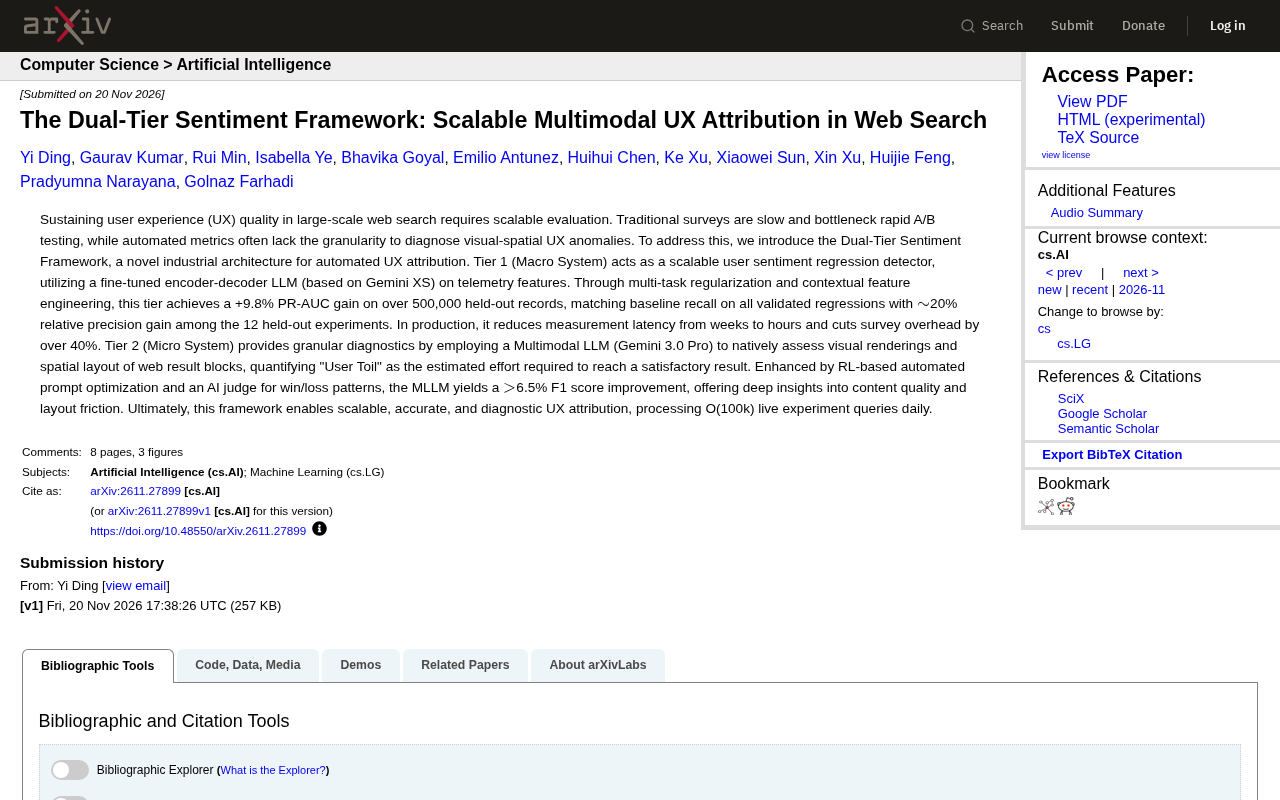
The Dual-Tier Sentiment Framework combines macro telemetry regression with micro multimodal diagnosis to enable scalable search UX attribution.
The article introduces an industrial-grade "Dual-Tier Sentiment Framework" for large-scale web search to replace slow surveys and overly coarse automated metrics. The macro tier, based on fine-tuned Gemini XS and telemetry features, acts as a scalable user sentiment regression detector, achieving +9.8% PR-AUC on 500K+ held-out records, about a 20% relative precision improvement, and reducing measurement latency from weeks to hours while cutting survey overhead by more than 40%. The micro tier uses Gemini 3.0 Pro to natively evaluate the visual rendering and spatial layout of web result blocks, quantifying "User Toil" as the effort required to reach a satisfactory result, and combines RL-based automatic prompt optimization with an AI judge to achieve an F1 improvement of over 6.5%. The two tiers form a closed loop from detection to diagnosis, balancing speed, cost, and attribution depth.
In large-scale web search, maintaining user experience quality depends on a scalable evaluation system. Traditional surveys are slow and drag down rapid A/B testing, while automated metrics often lack sufficient granularity to diagnose UX anomalies at the visual-spatial level. To address this, an industrial-grade architecture called the "Dual-Tier Sentiment Framework" is proposed to enable automated, scalable UX attribution.
Dual-Tier Architecture: Macro Detection and Micro Diagnosis
The core idea of this framework is to split UX evaluation into two complementary tiers. The first tier (macro system) serves as a scalable user sentiment regression detector, built on a fine-tuned encoder-decoder LLM (based on Gemini XS) and trained using telemetry features. Through multi-task regularization and contextual feature engineering, this tier achieved a +9.8% PR-AUC improvement on over 500,000 held-out records, matching baseline recall on all validation regressions across 12 held-out experiments with about a 20% relative precision improvement. In production, it reduced measurement latency from weeks to hours and cut survey overhead by more than 40%.
The second tier (micro system) provides fine-grained diagnosis, using a multimodal LLM (Gemini 3.0 Pro) to natively evaluate the visual rendering and spatial layout of web result blocks, quantifying "User Toil" as the estimated effort a user must expend to reach a satisfactory result. With reinforcement-learning-based automatic prompt optimization and an AI judge for win/lose patterns, this MLLM achieved an F1 score improvement of more than 6.5%, revealing content quality and layout friction issues in depth.
Technical Details: From Telemetry to Multimodal
Macro Tier: Sentiment Regression and Multi-Task Regularization
The macro tier is designed to capture overall trends in user sentiment at low cost and high speed. Rather than directly analyzing page pixels, it relies on telemetry features—behavioral signals from users during search. By fine-tuning the Gemini XS model and combining multi-task regularization, this tier can handle multiple related tasks simultaneously, avoid overfitting, and improve generalization. Contextual feature engineering further transforms raw telemetry signals into more predictive representations. In actual deployment, this tier processes O(100k) real-time experiment queries per day, becoming a fast feedback loop for A/B testing.
PR-AUC (Precision-Recall Area Under Curve) is a common metric for evaluating binary classification models on imbalanced datasets. Unlike ROC-AUC, PR-AUC focuses more on the recognition quality of the positive class (here, samples of "UX anomaly" or "sentiment decline"), and better reflects the model's practical value when the positive-negative ratio is highly skewed. It is calculated as the area under the precision-recall curve, ranging from 0 to 1; a higher value indicates that the model's precision declines more slowly while maintaining high recall. The +9.8% PR-AUC improvement reported for the macro tier means that at the same recall level, it can more accurately identify experiment regressions that truly need attention, thereby reducing ineffective investigation caused by false positives.
Multi-task Regularization refers to training multiple related prediction targets (such as sentiment score, click depth, session duration, etc.) simultaneously on a shared underlying representation, and suppressing overfitting by weighting each task loss or imposing consistency constraints. The principle is that related tasks serve as mutual inductive biases, forcing the model to learn more general telemetry feature representations rather than fitting only the noise of a single target. Compared with single-task fine-tuning, multi-task regularization usually brings more stable generalization performance in industrial telemetry scenarios with sparse labels or distribution shift.
Micro Tier: Multimodal Diagnosis and User Toil
The micro tier addresses the question the macro tier cannot answer: why does user sentiment decline? It leverages the multimodal capabilities of Gemini 3.0 Pro to directly "look" at the rendering and spatial layout of web result blocks. This native visual evaluation can capture layout friction missed by traditional metrics—for example, improper spacing between result blocks, confusing information hierarchy, and excessive visual noise. The introduction of the "User Toil" metric transforms user experience from abstract satisfaction into a quantifiable effort cost: how many scrolls and clicks a user needs to find a satisfactory answer. Reinforcement-learning-driven automatic prompt optimization allows the MLLM's evaluation capability to continuously iterate, while the AI judge provides stable comparative signals through win/lose pattern analysis.
RL-based Automatic Prompt Optimization means treating prompts as learnable policies and using reinforcement learning signals (such as win/lose rewards given by an AI judge or consistency scores with human annotations) to iteratively update the instructions, examples, and constraints in prompt templates. Compared with manually rewriting prompts repeatedly, this process can automatically search a larger prompt space, making the multimodal LLM's evaluation output more stable and better aligned with business definitions. Part of the MLLM's F1 improvement of more than 6.5% in the article comes from this continuous optimization mechanism.
AI Judge is an evaluation paradigm that uses a strong model to perform pairwise comparisons of two candidate outputs and determine which is better, usually adopting a "win/lose pattern" rather than absolute scoring to reduce score drift. Its advantage is that it can generate comparative signals at scale for prompt optimization and model iteration; its risk is that the judge's own bias can propagate into the optimization objective, so industrial deployment usually requires periodic manual spot-check calibration to ensure that automated judgments remain consistent with real user experience judgments.
Industrial Value: Speed, Cost, and Diagnostic Depth
The industrial value of the dual-tier framework is reflected in three dimensions. In terms of speed, measurement latency is compressed from weeks to hours, greatly shortening the iteration cycle of A/B testing so teams can validate hypotheses faster. In terms of cost, survey overhead is reduced by more than 40%, reducing dependence on slow manual feedback. In terms of diagnostic depth, the fine-grained attribution capability provided by the micro tier allows teams not only to know "the experience got worse" but also to pinpoint "which result block's layout caused friction." This closed loop from detection to diagnosis is exactly the key to continuously optimizing UX in large-scale search products.
The proposal of this framework also reflects a trend: the application of LLMs in industry is shifting from content generation to system evaluation. The encoder-decoder architecture handles structured telemetry data, while the multimodal model handles unstructured visual understanding; together they form a scalable, accurate, and diagnostically capable UX attribution pipeline. For teams facing similar evaluation bottlenecks, this dual-tier approach offers an architectural paradigm worth learning from.
One-line Summary
Dual-Tier Sentiment Framework combines macro telemetry regression with micro multimodal diagnosis to enable scalable search UX attribution.
Paragraph Summary
The article introduces an industrial-grade "Dual-Tier Sentiment Framework" for large-scale web search, intended to replace slow surveys and overly coarse automated metrics. The macro tier, based on fine-tuned Gemini XS and telemetry features, acts as a scalable user sentiment regression detector, achieving +9.8% PR-AUC on 500K+ held-out records, about a 20% relative precision improvement, and reducing measurement latency from weeks to hours while cutting survey overhead by more than 40%. The micro tier uses Gemini 3.0 Pro to natively evaluate the visual rendering and spatial layout of web result blocks, quantifying "User Toil" as the effort required to reach a satisfactory result, and combines RL-based automatic prompt optimization with an AI judge to achieve an F1 improvement of over 6.5%. The two tiers form a closed loop from detection to diagnosis, balancing speed, cost, and attribution depth.
Related articles

The Gemini 4 Trio and 3.8 Flash: A Full Comparison of Positioning, Pricing, and Benchmarks
A comparison of Gemini 4 Neon, Carbon, Argon, and Gemini 3.8 Flash: positioning, context, API pricing, Artificial Analysis and Arena benchmark scores, and available entry points.

AI Coding Model Leaderboard: Opus 5.5 Crowned, Gemini Neon Stages a Comeback
Tech blogger Matthew Berman releases an AI coding model tier list: Claude Opus 5.5 holds S-tier, Gemini Neon surprises with A-tier, OpenAI Astra lands B-tier. How do open-source models like DeepSeek fare? We break down the scoring logic and practical takeaways.

New Jersey Joe Sandwich: Meat and Coleslaw on Triple-Decker Rye
New Jersey Sloppy Joe isn't a ground beef burger—it's triple-decker rye bread with meat, Swiss cheese, and coleslaw, plus Russian dressing. Learn the authentic Essex County method and family recipe.