DuckDuckGo Courts Schools Amid Google AI Controversy

DuckDuckGo leverages the controversy over Google's AI policies to win over schools with privacy and the ability to disable AI features.
Against the backdrop of educators' dissatisfaction with Google over AI features that are enabled by default and difficult to disable, privacy-focused search engine DuckDuckGo is actively promoting its platform to schools, emphasizing that it does not track user data and offering the option to disable AI features. The article analyzes the root of Google's controversy—AI Overviews enabled by default, unclear use of student data, and schools' lack of control—while DuckDuckGo directly addresses these pain points with privacy protection and an AI switch, aligning with the education market's need for predictable, manageable, and compliant tools. This differentiated strategy does not seek to fully replace Google but instead exploits the mismatch between Google's policies and educational needs to build trust among conservative schools. The incident reflects that in the AI era, search competition is expanding from "who is smarter" to "who respects user choice more," and that transparency and controllability may be more important than feature innovation in education and scenarios involving minors.
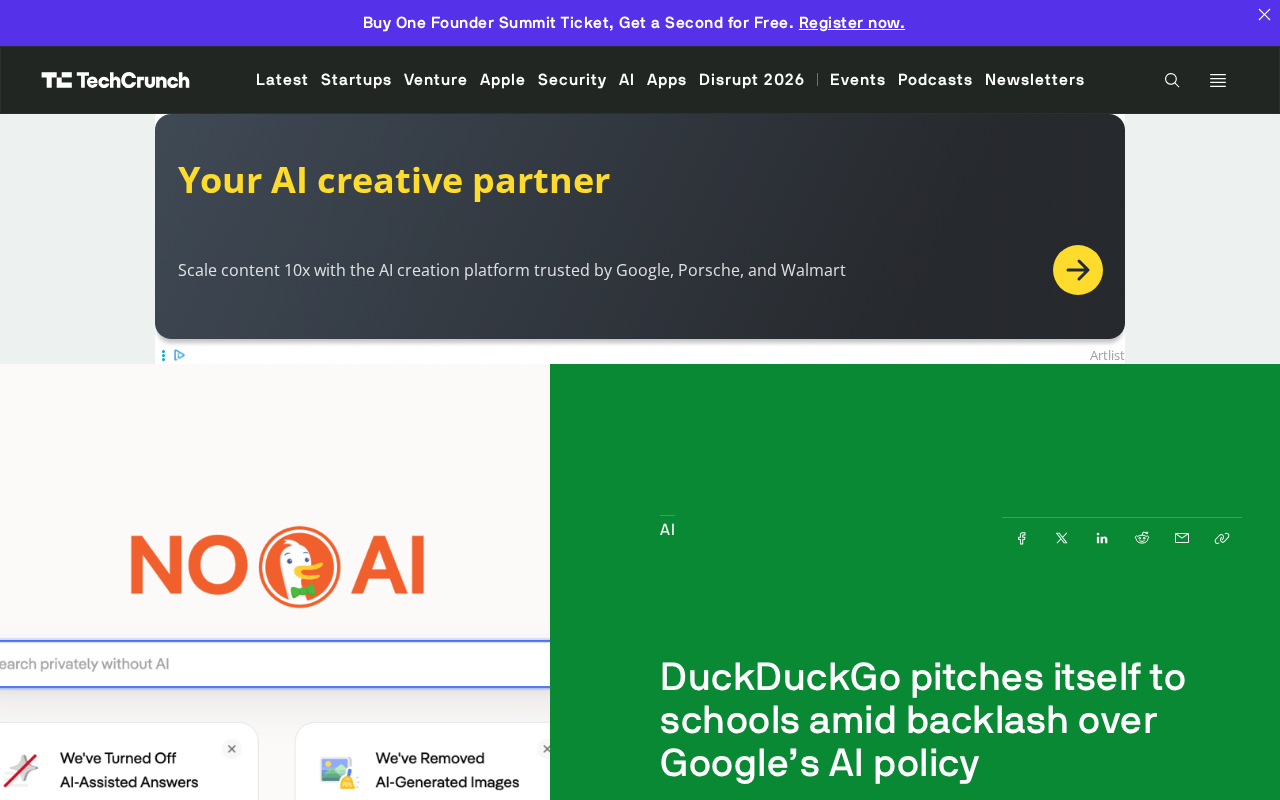
As Google faces backlash from the education sector over its AI policies, privacy-focused search engine DuckDuckGo is actively reaching out to schools, trying to persuade educators to switch to its platform by offering the option to disable AI features. This move reflects the education field's cautious attitude toward AI tools entering the classroom, as well as potential segmentation opportunities in the search market.
Why Google's AI Policies Are Causing Frustration in Schools
According to the original report, Google's recent policy adjustments regarding AI features have raised concerns among some schools. Although the report did not disclose specific policy details, it can be inferred that the controversy centers on AI-generated content being enabled by default, how student data is used, and schools' ability to control AI tools. For educational institutions, how to leverage AI to assist teaching while protecting student privacy and preventing academic misconduct is a dilemma.
As the world's largest search engine, Google's AI features (such as AI Overviews) are difficult to fully disable by default, which makes some schools that wish to maintain a traditional search experience uneasy. This dissatisfaction provides an opening for competitors.
AI Overviews is a generative AI feature launched by Google Search in 2024 that automatically generates a summary-style answer at the top of search results rather than merely listing links. The feature is enabled by default for certain queries, and users cannot completely turn it off in settings—they can only toggle it manually each time. For students, this means they may directly see AI-synthesized content when searching, bypassing original web pages, which both increases the risk of information accuracy issues and weakens students' ability to independently filter and evaluate information. For schools, the inability to uniformly disable the feature means it is difficult to maintain traditional information literacy instruction in the classroom and to ensure students are exposed to content with traceable sources—this is the technical root of the education sector's dissatisfaction with Google's policy.
DuckDuckGo's Response: The Privacy Card and an AI Switch
DuckDuckGo's response strategy directly addresses the pain points: it emphasizes the privacy protection features of its search engine to educators and offers the option to disable AI features. This means schools can obtain a more controllable environment with less AI interference without sacrificing search functionality.
DuckDuckGo has long positioned itself around not tracking users and not collecting personal data, which has natural appeal in educational settings. Schools typically have strict requirements for data privacy, and DuckDuckGo's positioning fits this need perfectly. In addition, allowing AI features to be turned off gives schools the space to choose for themselves—neither completely rejecting technology nor being forced to accept default settings.
DuckDuckGo is a search engine founded in 2008 whose core selling point is privacy protection. Its core promise is not to track users' search history, not to build user profiles, and not to sell data to third parties. It mainly aggregates third-party index results such as Bing's, supplemented by its own crawler. Unlike Google's business model, which relies on precise ad targeting, DuckDuckGo makes money through contextual advertising—displaying ads based on the current search term rather than user history. This model gives it natural credibility in privacy-sensitive scenarios (such as schools and medical institutions). In addition, DuckDuckGo also offers promotion programs for schools such as DuckDuckGo for Education, emphasizing a search experience with no tracking and no filter bubbles, which aligns closely with educational institutions' requirements for data compliance and content neutrality.
The Competitive Logic of the Education Market
The education market has different requirements for search tools than the consumer market. Schools need tools that are predictable, manageable, and compliant with privacy regulations—not the flashiest products. Google is advancing AI quickly, but education customers have longer decision chains and are more sensitive to stability and compliance.
DuckDuckGo's entry at this moment exploits the mismatch between Google's policies and educational needs. It does not need to replace all of Google's functionality—it only needs to build trust among schools that take a conservative stance on AI. This differentiated competitive strategy may help DuckDuckGo gain a foothold in a niche market.
The Balancing Challenge of Privacy and AI
This incident also reflects a broader industry issue: should AI features be enabled by default? Do users (especially minor students) have the right to choose not to be exposed to AI-generated content? DuckDuckGo's "AI can be turned off" option is in fact a response to these questions—it returns the choice to users.
For other AI products, this may serve as a reminder: in scenarios involving education and minors, transparency and controllability may be more important than feature innovation. Google's controversy shows that even with leading technology, ignoring users' need for control can lead to backlash.
Default-on is a key but often overlooked ethical and compliance issue in AI product design. Under frameworks such as the EU's General Data Protection Regulation (GDPR) and the U.S. Children's Online Privacy Protection Act (COPPA), processing minors' data requires verifiable parental consent and should follow the principle of data minimization. When AI features are enabled by default and may collect interaction data, schools as data processors face compliance risks. In addition, the principle of "minimizing distractions," widely cited in education, also argues that teaching tools should reduce unnecessary features. Therefore, "AI that can be turned off" is not just a product option but a design approach that returns control to users and meets regulatory requirements—in sharp contrast to Google's approach of enabling by default with no way to disable globally.
Conclusion
DuckDuckGo's overture to schools is a precise flanking attack. It does not compete head-on with Google on AI capabilities but instead seizes on educational institutions' anxiety about privacy and AI control. The direction of this contest will depend on whether schools are willing to give up the convenience of Google's ecosystem for controllability. Regardless of the outcome, it reveals a trend: in the AI era, the competitive dimensions of search products are expanding from "who is smarter" to "who respects user choice more."
One-line Summary
DuckDuckGo leverages the controversy over Google's AI policies to win over schools with privacy and the ability to disable AI features.
Paragraph Summary
Against the backdrop of educators' dissatisfaction with Google over AI features that are enabled by default and difficult to disable, privacy-focused search engine DuckDuckGo is actively promoting its platform to schools, emphasizing that it does not track user data and offering the option to disable AI features. The article analyzes the root of Google's controversy—AI Overviews enabled by default, unclear use of student data, and schools' lack of control—while DuckDuckGo directly addresses these pain points with privacy protection and an AI switch, aligning with the education market's need for predictable, manageable, and compliant tools. This differentiated strategy does not seek to fully replace Google but instead exploits the mismatch between Google's policies and educational needs to build trust among conservative schools. The incident reflects that in the AI era, search competition is expanding from "who is smarter" to "who respects user choice more," and that transparency and controllability may be more important than feature innovation in education and scenarios involving minors.
Related articles
 Tech Frontiers
Google Omni 1.2 Flash: 15-Second AI Video at Just $0.07 per Second
Google DeepMind releases Gemini Omni 1.2 Flash: 15-second video, 720p at $0.07/sec (30% cheaper), multi-turn editing without regeneration, draft upscaling to 4K.
 Tech Frontiers
No AI Ghostwriting: Writer's Quarter Reinvents Novel Writing with a Visual Workbench
The Writer's Quarter is an AI-free novel writing and planning tool that unifies character building, story planning, and manuscript writing in one visual workbench. This article analyzes its positioning, target users, and differentiated value amid the rise of AI writing tools.
 Tech Frontiers
Fleeep: A Unified Inspiration Collection Notes App for Creatives
Fleeep is a notes app for creatives that unifies screenshots, bookmarks, saved posts, and inspiration into one calm, cross-device, offline-capable space. This article analyzes its positioning, differentiation, and target users.