Dwarf Fortress Abandons Version Control Resistance: A Turning Point in 20 Years of Development

Dwarf Fortress developer Tarn Adams went from rejecting version control in 2013 to using it daily in 2023, reflecting the project's evolution from personal experiment to commercial product.
Dwarf Fortress developer Tarn Adams finally began using version control around 2023, ending his two-decade unconventional development habit. In 2013, he publicly rejected version control, seeing code committed into a "black box" without immediate benefits; by 2016, he framed it as self-awareness. The turning point came after the Steam release made workflow reliability unavoidable. The article notes that without version control there's no rollback, no diff, no safe branching, and difficulty locating bugs—Adams relied on exceptional memory for twenty years. The lesson: this is an extreme outlier, and version control's benefits show early.
The End of a Legend
Tarn Adams, developer of Dwarf Fortress, has finally started using version control. For players familiar with the project, this news carries significance far beyond a routine development tool update—it marks the end of a legendary habit spanning two decades.
The project is renowned for its astonishing simulation depth, from terrain generation to dwarven mood swings to the historical evolution of civilizations—nearly every system interweaves within a massive codebase. Precisely because of this, the fact that it operated without version control seems all the more incredible.
From 2013 to 2023: The Complete Trajectory of a Changed Attitude
Tarn Adams's rejection of version control was not stubbornness but a conscious choice.
The "Black Box" Concern
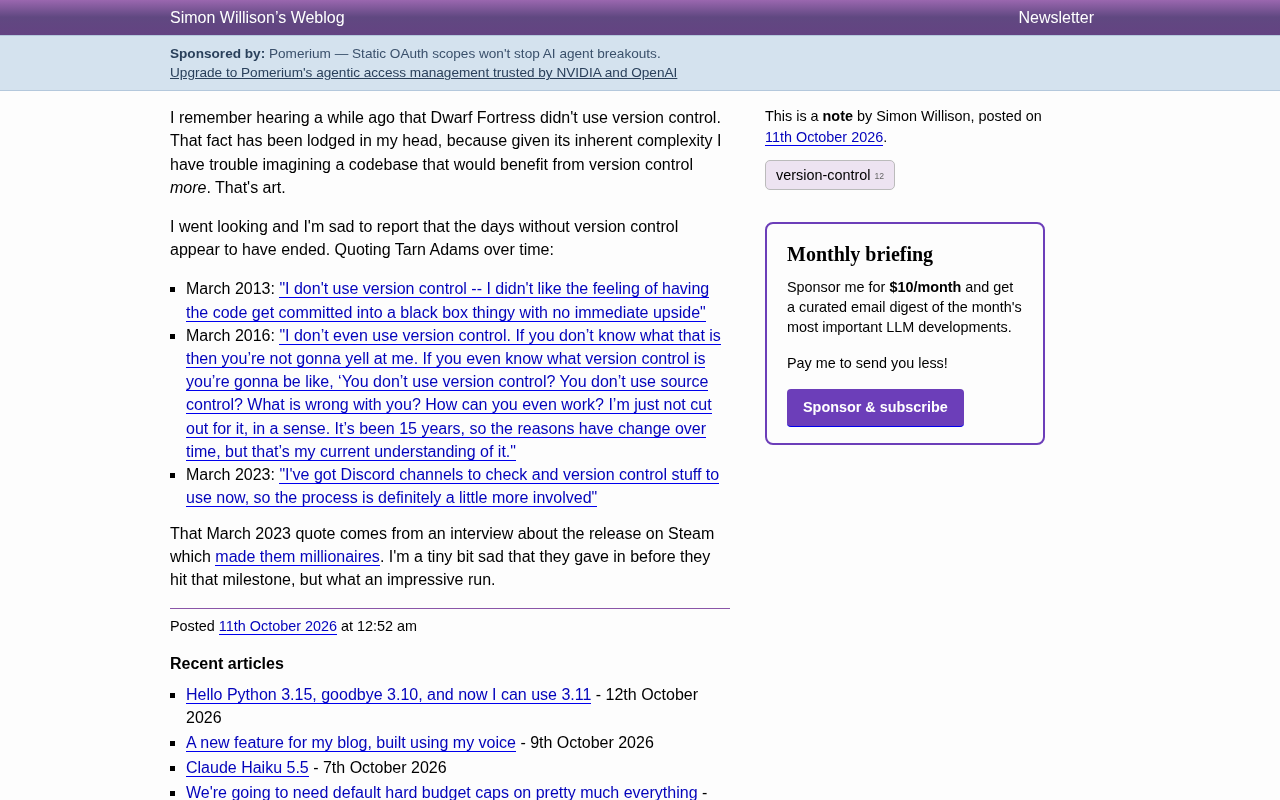
In 2013, he stated bluntly during a Reddit IAmA session:
"I don't use version control—I don't like the feeling of code being committed into a black box without seeing immediate benefits."
This statement directly articulates his core concern: version control, at the time, didn't offer sufficiently tangible returns for him.
"I'm Just Not Suited for It"
In a 2016 PC Gamer interview, his attitude seemed more like self-awareness:
"I don't even use version control. If you don't know what that is, you won't yell at me. But if you know what version control or source management is, you'd definitely ask, 'You don't use version control? What's wrong with you? How do you even work?' I'm just not suited for that stuff. It's been 15 years, the reasons have changed over time, but that's my current understanding."
There's an easily overlooked detail in this passage: he wasn't unaware of version control's value, but had long believed he couldn't fit into that way of working. For a solo-led project with strong continuity, this judgment wasn't necessarily unreasonable—after all, there were no merge conflicts, no branch management, and no rigid need for team collaboration.
Merge conflicts are the most criticized pain point of version control in multi-person collaboration: when two people modify the same area of the same file, the system cannot automatically decide which version to keep, requiring manual intervention. There's also branch management, commit granularity, history cleanup, and other operations requiring discipline. For a long-term solo-developed project, these costs are indeed nearly nonexistent—Tarn Adams's description of being "not suited" partly stems from this: he was facing a tool designed for team collaboration, while his working style happened to bypass its most core purpose.
The Turning Point Came in 2023
By the time of a 2023 Game Developer interview, his language had changed:
"I now have to check Discord channels and use version control and such, so the process has indeed become more complex than before."
This statement emerged against the backdrop of the Steam release. According to PC Gamer, the Steam launch made the developers millionaires. The Steam version brought not just revenue, but also more complex release processes, more frequent update cycles, and broader collaboration needs.
Why This Matters
The Cost of Not Using Version Control
The core value of version control lies in traceability and recoverability. For a project with logic as dense as Dwarf Fortress, any accidental deletion or regression error could require hours or even days of manual investigation. Without version control, this means:
- No ability to roll back to any historical version
- No way to use diff to compare changes before and after modifications
- No safe experimentation with new features through branches
- Difficulty pinpointing which change introduced a bug
Tarn Adams managed to develop continuously for twenty years under these constraints, relying on exceptional memory and code mastery. This itself is a rare development model.
Version control is a class of systems for tracking file change history, with Git being the most commonly used implementation. Its basic unit is the "commit," where each commit creates a traceable snapshot of the current code state, along with author, timestamp, and description. Developers can use it to roll back to any historical version, compare differences between two modifications (diff), experiment with new features on independent branches without affecting the mainline, and merge changes during multi-person collaboration. For solo projects, it provides at least two safeguards: accidentally deleted or corrupted code can be recovered, and bugs can be traced to a specific change. Because of this, modern software development almost universally treats version control as infrastructure rather than an option.
Why He Finally Changed
From the outside, the Steam release was clearly the catalyst. When a project shifts from "one person's long-term experiment" to "a formal product with commercial commitments and player expectations," process reliability becomes unavoidable. Discord community management, more frequent patch releases, potential collaboration needs—all of these push workflows toward standardization.
Tarn Adams hasn't publicly stated exactly when he started using version control, nor revealed whether he uses Git or another tool. But his 2023 statement clearly indicates that version control has become part of his daily work.
The Steam release for Dwarf Fortress wasn't just about putting up a store page. It meant paying users, refund policies, changelogs, platform review, and expectation management—pushing the project from "a continuously updated personal experiment" to "a product with commercial commitments." Such transitions amplify the cost of process flaws: an erroneous update that can't be rolled back could affect hundreds of thousands of paying players, while frequent patches demand rapid identification of regression issues. The Discord community further increased the density of communication and coordination. These factors combined turned version control from "an optional personal preference" into "an essential tool for maintaining release cadence."
Lessons for Indie Developers
The Dwarf Fortress example is easily misread as "you can succeed without version control." A more accurate interpretation is: it survived twenty years under extreme conditions through individual capability, and ultimately still turned to industry-standard tools.
For the vast majority of developers, the benefits of version control become apparent early in a project. Tarn Adams himself acknowledged that as the project scaled and external collaboration increased, the reasons against version control gradually lost validity.
This transition wasn't dramatic, nor accompanied by any public "I was wrong" declaration. It was merely mentioned in passing during an interview question, like something that should have happened long ago finally happening. For a project known for stubbornness and depth, this understatement may itself be the best footnote.
One-line Summary
Dwarf Fortress developer Tarn Adams went from rejecting version control in 2013 to using it daily in 2023, reflecting the project's evolution from personal experiment to commercial product.
Paragraph Summary
Dwarf Fortress developer Tarn Adams finally began using version control around 2023, ending his two-decade unconventional development habit. In 2013, he publicly expressed rejection of version control, believing code was committed into a "black box" without immediate benefits; by 2016, he described this choice as self-awareness. The turning point came after the Steam release: revenue, player expectations, Discord community management, and more frequent update cycles made workflow reliability unavoidable. The article notes that without version control, there's no rollback, no diff, no safe branching experiments, and difficulty locating bugs—Tarn Adams persevered for twenty years through exceptional memory and code mastery. The lesson for indie developers is that this is an extreme outlier; version control's benefits manifest early in a project.
Related articles

WorkBuddy Full Tutorial: Build an AI Office Automation Agent from Scratch
A complete WorkBuddy tutorial: installation, three working modes, multimodal picture book video practice, expert team agent building, and workflow configuration for low-cost AI office automation.

WorkBuddy Agent Complete Guide: From Beginner to Automation in 7 Days
Based on Bilibili's 256-episode WorkBuddy masterclass, this systematically breaks down Tencent's AI office workbench core capabilities: Agent principles, Skill encapsulation, cross-platform connectors, scheduled automation, knowledge bases, and zero-code development, with learning path recommendations.

8 AI Accounts, 7 Failed: An Honest Review of Using AI to Get Work Done
Only 1 of 8 AI-run Bilibili accounts succeeded. We break down the real difference between "performing AI" and "using AI to get work done."