Earlybird: A Speech Recognition Model That Predicts Words 90ms Early

Earlybird predicts speech 90ms before words finish using a 29M-parameter on-device model to cut voice agent latency.
Earlybird, an open-source model on Product Hunt, takes a counterintuitive approach to speech recognition: it predicts each word about 90ms before the speaker finishes saying it, with per-word confidence scores. At just 29M parameters and 17 MB, it runs entirely on-device with open weights and code, eliminating cloud round-trip overhead. Early prediction plus confidence lets voice agents start downstream intent understanding and tool calls sooner, compressing the response chain. The article also notes limits: accuracy varies with accent, speed, and noise, overturned predictions need rollback handling, and real benefits await integrator validation.
The bottleneck in voice interaction often comes down to one word: "waiting." The user finishes speaking, and only then does the voice assistant begin processing — that sense of delay directly determines whether the conversation feels natural. Earlybird, an open-source model that appeared on Product Hunt, tries to change this rhythm at its source: it doesn't wait for a word to be finished — it predicts ahead.
A Counterintuitive Design: Speak First, Listen Later
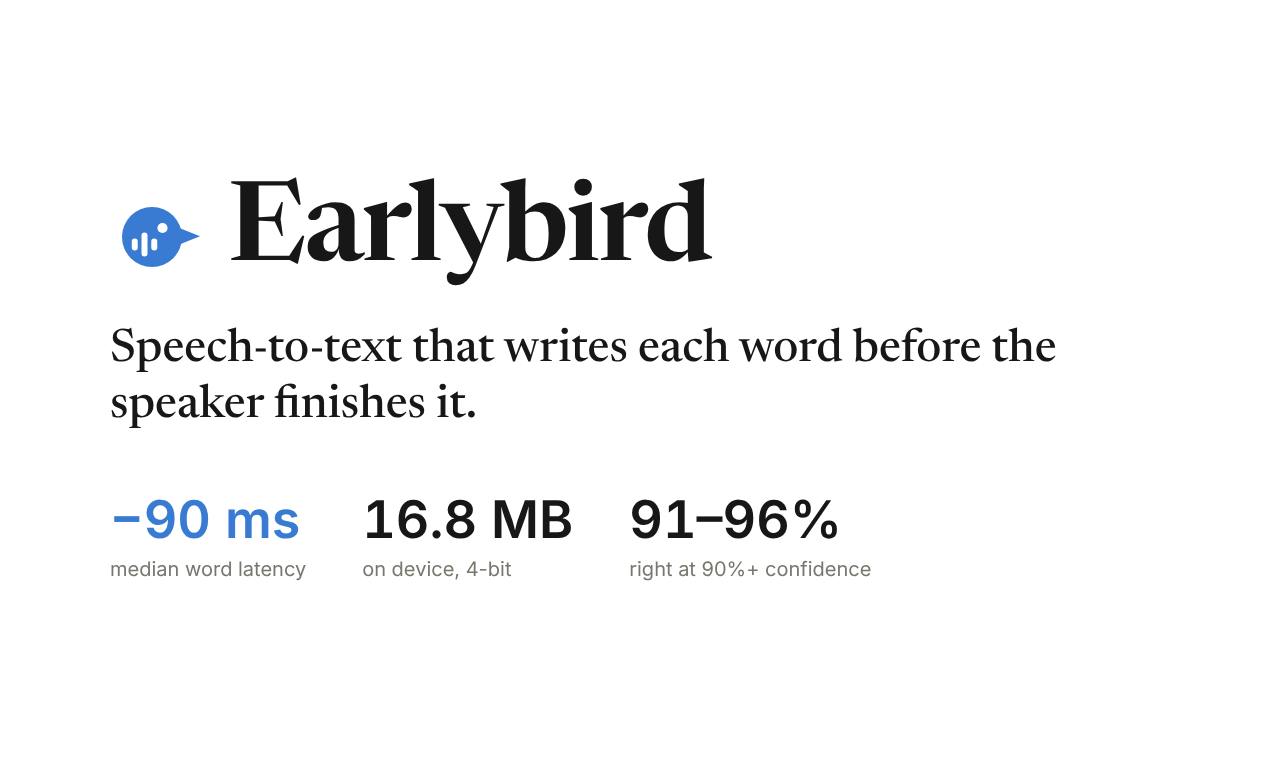
Earlybird's core proposition is written in its tagline — a 29M-parameter speech-to-text model that "outputs words before they're finished." Specifically, it can correctly predict each word about 90 milliseconds before the speaker finishes saying it, and it attaches a confidence score to every word.
This time window may seem tiny, but its significance for voice agents is different. Traditional streaming speech recognition is "transcribe while listening," but in essence it's still waiting for phonemes to fully land; what Earlybird does is "guess while listening," moving the act of prediction to the moment before the speech signal has completed. The model's size is also worth noting: 17 MB, running entirely on-device, with open weights and code.
Streaming ASR (Streaming Automatic Speech Recognition) refers to a model outputting text synchronously as audio is continuously fed in, rather than transcribing after the entire recording has ended. Traditional streaming approaches typically rely on structures like CTC (Connectionist Temporal Classification) or RNN-T, decoding progressively frame by frame or phoneme-block by phoneme-block, but the decoding unit still has to wait until the corresponding phoneme is essentially complete before outputting. Earlybird's difference lies in pushing the prediction timing even earlier: it produces candidate words and their confidence scores before a word has been fully spoken, effectively layering a "look-ahead prediction" on top of streaming recognition. As a result, the text it outputs may precede the full arrival of acoustic evidence, and this uncertainty needs to be managed via confidence scores.
Why 90 Milliseconds Early Matters
The turn-taking gap in human conversation is typically on the order of a few hundred milliseconds. If a voice assistant has to wait for the user to finish completely, then complete recognition, then start inference every time, the accumulated latency makes the interaction feel sluggish. Advancing word prediction by 90 milliseconds means downstream intent understanding and tool calls can start earlier, compressing the overall response chain.
More critically, there's the design of "every word has a confidence score." Early prediction inherently carries uncertainty, and confidence gives the system a basis for decision-making: when confidence is high, it can act first; when confidence is low, it keeps waiting. This makes "early" not equal to "risky," but rather a controllable trade-off.
Turn-taking gap is a concept from conversation analysis, referring to the pause between one party finishing speaking and the other beginning to vocalize — typically around 200 milliseconds in everyday human conversation. For a voice agent to feel natural, its end-to-end response latency should ideally approach this order of magnitude. But the full pipeline includes voice activity detection, ASR decoding, intent understanding, and tool calls, each of which adds latency. Earlybird advances word-level prediction by about 90 milliseconds, effectively buying extra budget for downstream stages; combined with per-word confidence, the system can trigger intent parsing early when confidence is high and continue listening when confidence is low — thereby compressing perceived latency without sacrificing accuracy.
The Engineering Trade-off of 29M Parameters and 17 MB
In an era of speech models with billions of parameters, 29M parameters is a deliberate act of restraint. A 17 MB footprint means it can run on edge devices without relying on cloud round-trips. For voice agent scenarios that demand low latency, the network overhead saved by on-device inference may be more directly impactful than optimizations to the model itself.
Open weights and code lower the barrier to verification. Developers can directly test the real-world benefits of early prediction on their own voice pipelines, without first having to trust vendor benchmark numbers.
On-device inference refers to a model running directly on a phone, PC, or embedded device rather than calling a cloud API. Its advantages are eliminating network round-trips (typically tens to hundreds of milliseconds) and protecting privacy; the cost is being constrained by the device's compute, memory, and power. A 17 MB model size is very friendly for on-device deployment — it can reside in memory or even be embedded in a browser or mobile app; but it also means limited model capacity, and robustness in noisy environments, with multiple accents, or in domain-specific terminology scenarios needs empirical validation. Open weights allow teams to fine-tune or distill on their own data to adapt to specific vertical scenarios.
Applicable Boundaries and Real-World Constraints
What needs to be viewed soberly is that early prediction accuracy is strongly correlated with language, accent, and speaking rate. The 90-millisecond lead holds under controlled conditions; in real-world scenarios, noisy environments, non-native pronunciation, and connected speech in fluent streams can all affect prediction hit rates. The confidence mechanism can mitigate some of these issues, but it is essentially a probabilistic tool, not a deterministic guarantee.
Another practical question: if a predicted word is overturned by subsequent audio, how does the system handle the rollback? This imposes new requirements on the fault tolerance design of downstream applications. Earlybird provides the capability; how to use it well still depends on the integrator.
Who Should Pay Attention
The most direct beneficiaries are teams building real-time voice agents — customer service bots, voice assistants, real-time captions, meeting transcription, and similar scenarios all have genuine needs for "getting text earlier." The on-device deployment characteristic also gives privacy-sensitive applications another option.
For researchers, this model offers an interesting sample: between parameter scale and latency, there exists a path different from "stacking bigger models." Open weights mean you can open it up and see exactly how it does it.
Earlybird currently has 71 votes and ranks 18th on Product Hunt — discussion heat isn't particularly high, but the direction it points to is worth noting: the next round of competition in voice interaction may not be about how accurately it recognizes, but about how early it recognizes.
One-line Summary
Earlybird uses a 29M-parameter on-device model to predict speech 90 milliseconds before words are finished, compressing voice agent latency.
Paragraph Summary
Earlybird, an open-source model on Product Hunt, proposes a counterintuitive speech recognition approach: instead of waiting for a word to be finished, it predicts each word about 90 milliseconds before the speaker finishes saying it, and attaches a confidence score to every word. The model has only 29M parameters and a 17 MB footprint, with open weights and code, running entirely on-device to eliminate cloud round-trip overhead. Early prediction combined with a confidence mechanism allows voice agents to preemptively start downstream intent understanding and tool calls when confidence is high, thereby compressing the overall response chain. The article also notes its boundaries: prediction accuracy is affected by accent, speaking rate, and noise; when early predictions are overturned, rollback fault tolerance design is needed; and real-world benefits still await validation by integrators.
Related articles

AI Writes Your Code—Do You Still Need to Learn Git? Five Reasons
AI coding agents handle Git operations automatically—is it still necessary to learn Git? Five reasons: team communication, reviewing agent PRs, monitoring code changes, fallback when AI goes down, and the joy of learning—plus how the focus of learning Git is shifting in the agent era.

Anthropic Reportedly Prices IPO at $83 Per Share, Valuing Company at $1.5 Trillion
Anthropic reportedly prices IPO at $83 per share, above the expected range, with a fully diluted valuation of $1.5 trillion. This article analyzes the signal significance of the pricing and its impact on the AI industry's financing environment.

Open-Source Code Hosting Platform Codeberg Suffers Outage, Sparking Debate in Developer Community
Open-source code hosting platform Codeberg.org suffered an outage, sparking Hacker News debate over nonprofit platform stability and open-source infrastructure dependency risks.