Edge Storage Network Upgrade, PG Log Compression, and Copilot Studio Conversation Runtime

Three updates from Edge, Azure PostgreSQL, and Copilot Studio jointly compress extra overhead and uncontrollable variables.
This developer news roundup covers three Microsoft ecosystem updates. Edge 1.56 switches newly created IndexedDB storage's underlying engine from LeveledDB to SQLite—API unchanged but runtime behavior may change; it also supports retrying failed module imports and lets WebTransport carry request/response headers during initial connection, so authentication info needn't go in URLs. Azure Database for PostgreSQL Flexible Server adds ZSTD compression for WAL in PostgreSQL 15/16/17, suited to write-intensive and cross-region replication scenarios, with component updates like PGVector. Copilot Studio's Customer Conversation Harness enters public preview with multi-agent orchestration, mixed generative and deterministic topics, and voice/digital channel session migration.
Edge 1.56: Storage Engine Overhaul and WebTransport Header Support
In Microsoft Edge 1.56, newly created IndexedDB storage will switch to SQLite at the underlying layer, replacing the previous LeveledDB. The official goal is to improve reliability and performance while keeping the IndexedDB API unchanged. This means existing code doesn't need to be rewritten, but runtime behavior may change. Teams that rely on underlying implementation details for performance tuning or troubleshooting should include this version in their regression testing scope.
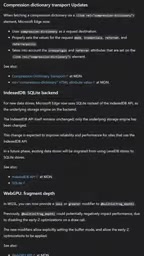
The same version also brings two network-side improvements. Failed JavaScript module imports can be retried after issues like network failures, reducing scenarios where module load failures cause application startup to hang. WebTransport now supports request and response headers during the initial connection phase, allowing applications to handle authentication, routing, and compatibility negotiation in headers—no need to stuff tokens into URLs or incur an extra round trip.
What's most noteworthy here isn't any single feature, but that browser version upgrades themselves can change critical runtime behavior—even if your application code hasn't changed a single line. Treating browser upgrades as dependency changes is becoming standard practice in frontend engineering.
IndexedDB is a client-side structured storage API provided by browsers, allowing web pages to persistently store key-value pairs and indexed data on user devices. It's commonly used for offline applications, caching, and large-scale frontend state management. It's a specification-level interface, and each browser can choose different underlying storage engines to implement it. Microsoft Edge previously used LeveledDB as the backend for newly created IndexedDB storage, and this time it's switching to SQLite. SQLite is a widely deployed embedded relational database known for transactional reliability and mature crash recovery mechanisms. The engine switch won't change IndexedDB's API semantics, but read/write performance characteristics, disk usage, concurrency behavior, and failure recovery paths may all differ. Applications with deep dependencies on the storage layer need to re-validate.
WebTransport is a modern browser transport API based on HTTP/3 and QUIC, designed for scenarios requiring low latency, multiplexing, and unreliable datagrams—such as real-time collaboration, cloud gaming, and streaming media. Compared to WebSocket, it's built on QUIC and supports independent data streams and bidirectional communication. Supporting request and response headers during the initial connection phase means clients can carry authentication tokens, routing labels, or protocol negotiation information when establishing sessions, which servers can directly read and respond to during the handshake phase. Previously, such information could often only be encoded into URL query parameters, which were both exposed in logs and could trigger extra authentication round trips. Header support merges connection establishment with identity and routing decisions into a single step.
Azure PostgreSQL: ZSTD Compression for WAL, a New Option for Write-Intensive Scenarios
The October maintenance release of Azure Database for PostgreSQL Flexible Server adds ZSTD compression support for write-ahead logs (WAL) in PostgreSQL 15, 16, and 17.
WAL is fundamental to recovery and replication, but it also genuinely consumes storage space and network bandwidth. ZSTD gives teams a new compression option for trading off between CPU overhead and WAL size—especially for write-intensive systems or replica scenarios requiring cross-region data transfer, where the benefits are more pronounced.
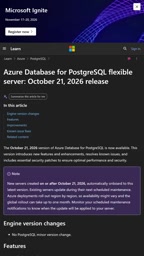
This version also updates PGVector to 0.8.7, non-extension to 3.2.2, Orpheus to 14.16.13, and includes security hardening. New servers automatically receive updates, while existing servers get them through scheduled maintenance during rolling releases across regions.

For operations teams, compression isn't the default answer. We recommend first comparing CPU usage and WAL transfer volume before and after compression on your own write workloads, then deciding whether to enable it on cross-region replication links.
The write-ahead log (WAL) is PostgreSQL's core mechanism for ensuring transaction durability and replication consistency: before any data page modification is written to disk, the corresponding change record must first be sequentially written to WAL. Therefore, WAL generation rate is directly related to write load, and in high-write systems it quickly accumulates into substantial storage usage while consuming significant network bandwidth during streaming replication or cross-region transfers. ZSTD is a modern general-purpose compression algorithm offering multiple levels from fast/low-compression-ratio to slow/high-compression-ratio, allowing adjustment between CPU overhead and compression benefits. Enabling ZSTD compression for WAL essentially trades additional CPU computation for smaller log size and lower transfer costs. Whether it's worthwhile depends on workload characteristics and replica link bandwidth.
Copilot Studio: Consumer-Facing Conversation Runtime Enters Public Preview
Microsoft has introduced the public preview of Customer Conversation Harness for Copilot Studio, a dedicated runtime and builder for consumer-facing scenarios covering both voice and chat channels.
In terms of capabilities, developers can orchestrate teams of multiple specialized agents, configure each agent with its own knowledge and tools, and combine generative capabilities with deterministic topics in the same system. Conversations can migrate between digital and voice channels while maintaining consistency. For scenarios requiring human handoff, context handover can be completed through Teams or existing call center systems.

The value of this design lies in making "when to let the model generate freely and when to follow deterministic flows" an explicit orchestration decision. Customer service scenarios have far higher requirements for predictability than general assistants. The existence of deterministic topics prevents critical paths from being undermined by model randomness, while multi-agent division of labor allows complex business to be broken into small blocks with clear boundaries.
Deterministic topics are a structured conversation unit in conversational AI orchestration, where developers predefine trigger conditions, conversation flows, and response logic, with the model not participating in free generation. In contrast, generative responses are produced in real-time by large language models based on context. In consumer-facing scenarios like customer service, critical paths such as refunds, identity verification, and order queries require predictable, testable, and auditable behavior—deterministic topics are designed precisely for this. Multi-agent orchestration breaks complex business into multiple agents each with specific responsibilities, with each agent bound to specific knowledge and tools, and the runtime deciding when to invoke which one. Combined, they allow the system to maintain flexibility while imposing hard constraints on critical processes.
The Common Logic Behind Three Updates
Looking at these three together: Edge moves authentication information from URLs to connection headers, reducing a round trip; PostgreSQL uses compression to directly cut WAL storage and bandwidth usage; Copilot Studio uses deterministic topics to constrain the boundaries of generative behavior. All three are compressing "unnecessary overhead" and "uncontrollable variables."
Practical recommendations for developers are layered: frontend teams should add Edge 1.56 to their regression matrix, focusing on validating IndexedDB-intensive read/write and module load failure recovery; data platform teams should do A/B comparisons of ZSTD on replica links; teams building customer service agents can apply for the preview and first get conversation migration between digital and voice channels and human handoff working.
One-line Summary
Three updates from Edge, Azure PostgreSQL, and Copilot Studio jointly compress extra overhead and uncontrollable variables.
Paragraph Summary
This developer news roundup covers three updates in the Microsoft ecosystem. Edge 1.56 switches the underlying engine for newly created IndexedDB storage from LeveledDB to SQLite—API unchanged but runtime behavior may change; it also supports retrying failed module imports and lets WebTransport carry request and response headers during the initial connection phase, so authentication information no longer needs to go into URLs. Azure Database for PostgreSQL Flexible Server adds ZSTD compression option for WAL in PostgreSQL 15/16/17, suitable for write-intensive and cross-region replication scenarios, and synchronously updates components like PGVector. Copilot Studio's Customer Conversation Harness enters public preview, supporting multi-agent orchestration, mixing generative and deterministic topics, and conversation migration between voice and digital channels. All three point toward reducing unnecessary overhead and constraining uncontrollable variables.
Related articles

AI SDK Workflow 2.0.95 Update: Stream Transform API Removed
AI SDK Workflow 2.0.95 removes the experimental_transform option from WorkflowAgent.stream() and the StreamTextTransform type export, as stream transforms cannot reliably cross workflow step boundaries. This article covers the reasons, migration points, and upgrade advice.

AI SDK Vue 4.0.163 Patch Released: Full Dependency Chain Update
AI SDK Vue releases patch 4.0.163, synchronously upgrading dependencies including ai@7.0.163 and @ai-sdk/provider-utils@5.0.75. This article analyzes the practical impact of this dependency chain update.

AI SDK Voyage 2.0.75 Patch Release: What the Dependency Chain Update Means
AI SDK's Voyage Provider releases patch version 2.0.75, syncing only @ai-sdk/provider and provider-utils deps. We analyze the impact and upgrade guidance.