Efficient Edge-aware Attention Network: A New Memory Optimization Approach for Graph Generative Models

Proposes an edge-aware attention layer compatible with FlexAttention, cutting memory by 65% and greatly boosting throughput.
Graph generative models often use graph-specific Transformers to jointly update node and edge features, but custom attention implementations struggle to leverage hardware-aware optimized kernels like FlashAttention, becoming a scalability bottleneck. The research introduces an edge-aware attention layer that injects structural information into attention scores via head-wise score modulation and updates edge representations with a lightweight residual mechanism, enabling efficient mapping onto PyTorch FlexAttention. Experiments show that compared with baseline graph-specific Transformers, the new architecture reduces peak GPU memory by approximately 65% with similar generation quality, while significantly improving training and sampling throughput. The authors consider this work a practical path toward scalable graph foundation models.
Graph generative models often use graph-specific Transformer architectures to jointly update node and edge features, yet they struggle to directly benefit from hardware-aware attention implementations, becoming a scalability bottleneck. A study titled "Efficient Edge-aware Attention Network for Graph Generation" proposes an edge-aware attention layer that injects structural information through head-wise score modulation and updates edge representations with a lightweight residual mechanism. Implemented via PyTorch FlexAttention, it maintains generation quality while reducing peak GPU memory by approximately 65% and significantly improving training and sampling throughput.
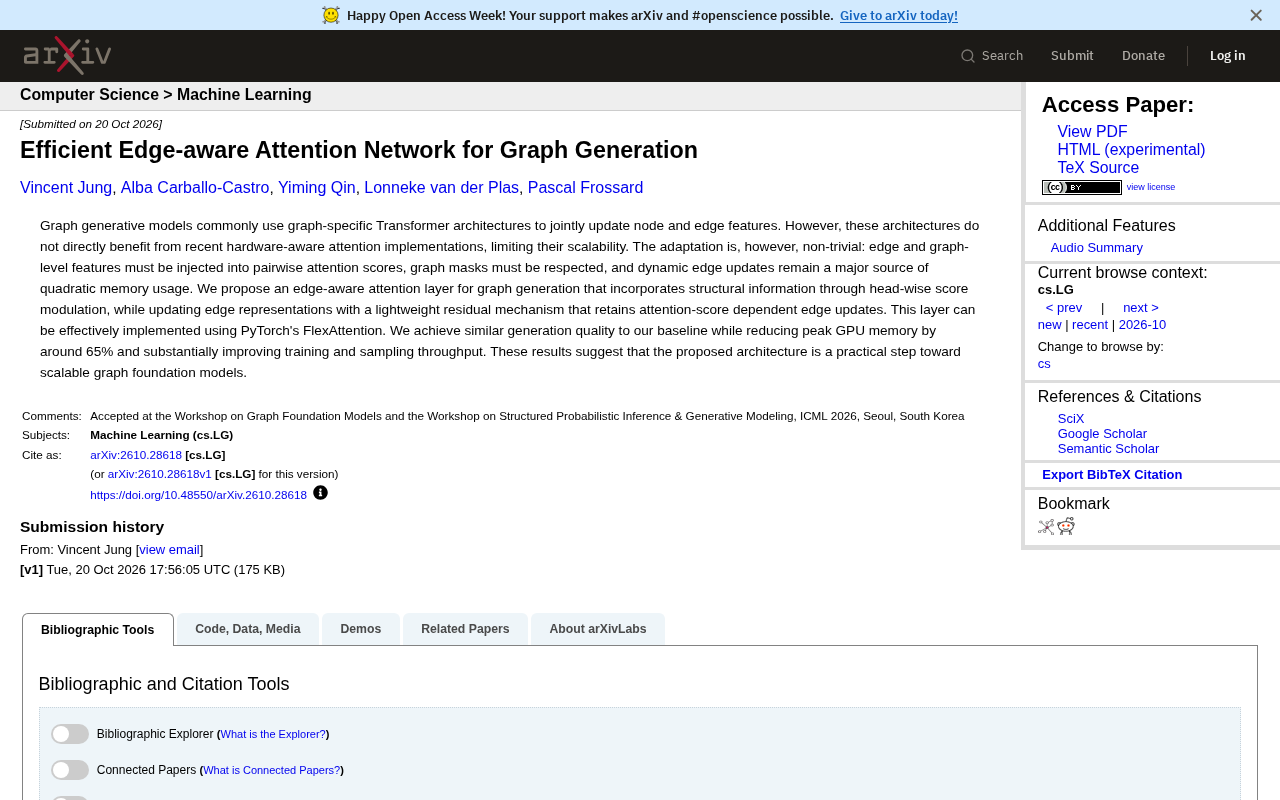
The Scalability Dilemma of Graph Generative Models
In graph generation tasks, jointly modeling nodes and edges is a core challenge. Mainstream methods adopt graph-specific Transformers that consider both node and edge features in attention computation. However, such custom implementations often cannot leverage hardware-aware optimized kernels like FlashAttention, leading to inefficient training and inference. More critically, edge-level and graph-level features need to be injected into pairwise attention scores, graph masks must be strictly respected, and dynamic edge updates incur quadratic memory overhead. The research points out that these factors together limit model scale growth, posing practical obstacles to building graph foundation models.
FlashAttention is a hardware-aware attention algorithm that, through tiling and recomputation strategies, reduces the memory complexity of attention computation from quadratic in sequence length to linear, and substantially reduces data movement between GPU high-bandwidth memory (HBM) and on-chip SRAM, thereby significantly accelerating training and inference in long-sequence scenarios. Its core idea is to avoid instantiating the full N×N attention matrix and instead compute softmax block by block in a streaming fashion. Since graph-specific Transformers typically need to inject edge-level and graph-level structural information into attention scores and strictly respect graph masks, these custom operations often cannot directly invoke optimized kernels like FlashAttention, forcing implementations to fall back to standard attention or hand-written CUDA kernels, losing the efficiency benefits of hardware acceleration.
Design Strategy of the Edge-aware Attention Layer
The core of the research is designing an edge-aware attention layer compatible with modern attention kernels. It incorporates structural information into attention computation through head-wise score modulation: each attention head applies a different modulation to the scores, thereby encoding edge information without breaking standard attention patterns. Meanwhile, edge representations are updated using a lightweight residual mechanism that preserves the edge update path dependent on attention scores, avoiding additional complex operations. This design allows the entire layer to be efficiently mapped onto PyTorch's FlexAttention, directly gaining the benefits of hardware acceleration.
PyTorch FlexAttention is a programmable attention interface introduced in PyTorch 2.5, allowing users to customize attention score modifications and masking logic through hooks such as score_mod and mask_mod, while the underlying system automatically generates fused efficient kernels, balancing flexibility and hardware acceleration. Its key value lies in enabling users to express graph-specific logic such as edge information modulation and graph masking as score modification functions without writing CUDA code, with the compiler mapping them onto tiled attention kernels. The edge-aware attention layer in this article precisely leverages this mechanism to express head-wise score modulation and lightweight residual edge updates as score modification patterns recognizable by FlexAttention, thereby achieving execution efficiency close to FlashAttention without sacrificing graph structural constraints.
Head-wise score modulation refers to assigning independent modulation parameters or functions to each attention head in multi-head attention, applying different transformations to attention scores rather than sharing a single structural injection scheme across all heads. Compared to superimposing a uniform edge bias on scores, head-wise modulation allows different heads to focus on different types of edge relations or subgraph patterns, enhancing the model's expressive capacity for heterogeneous structural information. Moreover, since modulation operates only at the score level without altering the overall attention computation graph, it is naturally compatible with the tiled computation flow of standard attention kernels, avoiding the hardware-unfriendliness caused by introducing additional tensor operations.
Performance Gains: 65% Memory Reduction, Substantial Throughput Improvement
Experimental results show that compared with baseline graph-specific Transformers, the new architecture maintains similar generation quality while reducing peak GPU memory by approximately 65%. This memory saving mainly comes from optimizing the memory footprint of dynamic edge updates and from efficiency improvements in attention implementation. In addition, both training and sampling throughput show substantial improvements, meaning the model can handle larger-scale graph data on the same hardware or complete training iterations faster.
Significance for Graph Foundation Models
The authors believe this work represents a practical step toward scalable graph foundation models. By combining structural information injection in graph generation with hardware-friendly attention implementation, the approach lowers the memory barrier, improves computational efficiency, and provides a viable path for future training of generative models on larger-scale graph data. Although still in the research stage, its ideas offer valuable reference for AI applications that need to handle complex graph structures.
One-line Summary
Proposes an edge-aware attention layer compatible with FlexAttention, cutting memory by 65% and greatly boosting throughput.
Paragraph Summary
Graph generative models often use graph-specific Transformers to jointly update node and edge features, but custom attention implementations struggle to leverage hardware-aware optimized kernels like FlashAttention, becoming a scalability bottleneck. The research introduces an edge-aware attention layer that injects structural information into attention scores via head-wise score modulation and updates edge representations with a lightweight residual mechanism, enabling efficient mapping onto PyTorch FlexAttention. Experiments show that compared with baseline graph-specific Transformers, the new architecture reduces peak GPU memory by approximately 65% with similar generation quality, while significantly improving training and sampling throughput. The authors consider this work a practical path toward scalable graph foundation models.
Related articles

Amphibious Transforming Drone: Beyond 100x Power Savings, What Are the Real Needs?
Is the amphibious transforming drone just a gimmick? Starting from the 100x power difference of the M4 Morphobot, explore real application scenarios and thesis topic ideas, analyzing boundary conditions where pure drones and pure ground robots both fail.

Warhound Raises $200 Million: Genetically Engineered "War Dogs" Paired with Anduril Gear
Warhound raises $200M, backed by Ben Lamm and Palmer Luckey, to genetically engineer dogs for military and law enforcement use and equip them with Anduril gear. This article analyzes its technology direction, funding logic, and ethical controversy.

Claude API Comes to Google Cloud: IAM Integration and SDK Access Guide
Anthropic hosts the full Claude API on Google Cloud with IAM-controlled permissions and unified billing. This guide covers the Vertex AI and Anthropic-hosted entry points, IAM role configuration, and SDK access.