Ekko Studio + Jev: Reducing Agent Wait Time at the Decision Layer

Jev isolates Agent decision-making into a lightweight scoring component so the main model can focus on execution.
Ekko Studio builds the Agent framework while Jev handles only judgment — returning selections, scores, and probabilities rather than natural language. This decouples decision-making from execution, reducing main model compute. In context compression and summarization, Jev filters for relevance while the LLM generates the output. Three use cases are covered: agent routing, workflow conditional logic, and pre-execution tool checks. Crucially, the authors are candid about limits: type correctness ≠ judgment correctness, confidence isn't accuracy, and Jev cannot replace permission checks or human approval. Real value must be validated with actual workflows.
In real-world AI Agent operations, a significant amount of time isn't spent on actual execution — it's consumed by a series of decision and filtering steps: which tool to call, how to compress an overly long context, how to distill summaries from massive amounts of material. The combination of Ekko Studio and Jev focuses its optimization efforts on this often-overlooked "selection layer," aiming to cut down on unnecessary waiting.
How Ekko Studio and Jev Divide Responsibilities
Ekko Studio handles the organization of agents and workflows — it's the framework layer for building Agent systems. Jev plays a distinctly different role: it doesn't chat or write code. Instead, it returns selections, scores, and probabilities for programs to use in decision-making.
In other words, Jev doesn't generate content — it makes judgments. Before a tool is called, Jev selects the appropriate one from a set of candidates and hands it off for execution. One important distinction to clarify: it accelerates the "selection" step, not the tool's execution itself.
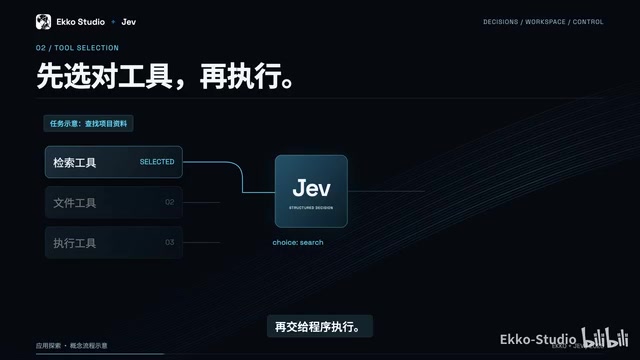
This design decouples "judgment" from "execution." In traditional pipelines, models often have to simultaneously figure out what to call and organize their language output — judgment and generation are tangled together. Jev separates the judgment out, using lightweight scoring and probability outputs to handle the decision-making role, freeing the main model to focus on tasks that genuinely require generative capability.
This "judgment-execution decoupling" architecture has roots in engineering practice. Traditional LLMs in Agent workflows often play a "full-stack" role — understanding intent, planning steps, and generating output — meaning every step consumes full inference compute. In recent years, the industry has increasingly moved toward isolating a "Router Model": a smaller, lower-latency specialized model handles classification and routing, reserving the heavy generative model's compute for tasks that actually require creation or reasoning. Jev fits squarely into this pattern — it's essentially a lightweight decision/scoring model whose output isn't natural language but structured probability and scoring signals for downstream programs to consume directly. The potential benefits of this design include reduced token consumption by the main model, lower average response latency, and more auditable and debuggable decision logic. The trade-off is increased system component count and the risk of errors introduced by the routing layer itself.
A New Approach to Context Compression and Content Summarization
When faced with very long contexts, Jev first evaluates the relevance of information, retains key constraints, and then hands the result to the original model for compression. Its role is to assist with filtering, not to directly generate compressed text.
Content summarization follows the same logic: first identify relevant material, then have the language model organize it into prose, and finally verify the key facts. Throughout this chain, Jev handles "material selection" and "fact-checking," while the language model handles "writing."
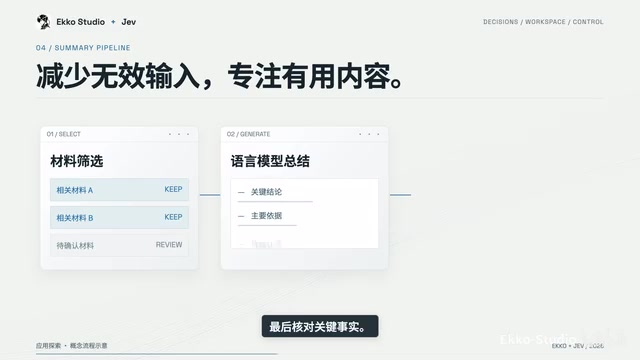
The goal of this design is clear: reduce irrelevant input. Stuffing a context with large amounts of unrelated information not only slows things down but can also interfere with the model's judgment. Running a relevance filter first should theoretically improve efficiency. That said, the authors are candid: whether this actually speeds things up in practice needs to be validated through testing — it's not a guaranteed outcome on paper.
Three Exploration Directions
Ekko Studio + Jev currently presents three concrete application directions, covering different parts of an Agent system.
Agent Routing
The first direction is selecting the appropriate agent from candidates based on task type. Development, analysis, and execution each take their own path, rather than running all agents simultaneously. This routing mechanism avoids redundant resource consumption and ensures each task type is handled by a more specialized actor.
Workflow Conditional Logic
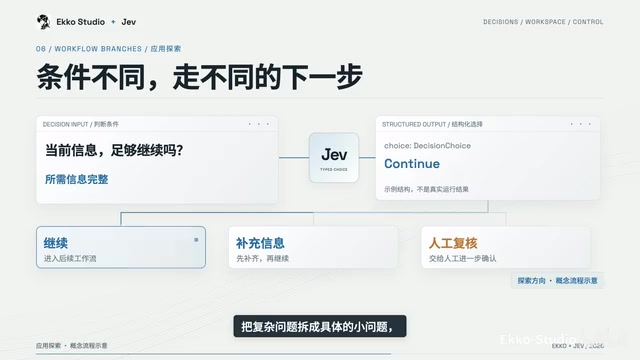
The second direction involves breaking complex problems into specific sub-questions, then combining results in code. When information is insufficient, context is supplemented; when uncertain, the task is escalated for review. This "decompose–judge–combine" pattern gives complex workflows branching and fallback capabilities.
Pre-Execution Tool Checks
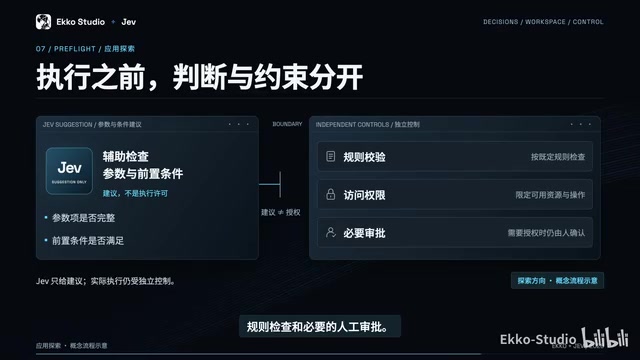
The third direction is providing an auxiliary check before tool execution — comparing parameters against task conditions and offering judgment recommendations. However, there is a clear hard limit here: it cannot replace permission validation, rule enforcement, or necessary human approval.
Boundaries Worth Recognizing Clearly
The most commendable aspect of this approach is precisely its candor about its own limitations. The authors repeatedly emphasize several boundary conditions.
"Type correctness doesn't mean judgment correctness" — even if the returned data format is valid, that doesn't mean the judgment itself is right. Confidence scores are likewise not guarantees; high-confidence results can still be wrong.
For real-world deployment, this means testing against actual tasks, setting appropriate thresholds, and preserving fallback paths for errors and uncertain cases. This is an engineering challenge that any system introducing probabilistic judgment into production workflows must face — the deeper a decision component sits in a critical path, the more essential a fallback mechanism becomes.
The "confidence" concept mentioned repeatedly here has a specific meaning in machine learning worth unpacking. A model's confidence score typically derives from the probability distribution of the softmax layer, reflecting the model's "subjective certainty" about its own prediction — not a guarantee of objective accuracy. A well-calibrated model's confidence scores should trend toward alignment with actual accuracy rates; in practice, however, many models are overconfident or underconfident. High-confidence incorrect judgments are especially common on out-of-distribution inputs. Therefore, before using a confidence threshold as a production-level routing criterion, you must first run calibration tests on real business data — you can't simply carry over threshold values from the development phase. Common engineering practices include: setting an intermediate zone where low confidence triggers human review rather than using a single threshold for binary decisions, and periodically re-evaluating threshold effectiveness with new data.
Closing Thoughts
The core value of Ekko Studio + Jev can be summed up in one sentence: make judgment lighter, let execution be more focused. It doesn't promise that tools will run faster — instead, it reduces unnecessary input and idle waiting by trimming the decision steps around selection, compression, and summarization.
For developers building complex Agent systems, the idea of making "decision-making" an independent component is worth paying attention to. But as the authors themselves acknowledge, its real value needs to be validated with real workflows — not left at the conceptual level. Before integrating it into a production environment, make sure you've thought through where the fallback paths and human approval steps should live.
Related articles

Random Pruning of the DPO Computation Graph: 1.4x Training Speedup and Lower Peak Memory
DPO training too slow and memory-hungry? This paper proposes a random pruning framework for the DPO computation graph, sampling independently across position, sequence, and branch dimensions; branch pruning achieves a 1.426x step-time speedup and cuts training time by about 30%, with in-depth attribution of memory and time gains.

Why Does JEPA Underperform MLM in Longitudinal EHR Representation Learning?
New study compares JEPA and MLM for longitudinal EHR representation learning on MIMIC-IV: three JEPA variants train stably without collapse but underperform MLM; target size, not heterogeneity, drives prediction error.

Transfer Learning + Visible Light Communication: A New Approach to Energy-Efficient Indoor Positioning
A study proposes a transfer learning-based visible light communication indoor positioning method, achieving 47% accuracy improvement on the BOSCH factory dataset, 67.5% model efficiency under high noise, and introducing the ME composite metric for energy-efficient positioning in energy-constrained industrial IoT scenarios.