El Yayster: A New AI Programming Paradigm with LLMs Living in Emacs
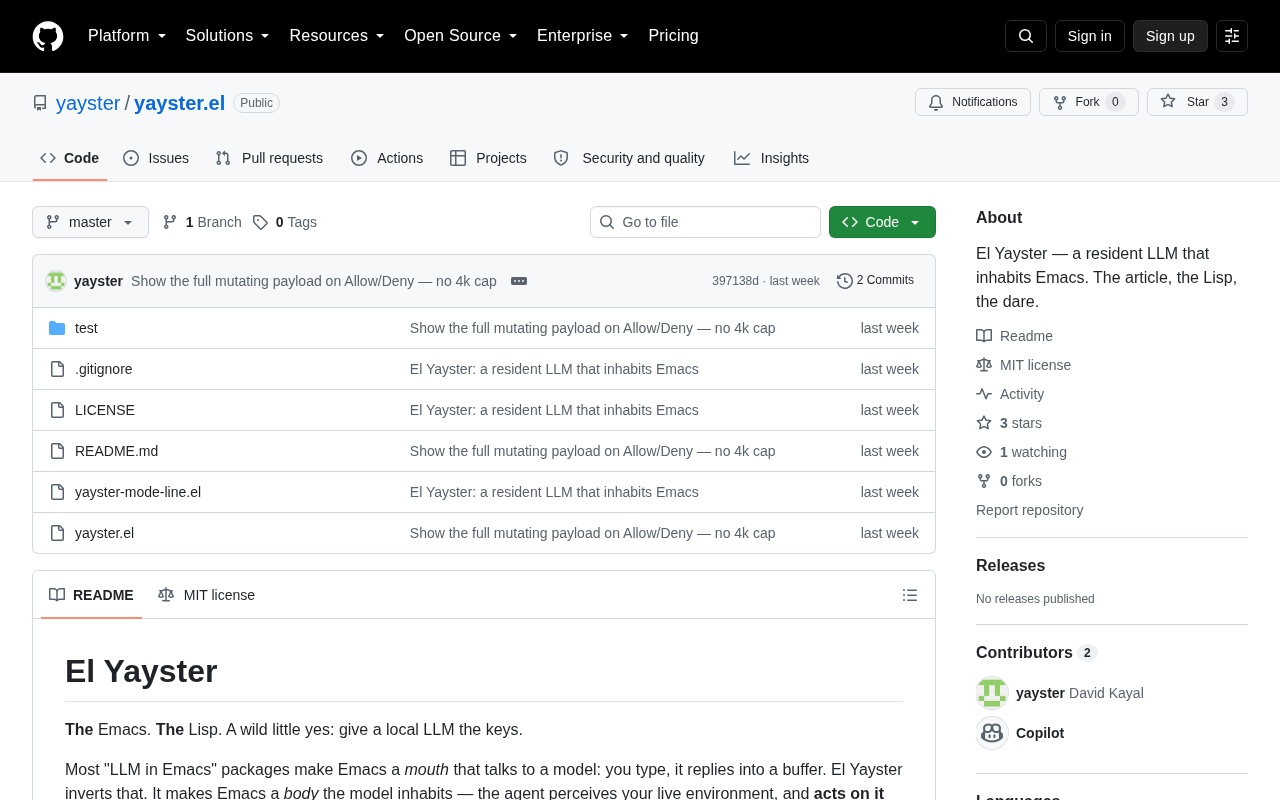
El Yayster makes LLMs resident in Emacs, redefining AI programming assistants as integrated partners.
El Yayster is an open-source project that explores making LLMs "resident" within Emacs rather than external chat tools. By deeply integrating with Emacs' Lisp environment, it enables AI to continuously sense editing context, buffers, and operations—representing a shift from "tool" to "cohabitant." While early-stage and facing challenges like token costs and privacy controls, it offers a novel paradigm for environment-native AI in development workflows.
When LLMs Move Into Your Editor
In today's landscape of proliferating AI programming assistants, most tools share a similar form: a sidebar chat window or inline code completion suggestions. Yet an open-source project called El Yayster has chosen a radically different path—it attempts to make large language models (LLMs) "resident" within Emacs, turning them into native inhabitants of the editor itself.
What is a Large Language Model? A Large Language Model (LLM) is a deep learning-based natural language processing model that learns statistical patterns and semantic relationships in language by pretraining on massive text datasets. Notable examples include OpenAI's GPT series, Google's Gemini, and Anthropic's Claude. These models excel at understanding context, generating coherent text, and completing various language tasks such as translation, summarization, and code generation. In programming, LLMs can understand code semantics, complete code snippets, explain technical concepts, and even perform code refactoring and bug fixes. They work by converting input text into token sequences, processing them through neural networks with billions of parameters, and ultimately predicting and generating the most probable subsequent content.
This project recently appeared on Hacker News. While it hasn't garnered much attention yet, its approach deserves notice from those working in AI and developer tools: rather than connecting an editor to an LLM, why not deeply integrate the LLM into the editor's workflow itself?
What Does "Resident" Mean?
The word resident in the project's name is key to understanding its design philosophy. Traditional AI programming plugins are more like "visitors"—you summon them when needed, they leave when done, and the model has only fragmentary awareness of your editing context. El Yayster emphasizes a "resident" state: the LLM exists continuously as part of the editing environment, persistently aware of your buffers, cursor position, content being edited, and even operation history.
Evolution of AI Programming Assistants: AI programming assistants have evolved through three main stages. The first stage, exemplified by GitHub Copilot (launched 2021), focused on code completion based on OpenAI's Codex model—providing single-line or multi-line code suggestions as developers type. The second stage saw conversational tools emerge, like Cursor, GitHub Copilot Chat, and JetBrains AI Assistant, allowing developers to communicate with AI in natural language to explain code, generate functions, and refactor code blocks. These tools typically include sidebar chat interfaces that understand selected code context. We're now entering a third stage—'Agentification' and 'Environment Integration,' where AI is no longer a passive response tool but an intelligent agent that actively perceives the development environment and executes multi-step tasks. These tools can understand project structure across files, automatically run tests, and even execute command-line operations.
This design aligns closely with Emacs' own philosophy. Emacs has never been just a text editor—it's an infinitely extensible Lisp runtime environment where email clients, file managers, terminals, and Org-mode note systems can all run. For Emacs users, having an LLM "move in" like any other subsystem is a very natural extension.
Why Emacs?
Choosing Emacs as the host for an LLM is no accident. Background on Emacs: Emacs is an extensible text editor born in 1976, created by Richard Stallman. Unlike ordinary editors, Emacs is essentially a Lisp interpreter with a core written in C, while most functionality is implemented through Emacs Lisp (elisp). This architecture gives Emacs exceptional extensibility—users can modify and extend any editor behavior at runtime. The Emacs community has developed thousands of extension packages covering code editing, project management, Git integration, note systems (Org-mode), email clients, and more. For experienced developers, Emacs isn't just an editor—it's an integrated working environment.
Emacs' entire environment is built on Emacs Lisp, and nearly all behavior can be programmatically read and modified. This means a resident LLM can:
- Directly access and manipulate content in any buffer
- Call editor internal functions and commands
- Sense the user's current mode (major mode) and context
- Execute actual editing actions through Lisp expressions
By contrast, editors like VS Code, while having larger ecosystems, impose stricter sandbox limitations on their extension APIs. VS Code's Extension Mechanism: Visual Studio Code is Microsoft's open-source code editor that has rapidly become the most popular development tool since its 2015 release. VS Code's extension system is based on the Extension API, using a strict sandbox model—extensions run in isolated processes and can only communicate with the editor core through restricted APIs. This design ensures stability and security: malicious extensions cannot directly access the file system or execute arbitrary system commands. But it also limits extension capabilities—for instance, extensions cannot modify the editor's core UI layout or intercept all user operations.
This 'programmable editor' philosophy contrasts sharply with modern IDEs' 'extension marketplace' model—the former allows users to directly modify editor kernel behavior, while the latter provides extension capabilities through restricted APIs. Emacs' high programmability makes it an ideal testing ground for this kind of "deep integration" experiment.
A Paradigm Shift from "Chatting" to "Cohabiting"
El Yayster reflects a subtle but important paradigm evolution in AI programming tools. First-generation tools (like early Copilot) solved the "completion" problem; second-generation tools (like Cursor and various Chat panels) solved the "conversation" problem. "Resident" LLMs attempt to answer a more fundamental question: Can AI become a continuously present, always-informed collaborator in the working environment?
The significance of this shift lies in reducing interaction friction. When the model is always aware of your context, you don't need to repeatedly copy-paste code, explain background, or switch between multiple windows. Ideally, AI assistance becomes an ambient capability of the environment—like syntax highlighting—rather than an external service requiring deliberate invocation.
Potential Challenges
Of course, the "resident" concept brings real-world challenges. Continuous context awareness means higher token consumption and API costs. About Tokens and Context Windows: In LLM applications, a token is the basic unit of text measurement, roughly corresponding to 0.75 English words or 0.5 Chinese characters. A model's 'context window' refers to the maximum number of tokens it can process in a single interaction. Early GPT-3 models supported only 4K tokens (about 3,000 words), while the latest GPT-4 Turbo, Claude 3, and other models support ultra-long contexts of 128K or even 200K tokens. For 'resident' LLMs, continuously sensing editor state means every interaction must send large amounts of contextual information—current file content, relevant file fragments, editing history, etc.—quickly consuming token quotas. Since most LLM APIs charge by token (GPT-4 is roughly $0.03/1K input tokens), the cost of continuous context awareness is not trivial. This is also the economic reason why most AI programming tools adopt 'on-demand invocation' rather than 'resident monitoring' modes.
Privacy and data boundary issues are also more prominent—a model that can read all buffers needs clear permission controls. Additionally, balancing "always present" with "non-intrusive" is key to whether such tools can be genuinely useful. As an early open-source experiment, El Yayster offers more of a possibility than a mature solution.
The Value of Open-Source Experiments
As an early-stage open-source project, El Yayster's value lies not in whether it will become a mainstream tool, but in exploring a direction overlooked by mainstream products. In an era when commercial AI programming tools are increasingly converging, "geek testing grounds" like the Emacs community often incubate genuinely novel interaction paradigms.
For developers, even if you don't use Emacs, the "environment-native AI" approach El Yayster represents is worth considering: future development tools may no longer be "editors with AI integrated," but rather "environments where AI and editing deeply coexist." This evolution from "tool" to "partner" may be the true next stop for AI programming.
Conclusion
El Yayster remains a niche community experiment with limited discussion and early-stage functionality. But its "resident LLM" concept offers a fresh perspective on understanding how AI integrates with development environments. In an era when everyone is building AI chat boxes, attempts to let models "move into the editor" are themselves explorations worth documenting.
Related articles

GPT-6 Astra Completes All 48 Levels of 'I'm Not A Robot' Game
GPT-6 Astra successfully completes all 48 levels of the 'I'm Not A Robot' game, demonstrating remarkable visual understanding, logical reasoning, and task adaptation. This article analyzes the technical capabilities behind this breakthrough and its implications for CAPTCHA verification and AI safety.
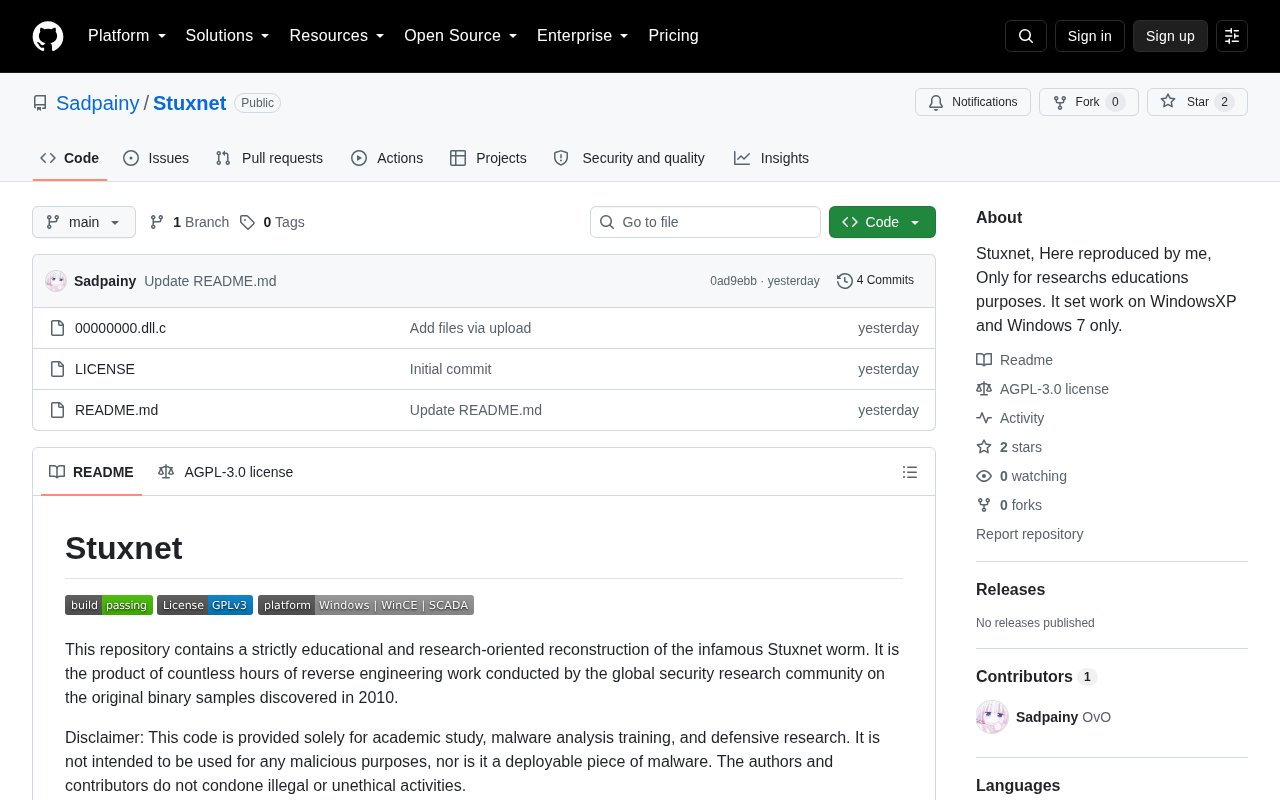
Stuxnet Source Code Reconstruction: Dissecting the Attack Chain of History's Most Complex Cyber Weapon
In-depth analysis of the Stuxnet source code reconstruction open-source project, examining how this cyber weapon targeting Iranian nuclear facilities exploited four zero-day vulnerabilities, stole digital certificates, covertly manipulated PLC centrifuges, and exploring industrial security lessons and ethical controversies of open-source reconstruction.
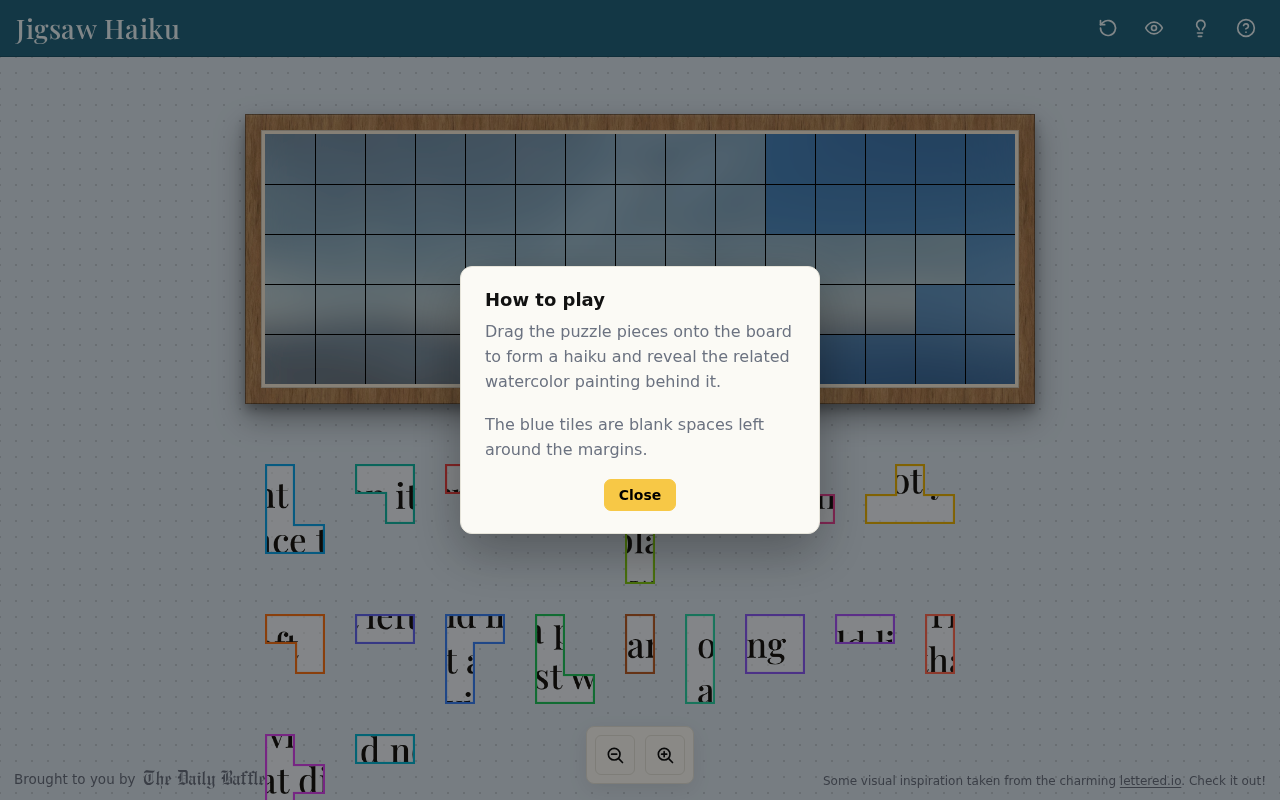
Minimalist Aesthetic Puzzle Game Development: Insights from Independent Creation
An in-depth analysis of an independent developer's aesthetic puzzle project shared on Hacker News, exploring minimalist design philosophy, Show HN community culture, and aesthetics-first product thinking in independent development.