EM-DETR: A Foundation Model for Medical Lesion Detection via Example-Based Grounding

Student-teacher strategy plus example-driven EM-DETR builds a multi-domain lesion detection foundation model from heterogeneous medical data.
To address scarce and heterogeneous annotated data in medical imaging AI, this study uses a student-teacher training strategy to integrate datasets with different label spaces, mitigating catastrophic forgetting and improving shared feature learning. It adapts the example-driven EM-DETR framework to multi-domain joint learning, enabling one model to perform fine-grained lesion detection across modalities such as X-ray and mammography. Image-level AUC on four key chest X-ray findings exceeds prior SOTA by about 1 point, and mAP50 on CXR and mammography is 2-3 points higher than single-dataset EM-DETR, confirming generalization gains from multi-domain training and offering a viable path to scalable foundation models from heterogeneous medical data.
Medical imaging AI has long been constrained by scarce and heterogeneous annotated data. A recent study proposes building a multi-domain lesion detection foundation model through an example-driven approach, achieving leading performance on chest X-rays and mammography.
The Data Dilemma in Medical Lesion Detection
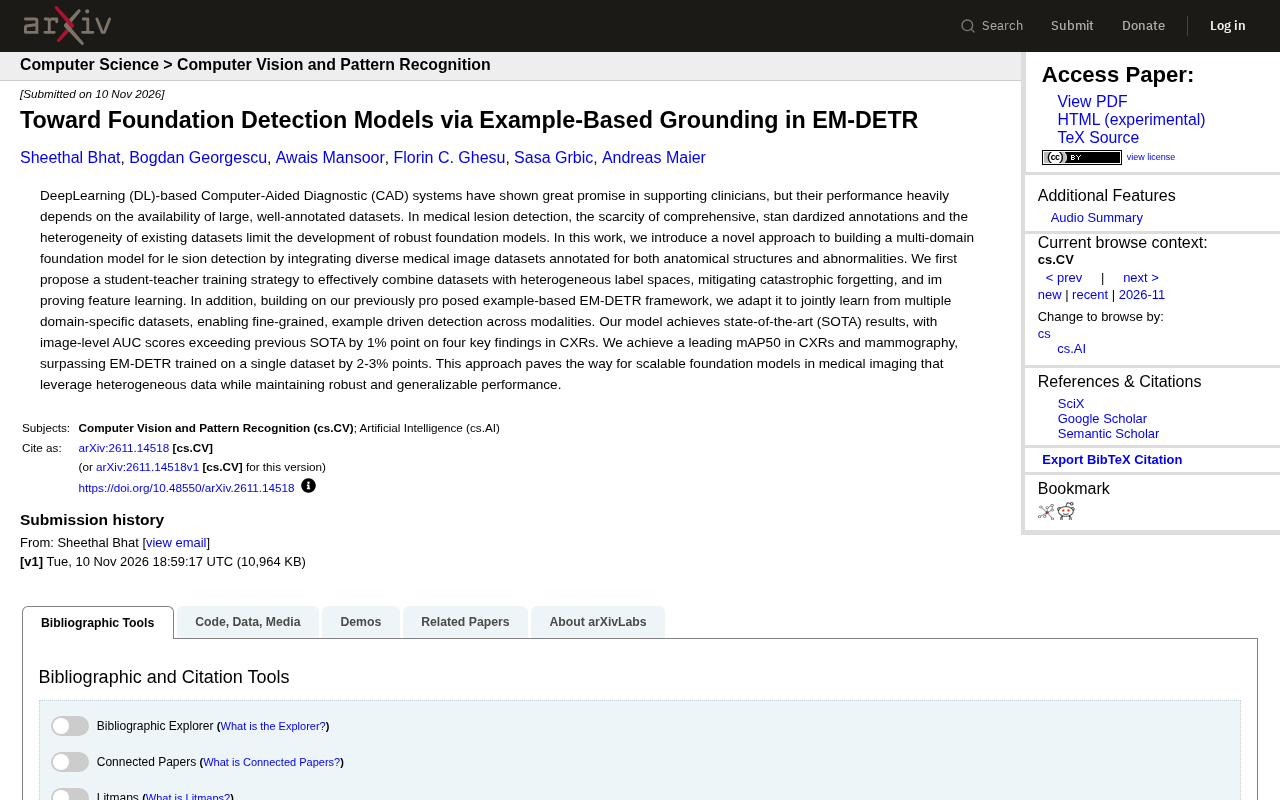
Deep learning-driven computer-aided diagnosis systems have shown promise in clinical support, but their performance depends heavily on large-scale, high-quality annotated data. In the field of medical lesion detection, comprehensive and standardized annotations are particularly scarce, and existing datasets are markedly heterogeneous—different datasets annotate different anatomical structures and abnormality types, making the label space difficult to unify. This directly limits the development of robust foundation models.
The research team's core idea is to integrate multiple medical image datasets that annotate different anatomical structures and abnormalities, building a multi-domain foundation model. However, simply mixing data introduces label conflicts and catastrophic forgetting, requiring dedicated training strategies.
Student-Teacher Training Strategy Solves the Heterogeneous Label Problem
To address the challenge of merging datasets with heterogeneous label spaces, the paper proposes a student-teacher training strategy. This method aims to effectively combine datasets with different label spaces, mitigate catastrophic forgetting, and improve feature learning.
The student-teacher framework is commonly used in medical imaging for semi-supervised learning and knowledge distillation, but here it is applied to align label spaces across datasets. The teacher model provides stable supervision signals while the student model learns on data from multiple domains, thereby preserving domain-specific discriminative information in a shared feature representation. This design enables the model to benefit simultaneously from data across multiple sources without losing previously learned knowledge when switching datasets.
Catastrophic Forgetting is a typical failure mode of neural networks when learning multiple tasks sequentially: when a model continues training on a new dataset or task, its weights shift substantially, overwriting previously learned knowledge and causing a sharp drop in performance on old tasks. In multi-dataset joint training, because different datasets differ markedly in label space, imaging modality, and abnormality types, the model can easily "lose one while gaining another" when the data distribution shifts. The student-teacher framework constrains the update direction of the student model by having the teacher model (typically a historical model or an exponential moving average version) provide stable soft supervision signals, thereby retaining discriminative ability on old domains while absorbing knowledge from new domains. This mechanism is widely adopted in continual learning and domain adaptation.
Example-Driven Extension of the EM-DETR Framework
Beyond the training strategy, the research team adapted their previously proposed example-based EM-DETR framework to the multi-domain joint learning setting. The core of EM-DETR lies in example-driven detection: the model localizes and identifies targets by referencing examples rather than relying solely on a fixed class classification head. This mechanism is naturally suited to scenarios with non-uniform label spaces, since examples can flexibly define detection targets.
The adapted framework can jointly learn on multiple domain-specific datasets, achieving cross-modal, fine-grained, example-driven detection. This means a single model can handle lesion detection tasks across different imaging modalities (such as X-ray and mammography) without training a separate model for each dataset.
Example-Based Grounding differs from the fixed class classification head in traditional object detection. Traditional detectors determine the set of classes during training and can only output predefined classes at inference; example-driven methods instead take a "reference example" (such as a cropped image with an annotated target region or a point prompt) as query input, and the model localizes regions semantically similar to the example in the target image through feature matching. The advantage of this paradigm is that detection targets are dynamically defined by examples, eliminating the need to redesign classification heads for each new class, making it naturally suited to multi-dataset scenarios with non-uniform label spaces and differing class systems. EM-DETR incorporates this idea into the DETR (Detection Transformer) architecture, leveraging Transformer's query mechanism to enable interaction between examples and image features.
Performance: Surpassing Previous State of the Art on Multiple Metrics
Experimental results show that the model achieves state-of-the-art performance. On four key findings in chest X-rays (CXR), the image-level AUC score exceeds the previous SOTA by 1 percentage point. On CXR and mammography, the model achieves leading mAP50, outperforming EM-DETR trained on a single dataset by 2-3 percentage points.
These improvements are practically meaningful in medical imaging detection tasks. AUC and mAP50 are core metrics for detection tasks, and consistent improvements across datasets indicate that multi-domain joint training genuinely enhances generalization rather than merely overfitting on a single dataset.
AUC (Area Under the ROC Curve) measures the model's overall ability to distinguish between positive and negative samples across different thresholds, with 0.5 equivalent to random guessing and 1.0 representing perfect discrimination; in image-level evaluation, it reflects the quality of the model's judgment on "whether an image contains a certain type of lesion" and is unaffected by class imbalance and threshold selection. mAP50 (mean Average Precision at IoU=0.5) is the standard metric for detection tasks: it first computes the area under the precision-recall curve (AP) for each class at an intersection-over-union (IoU) threshold of 0.5, then averages across classes, comprehensively measuring both localization and classification accuracy. The two metrics focus respectively on "presence judgment" and "localization precision," and reporting them jointly provides a more comprehensive reflection of the detection model's clinical usability.
Toward Scalable Medical Imaging Foundation Models
The significance of this work goes beyond metric improvements. It demonstrates a path to building scalable foundation models from heterogeneous data: handling label space differences through the student-teacher strategy, achieving cross-modal joint learning through the example-driven detection framework, and ultimately leveraging more data while maintaining robustness and generalization.
For medical imaging AI, annotated data will always be scarce, but the total volume of data accumulated across different hospitals, devices, and research projects is considerable. How to enable models to learn from this heterogeneous data rather than being hampered by label inconsistency is key to deploying foundation models. This study provides an actionable technical solution and leaves room for future extension to multimodal and multi-task scenarios.
One-line Summary
Student-teacher strategy combined with example-driven EM-DETR builds a multi-domain lesion detection foundation model from heterogeneous medical data.
Paragraph Summary
To address the scarcity and heterogeneity of annotated data in medical imaging AI, this study proposes using a student-teacher training strategy to integrate multiple datasets with different label spaces, mitigating catastrophic forgetting and improving shared feature learning. It also adapts the example-driven EM-DETR framework to multi-domain joint learning, enabling a single model to perform fine-grained lesion detection across modalities such as X-ray and mammography. Experiments show that image-level AUC on four key findings in chest X-rays exceeds the previous SOTA by about 1 percentage point, and mAP50 on CXR and mammography is 2-3 percentage points higher than EM-DETR trained on a single dataset, verifying the generalization gains from multi-domain joint training and providing a viable path toward scalable foundation models built from heterogeneous medical data.
Related articles

AI Writes Your Code—Do You Still Need to Learn Git? Five Reasons
AI coding agents handle Git operations automatically—is it still necessary to learn Git? Five reasons: team communication, reviewing agent PRs, monitoring code changes, fallback when AI goes down, and the joy of learning—plus how the focus of learning Git is shifting in the agent era.

Anthropic Reportedly Prices IPO at $83 Per Share, Valuing Company at $1.5 Trillion
Anthropic reportedly prices IPO at $83 per share, above the expected range, with a fully diluted valuation of $1.5 trillion. This article analyzes the signal significance of the pricing and its impact on the AI industry's financing environment.

Open-Source Code Hosting Platform Codeberg Suffers Outage, Sparking Debate in Developer Community
Open-source code hosting platform Codeberg.org suffered an outage, sparking Hacker News debate over nonprofit platform stability and open-source infrastructure dependency risks.