EmbeddingGemma 2 Released: A Native Multimodal Embedding Open-Source Model

Google open-sources EmbeddingGemma 2, unifying four modalities in one embedding model for private on-device retrieval.
Google's EmbeddingGemma 2 is an open-source multimodal embedding model that maps text, images, video, and audio into a unified embedding space, with up to 740M parameters optimized for edge hardware. It supports Matryoshka vector truncation (768-dim down to 128-dim) for flexible accuracy/storage trade-offs and an 8,000-token context window. Demos show fully offline natural language image search and video moment finding on-device without transcription or external APIs. Combined with lightweight generative models, it enables complete on-device RAG pipelines. Supports domain fine-tuning; weights available on Hugging Face.
Google's EmbeddingGemma 2 maps text, images, video, and audio into a single unified embedding space, breaking the long-standing reliance on multiple separate models for cross-modal retrieval. For developers looking to build search, retrieval, classification, and clustering systems on-device, this is an open-source model worth paying attention to.
One Model for Four Modalities
Traditional cross-modal retrieval typically requires three or more separate models — one for text, one for vision, one for audio — each needing to be aligned with the others. The core change in EmbeddingGemma 2 is that it maps text, images, video, audio, and any combination thereof into a single shared high-dimensional embedding space.
The official intuitive example: a photo of a cat, the word "cat," and the sound of a cat meowing would all be mapped to nearby positions in the shared embedding space. This means developers need just one model to simultaneously build search, retrieval, classification, and clustering capabilities across different data types — no need to maintain a collection of siloed sub-models.

From an engineering perspective, the biggest value of a unified embedding space is that it simplifies the entire retrieval pipeline. The most painful problem in legacy cross-modal systems was that vectors from different models lived in different coordinate systems, requiring additional bridging or projection layers. A single model means less deployment complexity and more consistent retrieval semantics.
Small Footprint, High Performance — Designed for On-Device Use
EmbeddingGemma 2 is explicitly targeting the sub-billion parameter space, and the official benchmarks claim it even surpasses much larger models on multiple evaluations, setting a new standard for this range.
The model uses a modular design with a maximum of 740 million parameters (740M) and outputs 768-dimensional vectors. Through Matryoshka Representation Learning (MRL), developers can truncate the output dimensionality down to as low as 128 dimensions — particularly practical for on-device scenarios sensitive to storage and retrieval costs, allowing flexible trade-offs between accuracy and efficiency.
The model supports an 8,000-token context window, sufficient for directly embedding long documents, codebases, or lengthy audio recordings on-device for subsequent search and retrieval. This parameter configuration reveals a clear design intent: bringing high-quality embedding capabilities to edge hardware like smartphones.

Matryoshka Representation Learning (MRL) is a vector compression training method named after Russian nesting dolls. The core idea is that during training, multiple dimension-truncated versions of the vector are optimized simultaneously, so that the first N dimensions of a complete high-dimensional vector (e.g., 768-dim) inherently form an effective lower-dimensional embedding (e.g., 128 or 256-dim) — no retraining or separate compression model needed. The key difference from traditional dimensionality reduction methods like PCA is that MRL-trained low-dimensional sub-vectors maintain semantic integrity, rather than losing information through post-hoc truncation. For on-device scenarios, this means developers can dynamically choose vector dimensionality based on device memory and latency budgets: use 768 dimensions for maximum accuracy when resources are available, and switch to 128 dimensions when storage or inference is constrained — with the underlying model remaining completely unchanged, greatly simplifying deployment and version management.
On-Device Testing: Natural Language Image Search and Video Moment Finding
Google demonstrated real-world performance through the Google AI Edge Gallery app. The first scenario is search — users can query photos and visual assets directly with natural language.
More interesting is the Video Moment Finder feature. In the demo, to find the "blowing out candles" moment in a birthday video, users simply search for "blowing out candles" and the model instantly locates that exact segment. The entire process runs directly on the phone, with no intermediate transcription step and no external API calls — meaning search can work completely offline.
This kind of on-device, offline, transcription-free retrieval experience is particularly appealing for high-frequency yet privacy-sensitive scenarios like managing video footage and organizing photo albums.
Pairing with Generative Models for On-Device RAG and Agents
EmbeddingGemma 2's bigger potential lies in pairing it with lightweight generative models to build RAG pipelines and agentic workflows that run entirely on-device, keeping sensitive user data on the hardware at all times.

Google demonstrated this capability in the AI Edge Foresight app: the app continuously monitors in the background, embedding audio streams, detecting questions posed by the user, immediately generating summaries, and retrieving corresponding system architecture diagrams from local storage. Since all embeddings are performed on-device, sensitive information remains strictly private.
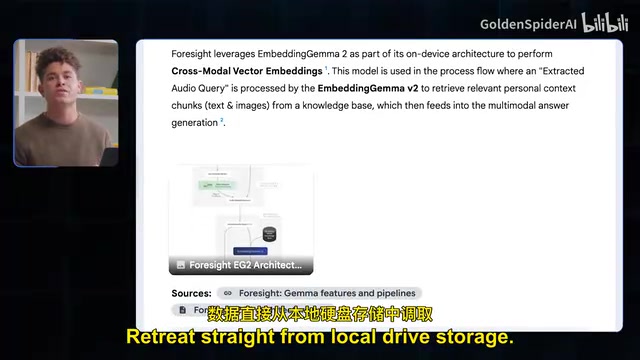
The value of this combination is bringing both "retrieval" and "generation" entirely local — eliminating the privacy risk of data transmission while reducing dependence on network connectivity and cloud APIs. This is especially critical for highly regulated domains like healthcare and legal services.
RAG (Retrieval-Augmented Generation) is an architectural paradigm that combines vector retrieval with large language model generation capabilities. The standard flow is: split knowledge base documents and convert them into vectors via an embedding model stored in a local index; when a user asks a question, it is likewise converted into a vector, matched against the index by similarity, the most relevant document chunks are retrieved, and these chunks are inserted as context into the generative model's prompt for the model to produce the final answer. This approach addresses hallucination and knowledge cutoff issues in pure generative models, while being far less costly than full fine-tuning. Running both core RAG components — the embedding model (EmbeddingGemma 2) and the generative model (e.g., a lightweight Gemma 2 variant) — on-device means the entire Q&A and retrieval pipeline can operate in a fully offline environment, and sensitive user data such as private documents and meeting recordings never passes through any external server.
Fine-Tunable for Vertical Domains
Beyond out-of-the-box quality, EmbeddingGemma 2 also supports fine-tuning for domain-specific vocabulary and specialized content — for example, building indexes for complex legal contracts, medical imaging, or technical product catalogs. Google emphasizes that this fine-tuning can improve retrieval accuracy without increasing model size.
In other words, developers can enjoy the deployment advantages of a small model while fine-tuning it into a domain expert — without having to adopt a larger model in pursuit of higher accuracy.
Model weights are now available for download on Hugging Face, and Google has provided accompanying notebooks in the Gemma Cookbook for hands-on practice. For teams focused on on-device AI and multimodal retrieval, this is a new option that's friendly to both cost and privacy.
Related articles

From Photons to Production: An Open-Source Computer Vision Engineering Reading Path
Reddit user open-sources a computer vision engineering reading path with 16 chapters from image formation to production deployment, emphasizing primary sources, dependency order, and reproducible benchmarks to help engineers understand why models fail and build reliable vision systems.

Prompt Failures? The Truth About Why AI Agents Struggle in Production—and How to Fix It
A Reddit developer built Agents with Copilot and Gemini but faced unstable behavior. This article analyzes three gaps in prompt engineering for Agent scenarios and offers three practical paths to reliable Agent deployment, including structured prompts, workflow-first approaches, and building an evaluation loop.

Tesla Robotaxi to Open Private Vehicle Access Next Year: Promise or Pipe Dream?
At its Q3 earnings call, Tesla said owners can add their cars to the Robotaxi fleet next year. We analyze the technical basis, Musk's missed deadlines, business logic, and competition.