EmbeddingGemma 2 Released: An Open-Source Multimodal On-Device Embedding Model with 740M Parameters

Google open-sources EmbeddingGemma 2, a 740M-parameter native multimodal embedding model built for on-device offline RAG.
Google has released EmbeddingGemma 2, an open-source natively multimodal embedding model with 740M parameters that supports unified vector representations across text, code, images, video, and audio. Unlike late-fusion approaches requiring adapter layers, it natively supports multimodality at the architecture level for more consistent cross-modal retrieval. Its lightweight, modular design suits deployment on phones and laptops, and it pairs especially well with Gemma 4 for fully offline, privacy-first RAG systems. Google claims it outperforms specialized models more than twice its size on some tasks, though independent validation is still needed. Weights are available on Hugging Face.
Google has introduced EmbeddingGemma 2, an open-source multimodal embedding model designed for on-device deployment. Positioned as a new efficiency benchmark for edge-side embedding models, its weights are now publicly available on Hugging Face for developers to download and use. For those who've been focused on local deployment and privacy-first applications, this is a new option worth exploring in depth.

A Natively Multimodal Embedding Model
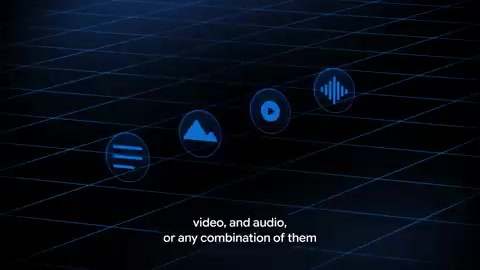
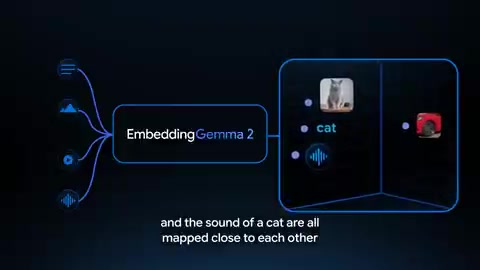
The most notable highlight of EmbeddingGemma 2 is that it's described as Google's first open-source, natively multimodal embedding model. Unlike many approaches that require additional adapter layers or late-stage fusion, it was designed from the ground up for multimodality — enabling a single model to handle text, code, images, video, and audio tasks.
Embedding models convert diverse content into unified vector representations, which is the foundational capability behind semantic search, similarity computation, and retrieval-augmented generation (RAG). Unifying multiple modalities in a single embedding space means developers can handle cross-modal retrieval and matching with one set of tools, without maintaining separate model pipelines for each data type.
What is an Embedding Model? An embedding model is a neural network that maps raw content into a high-dimensional vector space, where the output vectors preserve semantic relationships geometrically — content with similar meaning produces vectors that are closer together. The difference between "native multimodal" and "late-fusion multimodal" is this: the latter typically processes images and text separately with independent single-modal encoders, then fuses features through projection layers or attention mechanisms; whereas a natively multimodal model is exposed to data from multiple modalities during pretraining, allowing different content types to share the same representation learning mechanism — theoretically yielding more consistent cross-modal semantic alignment. This architectural difference is especially critical for cross-modal retrieval tasks (e.g., "find matching images using a text description"), where vectors must reside in the same comparable space rather than two independently calibrated spaces.
A Lightweight, Modular 740M Parameter Design
The model adopts a lightweight, modular architecture with 740M parameters. Compared to large models with billions or even tens of billions of parameters, the 740M scale makes it far easier to deploy on resource-constrained devices such as phones, laptops, or edge computing hardware.
The modular design philosophy is also worth noting. It means the model can be more flexibly trimmed or combined for different scenarios, allowing developers to make trade-offs based on their actual compute budget and task requirements. For teams that want to run inference locally rather than relying on cloud APIs, this parameter scale and architectural choice strikes a practical balance between performance and deployability.
Offline, Privacy-First RAG Scenarios
Google specifically highlights EmbeddingGemma 2's suitability for offline, privacy-first RAG scenarios — particularly when paired with Gemma 4. A typical RAG pipeline uses an embedding model to build a vector index over a document corpus, then retrieves relevant content at query time and passes it to a generative model for answering.
In this pipeline, the embedding model handles retrieval while the generative model handles generation. EmbeddingGemma 2 takes on the former role and Gemma 4 the latter, and together they can form a fully local question-answering system. This is especially valuable for applications handling sensitive data, operating without internet access, or with strict latency requirements — data never leaves the device, which substantially reduces privacy risk.
What is RAG? Retrieval-Augmented Generation (RAG) is an architectural paradigm that combines external knowledge bases with language models, designed to address issues like knowledge cutoffs, hallucinations, and the inability to inject private data into large models. Its core workflow has two phases: an offline indexing phase, where documents are chunked and converted into vectors via an embedding model and stored in a vector database; and an online retrieval-generation phase, where the user's query is also embedded as a vector, the most relevant document chunks are retrieved, and those chunks are injected as context into the generative model's prompt for it to answer accordingly. The challenge of local RAG is that both the embedding model and the generative model need to run on-device, which places high demands on memory bandwidth and compute. EmbeddingGemma 2's 740M parameter scale is a deliberate trade-off for exactly this constraint, enabling it to coexist with a lightweight generative model like Gemma 4 on the same device without resource conflicts.
Outperforming Larger Models
According to official claims, EmbeddingGemma 2 outperforms specialized models more than twice its size on certain tasks. If verified by independent benchmarks, this would be its most compelling selling point.
Specialized models are typically deeply optimized for a single modality or task, so a general-purpose multimodal model achieving competitive results at a smaller parameter count speaks to the quality of its training methodology and architectural design. That said, these performance claims currently come primarily from the official release, and real-world performance still needs to be validated by the developer community under actual workloads.
How Embedding Models Are Evaluated: The mainstream benchmark for evaluating embedding models is MTEB (Massive Text Embedding Benchmark), which covers task categories including retrieval, reranking, semantic textual similarity, and classification — and is the most widely cited comprehensive leaderboard in both academia and industry. Evaluating multimodal embeddings is more complex; common test sets include MSCOCO and Flickr30K (image-text cross-retrieval) and MSR-VTT (video-text retrieval). Specialized models often have an edge on specific benchmarks due to targeted fine-tuning, so when a general multimodal model achieves comparable results at smaller scale, it typically relies on higher-quality pretraining data mixtures and carefully designed contrastive learning objectives. When reviewing official performance claims, key details to watch include: the benchmark version used, the evaluation subsets, and whether the specialized models underwent equivalent fine-tuning — all of these factors can significantly affect the credibility of the comparison.
What This Means for Developers
EmbeddingGemma 2's weights are already available on Hugging Face, lowering the barrier to experimentation. Its open-source nature combined with its edge-friendly design makes it a ready-to-use foundational component for building local, privacy-sensitive applications.
As more applications pursue data localization and low latency, embedding models that combine multimodal capability with lightweight deployability are becoming both rare and important. The EmbeddingGemma 2 and Gemma 4 combination gives developers a fully cloud-free path to implementing RAG. That said, a word of caution: current information is largely drawn from official release documentation, and actual performance, fine-grained results across individual modalities, and comprehensive comparisons with competing models still need to be validated through broader real-world use.
Related articles

Random Pruning of the DPO Computation Graph: 1.4x Training Speedup and Lower Peak Memory
DPO training too slow and memory-hungry? This paper proposes a random pruning framework for the DPO computation graph, sampling independently across position, sequence, and branch dimensions; branch pruning achieves a 1.426x step-time speedup and cuts training time by about 30%, with in-depth attribution of memory and time gains.

Why Does JEPA Underperform MLM in Longitudinal EHR Representation Learning?
New study compares JEPA and MLM for longitudinal EHR representation learning on MIMIC-IV: three JEPA variants train stably without collapse but underperform MLM; target size, not heterogeneity, drives prediction error.

Transfer Learning + Visible Light Communication: A New Approach to Energy-Efficient Indoor Positioning
A study proposes a transfer learning-based visible light communication indoor positioning method, achieving 47% accuracy improvement on the BOSCH factory dataset, 67.5% model efficiency under high noise, and introducing the ME composite metric for energy-efficient positioning in energy-constrained industrial IoT scenarios.