Ember-1 Benchmarked: How Fewer Tokens Per Turn Cut AI Agent Costs

Ember-1 targets AI Agent cost reduction by consuming fewer tokens per turn across multi-step workflows.
Fireworks' Ember-1 model leads with token efficiency, backed by independent benchmark data from ValsAI showing lower per-turn token consumption. In AI Agent scenarios involving dozens of looped model calls, per-turn token savings compound across both cost and latency dimensions. Fireworks offers a Serverless API for easy A/B testing without GPU deployment, though developers should consult the full evaluation report before switching.
Ember-1's Core Value Proposition: Fewer Tokens Per Turn
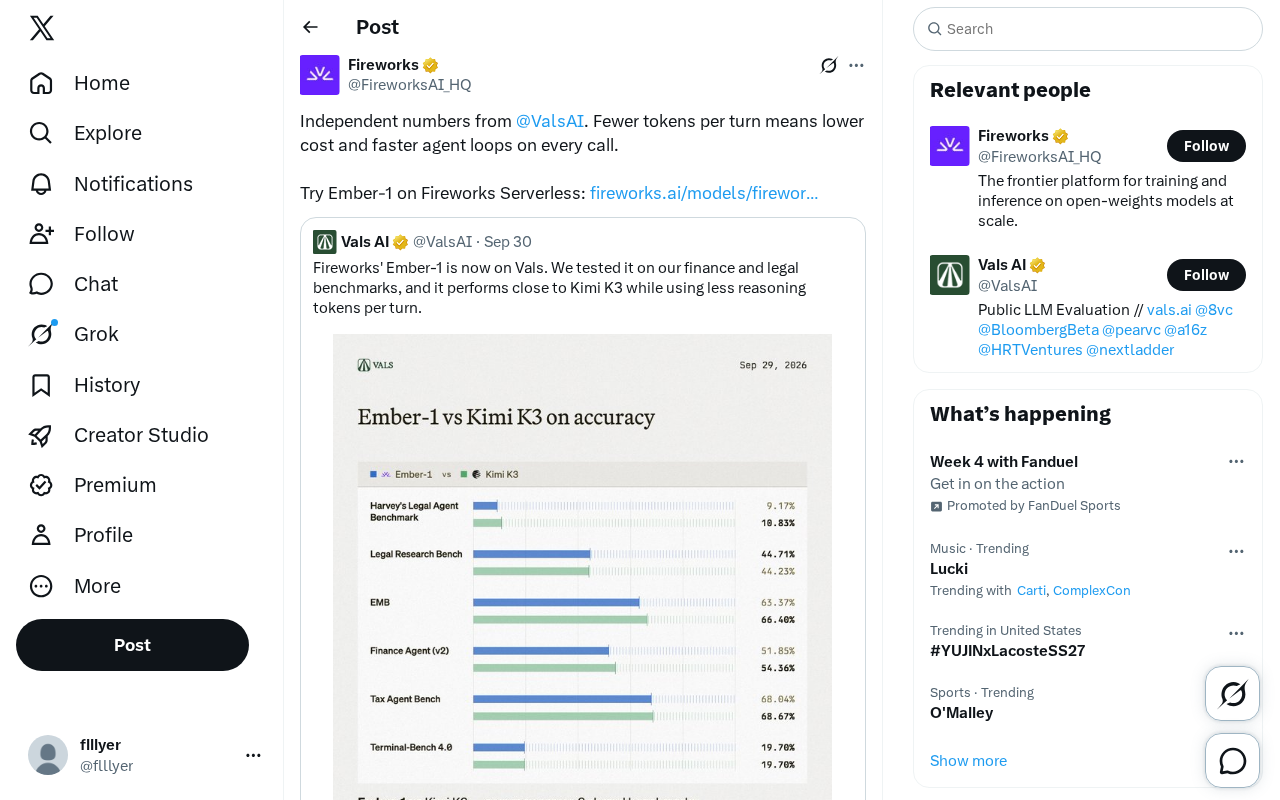
A tweet from Fireworks citing independent benchmark data from @ValsAI highlights that the Ember-1 model consumes fewer tokens per conversation turn. For developers building AI Agents, this metric is far more relevant to real-world engineering needs than raw benchmark scores alone.
The logic is straightforward: fewer tokens consumed per turn means lower inference costs and faster Agent loop execution. In a typical Agent workflow, the model often needs multiple rounds of reasoning, tool calls, and feedback loops — and the token overhead of each individual call compounds across the entire task chain. That's why improving single-turn token efficiency creates a multiplicative effect throughout the workflow.
Why Token Efficiency Is Critical for Agent Workloads
In traditional single-turn Q&A scenarios, token consumption mainly affects the cost and quality of a single response. In Agent scenarios, however, the dynamics are fundamentally different. An automated task may involve dozens of model calls — planning, execution, observing results, re-planning. This looping structure means that any per-turn overhead accumulates repeatedly.
The Cost Dimension
Most inference services charge by token, counting both input and output tokens toward the bill. If a model uses fewer tokens on average per turn to complete the same task, the savings in high-frequency production environments can be substantial. For enterprises deploying Agents at scale, this directly impacts the unit economics of each task.
The Latency Dimension
Beyond cost, token count directly affects response latency. Fewer generated tokens means shorter generation time, so each step in the Agent loop completes faster. In interactive applications or real-time automation pipelines, the accumulated latency reduction can meaningfully improve the user experience.
The underlying architecture of Agent workflows is commonly referred to as the "ReAct" loop (Reasoning + Acting). At each step, the model needs to output its reasoning, decide which tool to call, parse the tool's returned results, and then enter the next round of inference. This is fundamentally different from traditional one-shot completion: the context window grows continuously with each turn, causing input token counts for later turns to keep rising. In other words, even if output tokens are reduced by 20% per turn, the early savings suppress context bloat as task steps accumulate — producing non-linear compounding gains. This is precisely why token efficiency is considered a "multiplier metric" in Agent infrastructure, rather than a simple linear cost factor.
The Value of Independent Benchmarks
This data comes from the third-party evaluation firm @ValsAI, not from the model developer's own marketing materials. Independent benchmarks tend to carry more credibility because they reduce the likelihood of selective disclosure or test conditions skewed in the model's favor. Against a backdrop where model vendors frequently publish self-reported benchmarks, neutral third-party comparisons carry greater practical value for developers.
That said, the original tweet only provides a high-level conclusion without a complete methodology, a list of comparison models, or specific numerical results. To fully assess Ember-1's real-world performance, you'll still want to consult @ValsAI's full evaluation report and validate results against your own use case.
Getting Started
Fireworks offers a Serverless way to try Ember-1 — developers don't need to deploy or manage GPU resources themselves, and can access the model directly via API. This serverless approach lowers the barrier to experimenting with new models, making it easy to run A/B comparisons within real workflows to verify whether token efficiency actually translates into cost and speed gains for your specific project.
For teams actively building Agent systems, consider evaluating Ember-1 along these dimensions: average token consumption per task compared to your current model, end-to-end latency, and task success rate. Only by situating token efficiency within a complete task evaluation framework can you determine whether a switch is worthwhile.
Serverless inference refers to cloud platforms dynamically allocating GPU compute in the background, scaling elastically based on actual request volume. Developers simply call a REST API or SDK — no need to purchase or reserve GPU instances upfront. Compared to self-hosted or reserved-instance setups, Serverless is more cost-controllable during exploratory phases with variable traffic, though latency stability and pricing structures may differ at very high concurrency. Fireworks' Serverless endpoints support an OpenAI-compatible API format, which means projects already using LangChain, LlamaIndex, or the OpenAI SDK directly can typically switch for testing by simply updating the base_url and model parameters — making migration extremely low-effort.
Summary
Ember-1 positions itself around "fewer tokens, lower costs, faster Agent loops," backed by third-party benchmark data — directly addressing real pain points in Agent development today. The compounding effect of token efficiency in high-frequency call scenarios makes it a more practical evaluation dimension than a single benchmark score. However, given the limited information in the original source, developers should rely on the complete independent evaluation data and their own testing before making any adoption decisions.
Related articles

Amphibious Transforming Drone: Beyond 100x Power Savings, What Are the Real Needs?
Is the amphibious transforming drone just a gimmick? Starting from the 100x power difference of the M4 Morphobot, explore real application scenarios and thesis topic ideas, analyzing boundary conditions where pure drones and pure ground robots both fail.

Warhound Raises $200 Million: Genetically Engineered "War Dogs" Paired with Anduril Gear
Warhound raises $200M, backed by Ben Lamm and Palmer Luckey, to genetically engineer dogs for military and law enforcement use and equip them with Anduril gear. This article analyzes its technology direction, funding logic, and ethical controversy.

Claude API Comes to Google Cloud: IAM Integration and SDK Access Guide
Anthropic hosts the full Claude API on Google Cloud with IAM-controlled permissions and unified billing. This guide covers the Vertex AI and Anthropic-hosted entry points, IAM role configuration, and SDK access.