EMNLP Paper Withdrawn for Not Attending? The Author's Dilemma Under Visa Issues

An EMNLP author cannot attend due to visa issues and faces paper removal, sparking discussion on no-show policy flexibility.
An author's paper was accepted by EMNLP with a poster presentation, but visa issues prevent attendance and the conference refuses online participation, so the author fears removal from the proceedings. This reflects the conflict between no-show policies and authors' real difficulties. The article analyzes the policy's rationale and controversy and offers coping suggestions: keep visa evidence, contact area chairs, find proxy presenters, check official rules, and seek community experience. It calls for clearer appeal channels and alternatives for force majeure.
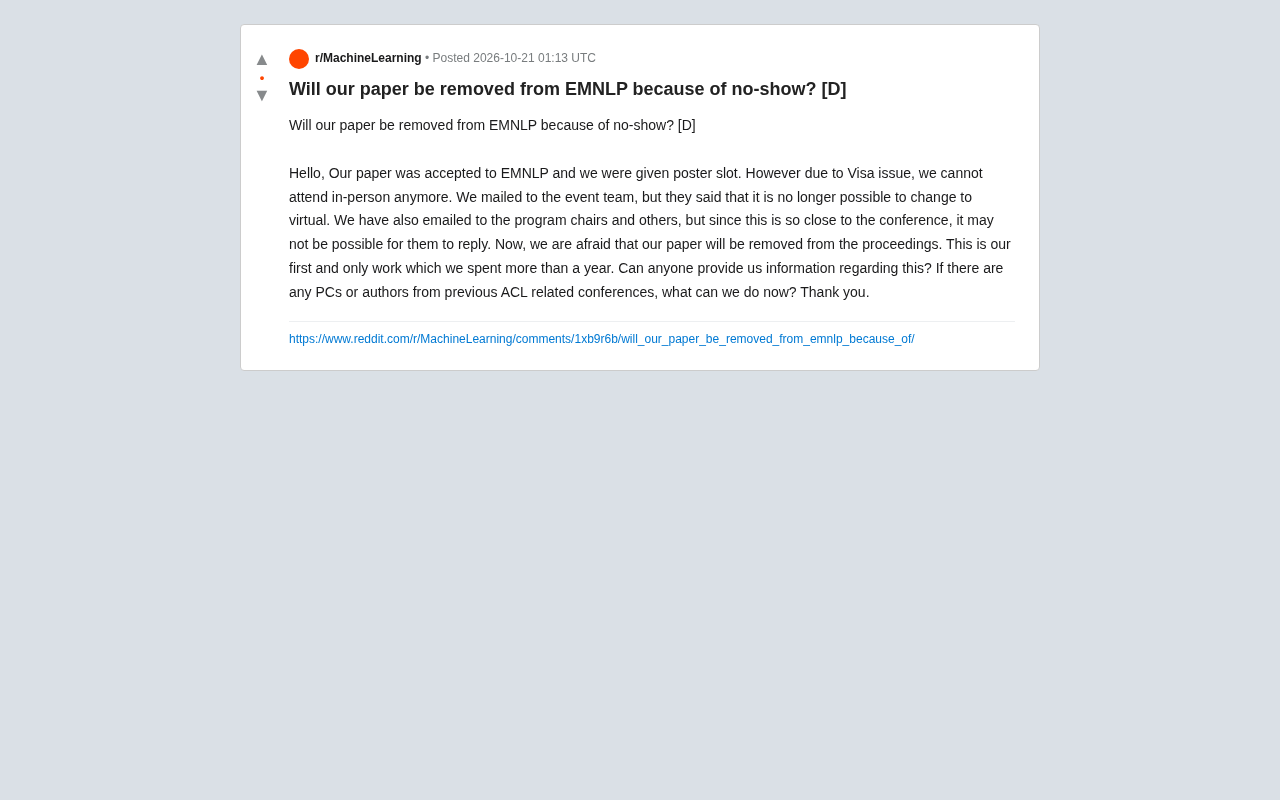
An author posted on Reddit for help: their paper was accepted by EMNLP with a poster presentation scheduled, but due to visa issues they cannot attend, and the conference organizers refused to switch to online participation. They worry the paper will be removed from the proceedings. This touches on an old problem: the conflict between academic conferences' "in-person attendance" requirements and authors' real-world difficulties.
Visa Obstacles Put Participation Eligibility at Risk
According to the post, the author's paper was accepted by EMNLP and received a poster presentation slot. However, due to visa issues, they cannot attend in person. They contacted the conference team, who said it was no longer possible to switch to online participation. They then emailed the program chairs and other relevant people, but given the proximity to the conference date, replies may not arrive in time.
The author's biggest concern is that the paper will be removed from the conference proceedings. They emphasized that this is their first and only work, into which they have invested over a year. The post asks program chairs or authors with experience in ACL-related conferences for advice on possible solutions.
What makes this case typical is that visa problems are a systemic risk for researchers in many countries, not personal negligence. Conferences usually have a "no-show policy" requiring at least one author to attend and present, otherwise the paper may be withdrawn from the proceedings. But whether this policy should have flexibility in the face of force majeure has long been a focus of community discussion.
EMNLP (Conference on Empirical Methods in Natural Language Processing) is one of the top academic conferences in natural language processing, alongside ACL and NAACL, and is organized by the ACL (Association for Computational Linguistics) community. ACL-series conferences typically require that at least one author of each accepted paper register and present in person; otherwise, the paper may be removed from the conference proceedings (i.e., withdrawn from the officially published Proceedings). This requirement is known as the "no-show policy," and its purpose is to ensure the quality of academic exchange during the conference. Having a paper included in the ACL Anthology (the open-access paper repository maintained by the ACL community) is crucial for authors, as it is the main channel through which work in the field is widely cited and indexed. Therefore, facing the risk of paper removal due to visa issues preventing attendance has serious consequences for authors, especially early-career researchers.
The Logic and Controversy of the No-Show Policy
There are reasonable grounds for conferences to set attendance requirements. Poster sessions and oral presentations are core components of a conference; authors need to be present to communicate with peers and answer questions, ensuring the quality of academic dissemination. If a large number of authors are absent, the on-site experience of the conference will be greatly diminished, and the investment of other attendees will be devalued. In addition, the no-show policy is a constraint mechanism to prevent authors from submitting solely to get their papers included without participating in conference exchange.
But the controversy lies in whether a one-size-fits-all policy is fair to authors who cannot attend due to visas, health, or emergencies. Visa issues, in particular, are often related to an author's nationality and location and carry a flavor of structural inequality. Some researchers point out that if conferences do not leave an exception channel for force majeure in their policies, they are effectively penalizing scholars who face higher travel barriers.
From the post, the author has already tried the usual channels: contacting the conference team and emailing the program chairs. But the tight time window before the conference makes communication difficult. In this situation, what else can the author do?
The "no-show policy" of ACL-series conferences usually stipulates that if a paper is accepted but no author attends to present it, the paper will be removed from the conference proceedings and may affect the authors' future submissions. This policy is stated in the conference registration terms and author guidelines. However, there is often some flexibility in enforcement, such as allowing exceptions for force majeure factors like health or visas, but authors need to communicate in advance and provide supporting documents. The enforcement standards may vary across conference years and program chairs. In addition, the ACL community has experimented with "remote participation" or "pre-recorded videos," but not all conferences offer such options. For visa issues, conferences usually advise authors to apply for visas as early as possible, but they have not established a unified fast-track appeals channel for emergencies, which leaves authors in a passive position as the conference approaches.
Coping Paths Authors Can Try
Based on past discussions in the ACL community, similar situations are not without room for maneuver. The following points are worth trying:
Keep written records from the outset. Official documents of visa refusal or delay and emails with the conference team should all be preserved completely. These materials can prove in subsequent communication that the absence was not voluntary.
Contact the area chair or senior community members. Program chairs are busy with many matters before the conference, and replies may be delayed. Area chairs or scholars who have held similar roles are more familiar with internal processes and may provide more specific advice or relay messages.
Look for alternative presentation options. Although the conference said it cannot switch to online, you can proactively propose that someone in the same field attending the conference post the poster on your behalf, or answer questions online during the conference. Some conferences allow a "proxy presenter," i.e., someone else presents on your behalf.
Check the conference's official policy details. In the proceedings of ACL-series conferences, the handling of no-show papers is usually explicitly stipulated. Some conferences allow appeals under special circumstances; the key is to find the right contact and attach evidence.
Seek experience sharing in the community. As this author did, posting on platforms like Reddit and Twitter often yields direct experience from people who have been through similar situations, and may even put you in touch with the organizers themselves.
One detail: the author mentioned in the post that "this is our first and only work." This situation is not uncommon among early-career researchers. The withdrawal of a paper may affect graduation, job hunting, or visa status, with consequences far beyond a single conference presentation. This is also why the community pays special attention to such issues.
In ACL-series conferences, the "Area Chair" is responsible for managing paper review and conference arrangements in a specific research direction, and is usually closer to the specific paper's presentation matters than the program chairs. When contacting the area chair, you should briefly explain the situation and attach official proof of the visa issue (such as a refusal letter or embassy/consulate notice). In addition, the ACL community has a practice of "proxy presenters," where other attendees post posters or give oral presentations on behalf of the author, but prior approval from the conference organizers is required. Authors can also check the conference's "Author Guidelines" or "Registration Policy" pages for clauses on "force majeure" or "exceptional circumstances." If the conference offers online participation options (for example, some conferences allow remote presentations), you should proactively ask whether you can switch to online. Finally, when posting on social media, using the conference's official hashtag (such as #EMNLP2023) and tagging the official conference account may increase the chance of being seen by the organizers.
Conference Policies Need More Flexibility
This help-seeking post reflects a broader discussion: how can academic conferences maintain on-site quality while retaining necessary flexibility for force majeure? Visa issues are not isolated cases. In recent years, multiple ACL-series conferences have seen authors unable to attend due to travel restrictions.
One feasible direction is for conferences to explicitly list appealable exceptions in their no-show policies and set up a fast-response channel before the conference. Another approach is to provide pre-recorded videos or online Q&A alternatives for authors who cannot attend, ensuring the dissemination of papers without completely sacrificing on-site exchange.
For this author, the most important thing now is to reach someone with decision-making authority through multiple channels as soon as possible and to prepare supporting documents for the visa issue. Whether the paper will be removed ultimately depends on the specific enforcement standards of the conference organizers, but before the outcome is clear, proactive communication is always more promising than passive waiting.
If you have experience attending ACL-series conferences or have encountered a similar situation, please share in the comments—it might help an author who is currently anxious.
One-line Summary
An EMNLP author cannot attend due to visa issues and faces the risk of their paper being removed from the proceedings, sparking discussion about flexibility in no-show policies.
Paragraph Summary
An author's paper was accepted by EMNLP with a poster presentation scheduled, but due to visa issues they cannot attend, and the conference organizers refused to switch to online participation. The author worries the paper will be removed from the proceedings. This reflects the conflict between academic conferences' no-show policies and authors' real-world difficulties. The article analyzes the policy's rationale (ensuring quality of on-site exchange) and controversy (lack of flexibility for force majeure such as visas, and structural inequality), and offers suggestions for authors: keep written evidence of visa issues, contact area chairs or senior community members, find proxy presenters, check official policy details, and seek experience sharing in the community. The article concludes by calling for conference policies to set up clearer appeal channels and alternative presentation options for force majeure.
Related articles

Amphibious Transforming Drone: Beyond 100x Power Savings, What Are the Real Needs?
Is the amphibious transforming drone just a gimmick? Starting from the 100x power difference of the M4 Morphobot, explore real application scenarios and thesis topic ideas, analyzing boundary conditions where pure drones and pure ground robots both fail.

Warhound Raises $200 Million: Genetically Engineered "War Dogs" Paired with Anduril Gear
Warhound raises $200M, backed by Ben Lamm and Palmer Luckey, to genetically engineer dogs for military and law enforcement use and equip them with Anduril gear. This article analyzes its technology direction, funding logic, and ethical controversy.

Claude API Comes to Google Cloud: IAM Integration and SDK Access Guide
Anthropic hosts the full Claude API on Google Cloud with IAM-controlled permissions and unified billing. This guide covers the Vertex AI and Anthropic-hosted entry points, IAM role configuration, and SDK access.