Empacer: The Voice-First AI Assistant for Small Business Owners That Topped Product Hunt

Empacer uses voice-first interaction and three-question onboarding to turn small business owners' voice requests into approvable finished work.
Empacer is an AI tool for small business owners that won #1 Product of the Day on Product Hunt with 231 upvotes and 47 comments. It tackles the pain point of re-explaining your business every time you use AI: setup asks just three questions to build a business profile, then voice requests become executable plans and finished work like customer replies, social posts, and invoices—all requiring owner approval before sending. The article covers the rationale for voice-first, the three-layer workflow, and how it differs from general assistants, noting the core challenge of covering diverse small businesses with three questions and balancing approval granularity.
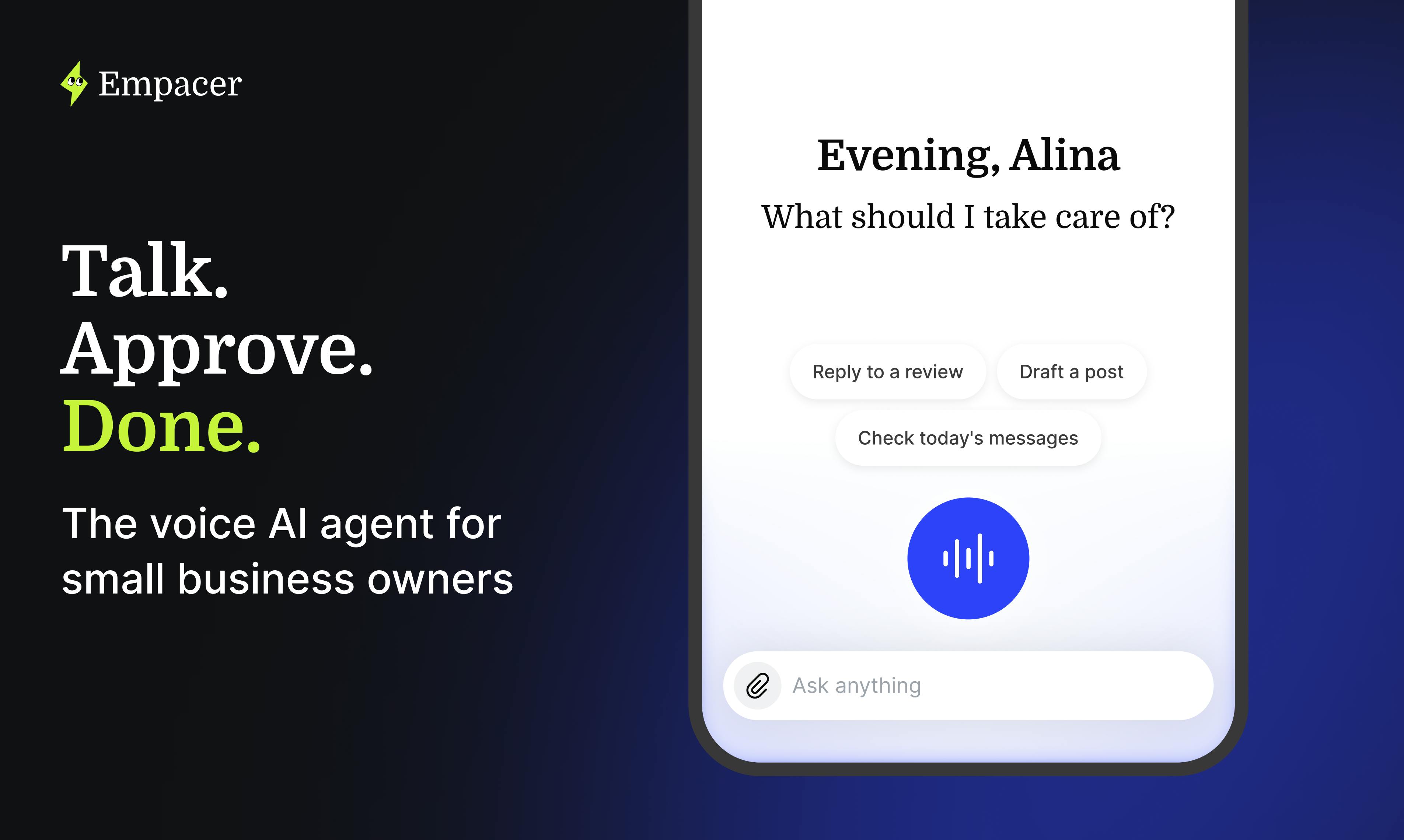
Small business owners using AI tools commonly run into an awkward problem: every time they open a new conversation, they have to re-explain their business from scratch—what they sell, who their customers are, their preferred tone, and their go-to templates. This repetitive work eats up time that could otherwise go into running the business. Empacer aims to eliminate this step: setup asks only three questions, and after that every voice request turns directly into an executable plan and finished work—covering customer replies, social media posts, invoices, and more—with nothing sent out until the owner approves it.
The product took the #1 spot on Product Hunt for the day with 231 upvotes and 47 comments, spanning the productivity, SaaS, and artificial intelligence categories.
Why "voice-first" is a choice worth noting
Most AI assistants still default to a text box, with voice as an add-on feature. Empacer flips the order: the owner speaks, and the system does. This choice maps to a real work scenario—small business owners are constantly in a "hands busy, mind racing" state, where typing is extra cognitive load and speaking is the more natural way to express themselves.
In terms of positioning, Empacer targets not people who "want to play with AI" but people who "don't have time to learn AI." Asking only three questions during setup is essentially about lowering the barrier to first use: rather than asking users to build a knowledge base, upload materials, and tune prompts, it trades minimal input for usable default context.
Voice-first interaction refers to a product making voice the primary or even default input method, rather than an auxiliary feature tacked onto a graphical interface. The concept originates in areas like smart speakers and in-car systems, with the core assumption that in scenarios where the user's hands are busy or they need to express something quickly, speaking is more natural and less cognitively demanding than typing. In recent years, as speech recognition accuracy has improved and large language models have gotten better at understanding conversational instructions, voice-first has begun entering the productivity tools space. Unlike traditional "speech-to-text," voice-first products typically parse the intent behind the speech directly and trigger the corresponding workflow, rather than merely generating a text transcript.
Three questions, one approval loop
Empacer's workflow can be broken down into three layers:
The first layer is minimal onboarding. Three questions establish a basic profile of the business, replacing the lengthy configuration process of traditional AI tools. The materials don't disclose what the three questions actually are, but given that the final output covers customer replies, social media content, and invoices, the onboarding information most likely centers on business type, audience, and communication style.
The second layer is the conversion from voice to finished work. The owner states a need, and the system outputs a "ready plan and finished work"—not suggestions, not draft frameworks, but directly usable results. This distinction is key: small business owners want finished products, not raw material to be processed further.
The third layer is the human approval gate. Nothing is sent out without the owner's approval. This design serves both as a safety boundary and as a trust-building mechanism—AI does the producing, and the human retains the final say.
Human-in-the-loop approval is a design pattern that inserts a human confirmation step into an AI automation workflow. Its purpose is to preserve AI efficiency while ensuring that critical operations or external-facing content are ultimately decided by a person, thereby reducing the risk of errors, meeting compliance requirements, and building user trust. In small business scenarios, content like customer replies and social media posts is hard to retract once sent, so the approval gate is not only a safety boundary but also a precondition for the product being accepted. The granularity of approval—whether items are confirmed one by one or in batches—directly affects the balance between efficiency and experience, and is a key variable in this kind of design.
How it differs from general-purpose assistants
General-purpose AI assistants have a higher capability ceiling, but users have to maintain the context themselves. Empacer takes a different path: trading a fixed business profile for out-of-the-box consistency. The cost is flexibility—whether the system can still deliver high-quality results when a business scenario falls outside the preset range is a question the materials don't answer.
Another point worth watching is the granularity of the approval process. If every output requires the owner to confirm item by item, the efficiency advantage is weakened; if approval is too loose, it violates the original intent of "human control." This balance point determines the upper limit of the product's experience in actual use.
Common challenges for small business AI tools
Empacer faces the shared challenge of this category of products: small business owners' operations vary enormously, from food service to consulting to retail, and whether the same three-question onboarding can cover enough scenarios is the key to whether the product can retain users. The support of 47 comments and 231 upvotes on Product Hunt shows it hit a real pain point, but there's still a long way between community buzz and long-term retention.
From an industry perspective, the combination of voice-first plus an approval loop reflects a consensus that is taking shape: for AI products aimed at micro and small businesses, the value isn't in how powerful the model is, but in embedding AI into existing workflows and not making users pay extra learning costs to use AI. Empacer's exploration is worth watching—whether it can turn "three questions" into a sustainable understanding of the business will be the next thing to look at.
Context maintenance refers to an AI assistant's ability to remember and understand a user's business background, preferences, and historical information across multiple turns of conversation or repeated use. General-purpose assistants typically require users to manually provide or upload background materials and re-inject them in every new conversation; vertical-scenario products, by contrast, try to reduce this repetitive work through onboarding profiles or continuous learning. The quality of context maintenance determines whether AI output is coherent and fits the business, but it also brings challenges around privacy and data updates. For small businesses whose operations vary enormously, how to build sufficiently accurate context from limited onboarding information is one of the core difficulties of product design.
One-line Summary
With voice-first interaction and three-question onboarding, Empacer turns small business owners' voice requests directly into approvable finished work.
Paragraph Summary
Empacer is an AI tool for small business owners that won #1 Product of the Day on Product Hunt with 231 upvotes and 47 comments. Addressing the pain point that small business owners have to re-explain their business every time they use AI, it uses voice-first interaction: setup asks just three questions to build a business profile, after which the owner states a need and the system directly outputs executable plans and finished work covering customer replies, social media posts, and invoices. All output must be approved by the owner before being sent, creating a human-checked trust mechanism. The article analyzes the rationale for voice-first, the three-layer workflow design, and the differences from general-purpose assistants, noting that its core challenges lie in whether three-question onboarding can cover hugely varied small business scenarios and in balancing approval granularity.
Related articles

The Truth Behind Titanic's Sinking: Key Decisions and Communication Failures in the National Geographic Documentary
National Geographic's The Unsinkable Ship uses survivor testimony to reconstruct Titanic's fatal decisions—from the missing MSG telegram prefix and the broken boiler-room-to-bridge link to how 'unsinkable' thinking delayed damage control and evacuation.

74M-Parameter Open-Source Model Partially Outperforms Jev AI in Testing
Fastino AI's Glider 2.5 models, with just 74M–300M parameters, reportedly outperform Jev AI in some guardrail benchmarks per YouTube testing, run on consumer hardware, and even play Doom. We analyze small models' competitiveness and deployment value on specific tasks.

Gemini 4 Argon Hands-On: Aggressive Pricing, 3D Capabilities Need Coaching
Gemini 4 Argon hands-on: limited-time $2/$10 pricing, million-token output, strong 3D and reverse-engineering work, but weak front-end aesthetics and zero-shot ability need coaching.