Energy Model CRAM: 1,000x Faster Inference Than Looped Models

CRAM replaces looped structures with energy descent, training 1,000x faster and cutting inference FLOPs by 282x.
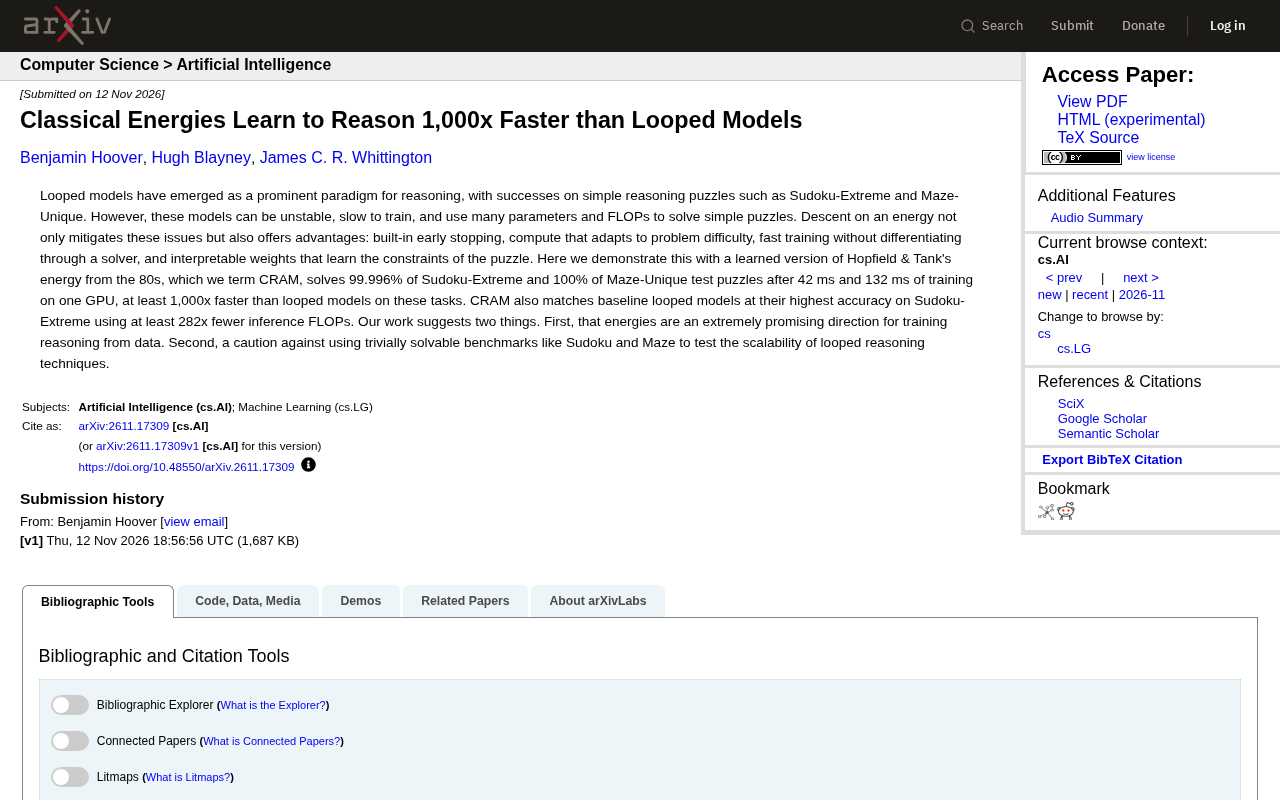
The article introduces a study that replaces looped models with energy models for reasoning. Looped models are effective on tasks such as Sudoku and mazes but suffer from unstable training, long training times, and high parameter and computational costs. The researchers turned the 1980s Hopfield & Tank energy into a learned model, proposing CRAM: reasoning simply requires descending on a parameterized energy function, without backpropagating gradients through an iterative solver. Experiments show that CRAM solves 99.996% of Sudoku-Extreme puzzles after 42 milliseconds of single-GPU training and 100% of Maze-Unique puzzles after 132 milliseconds, training at least 1,000x faster than looped models and reducing inference FLOPs by at least 282x. Energy models also offer early stopping, difficulty-adaptive computation, and interpretable weights. The authors draw two lessons: energy models are a promising direction for data-driven reasoning; and simple benchmarks like Sudoku and mazes may overestimate the scalability of looped reasoning techniques.
Looped Models perform well on simple reasoning puzzles (such as Sudoku and mazes), but they suffer from unstable training, slow speed, and high parameter and computational costs. A new study proposes replacing the looped structure with Descent on an Energy, and demonstrates a learned version based on the 1980s Hopfield & Tank energy—CRAM—which trains at least 1,000x faster than looped models on Sudoku and maze tasks and reduces inference FLOPs by at least 282x.
The Bottleneck of Looped Models and the Advantages of Energy Models
Looped models reason through iterative solvers and have achieved success on tasks such as Sudoku-Extreme and Maze-Unique, but at a high cost: unstable training, long training times, and large numbers of parameters and FLOPs. Energy models offer a new approach: descending on an energy function not only alleviates the above problems but also brings additional benefits—a built-in early-stopping mechanism, computation that adapts to problem difficulty, fast training without differentiating through the solver, and interpretable weights (the learned constraints of the puzzle).
Implicit Layers, Deep Equilibrium Models, and "Differentiating Through the Solver"
Looped models (such as Deep Equilibrium Models, DEQ, and the Universal Transformer) can be viewed as "implicit layers": the output is the solution to a fixed-point equation z = f(z, x), rather than a feedforward computation with a fixed number of layers. The forward pass of such models requires an iterative solver (such as Broyden's method or Anderson acceleration) to converge, and backpropagation typically relies on the implicit function theorem, solving a linear system at the fixed point to obtain gradients—this is known as "differentiating through the solver." This process is sensitive to solver convergence, prone to exploding/vanishing gradients or training instability, and requires multiple iterations per forward pass, causing FLOPs to rise with problem difficulty. Energy models bypass this bottleneck: training directly uses energy as the loss, and inference only performs energy descent, so there is no need to backpropagate through the iterative process, making training thousands of times faster.
CRAM: From Hopfield & Tank Energy to Fast Inference
The researchers turned the 1980s Hopfield & Tank energy into a learned model, proposing CRAM. Experimental results show that after 42 milliseconds of training on a single GPU, CRAM solved 99.996% of the Sudoku-Extreme test puzzles; after 132 milliseconds of training, it solved 100% of the Maze-Unique test puzzles. Compared with looped models, training is at least 1,000x faster. On Sudoku-Extreme, when CRAM reaches the highest accuracy of looped models, inference FLOPs are reduced by at least 282x.
Hopfield Networks and Hopfield & Tank Energy
The Hopfield network is a recurrent neural network proposed by John Hopfield in 1982, whose dynamics can be viewed as descent on an energy landscape: as the network state evolves according to asynchronous or synchronous update rules, a scalar "energy function" is monotonically non-increasing and eventually converges to a local minimum (attractor). In 1985, Hopfield and David Tank built on this to propose the continuous-time Hopfield-Tank network, using analog neurons and an energy function to solve combinatorial optimization tasks such as the traveling salesman problem; its energy typically consists of quadratic terms (couplings between states) and linear bias terms, and a gain parameter can adjust the "sharpness" of the solution.
CRAM's key innovation is that it no longer hand-crafts the energy function but instead parameterizes the energy and learns it in a data-driven way, so that the minima of the energy landscape correspond to the correct solutions of the puzzle; inference only requires iterating along the direction of energy descent, without backpropagating gradients through the solver. This also explains why CRAM can achieve early stopping (stopping when the energy no longer decreases) and computation that adapts to difficulty (simple instances fall into minima faster).
Implications for Reasoning Research
This work has two levels of significance. First, energy models are an extremely promising direction for training data-driven reasoning. Second, it warns us: do not use easily solvable benchmarks such as Sudoku and mazes to test the scalability of looped reasoning techniques. These tasks may not reflect reasoning ability in genuinely complex scenarios, and the advantages of looped models may be overestimated.
These properties of energy models—adaptive computation, early stopping, and interpretable weights—make them quite promising in resource-constrained scenarios or those requiring fast inference. In the future, researchers may need to explore the performance of energy models on more complex reasoning tasks and re-examine the evaluation benchmarks for looped models.
Benchmark Saturation and Scalability Evaluation
Sudoku-Extreme and Maze-Unique are "combinatorially solvable" closed-form puzzles: the state space is finite, the constraints are fully explicit, correctness can be verified exactly, and classical algorithms (backtracking search, shortest path) can solve them efficiently. When neural methods approach 100% accuracy on these benchmarks, the benchmarks become saturated, making it difficult to distinguish the true reasoning ability of different methods. More critically, the difficulty of such tasks can be increased linearly by enlarging the grid size, but they do not involve open-world knowledge, ambiguity resolution, or long-range semantic dependencies, so the advantages of looped models observed on them may not transfer to complex reasoning scenarios requiring multi-step abstraction and integration of external knowledge. This suggests that subsequent research should introduce benchmarks with greater out-of-distribution generalization pressure, requiring compositional generalization or multimodal evidence fusion, and compare architecture strengths and weaknesses only after uniformly accounting for computational budgets.
One-line Summary
CRAM replaces the looped structure with energy descent, training 1,000x faster and reducing inference FLOPs by 282x.
Paragraph Summary
This article introduces a study that replaces looped models with energy models for reasoning. Although looped models are effective on tasks such as Sudoku and mazes, they suffer from unstable training, long training times, and high parameter and computational costs. The researchers turned the 1980s Hopfield & Tank energy into a learned model, proposing CRAM: reasoning simply requires descending on a parameterized energy function, without backpropagating gradients through an iterative solver. Experiments show that CRAM solves 99.996% of Sudoku-Extreme puzzles after only 42 milliseconds of training on a single GPU, and 100% of Maze-Unique puzzles after 132 milliseconds, training at least 1,000x faster than looped models and reducing inference FLOPs by at least 282x. Energy models also come with advantages such as early stopping, computation that adapts to difficulty, and interpretable weights. Based on this, the authors offer two insights: energy models are a promising direction for data-driven reasoning; and they warn that simple benchmarks such as Sudoku and mazes may overestimate the scalability of looped reasoning techniques.
Related articles

Gemini 4 Helium Coming Soon? Signals of Google Loosening Subscription Restrictions
Google team member hints releases will continue; community speculates Gemini 4 Helium (Flash Lite) may be next. Subscription ban controversy gets a response as product lead says "Soon," suggesting restrictions may be lifted. This article covers Gemini developments, OpenAI Coding Agent and risk management, Doubao real-time audio-video API, and compute business dynamics.

AI-Assisted React Development in Practice: Optimizing a Video App and Handling Errors
A 14-year veteran developer demonstrates AI-assisted React video app optimization: compressing video from 80MB to 5MB (~94%) via ImageKit, plus reliable error handling and retry mechanisms. Includes planning, code understanding, and verification methods for working with AI.

Incident Response in the Age of AI Attackers: A 6-Month Retrospective and the Four Pillars
AI attackers are making attacks on AI infrastructure more frequent. This article explains MarkTechPost's four-pillar incident response playbook based on a 6-month retrospective, with Fireworks AI and Klue case studies on implementation.