ENFR: Flow-Matched Reference Evidence Networks Accelerate Bayesian Model Inference

ENFR uses flow-matched references to learn Bayesian factors, enabling amortized and accurate absolute evidence estimation.
ENFR is a new method for absolute evidence estimation in simulation-based inference (SBI). Building on the evidence network framework, it adopts a two-stage strategy: first learning Bayesian factors relative to a flexible reference distribution via normalizing flows and flow matching, then recovering the absolute evidence \(\mathcal{Z}\). Absolute evidence is more practically valuable than the Bayesian factor, as it can construct minimum-volume level-α tests for high-dimensional goodness-of-fit and model misspecification diagnostics. Experiments show ENFR outperforms flow-based baselines in estimating \(\mathcal{Z}\) and achieves the best performance among all density estimation methods. The paper also proposes and proves an architecture for jointly learning the evidences of multiple models, supporting amortized Bayesian model comparison. Its amortized nature means evidence estimation for new data requires only a single forward pass, significantly lowering the computational barrier to model testing in simulation-based science.
Introduction
In the Bayesian framework, the evidence (\mathcal{Z} = p(x | \mathcal{M})) is the core quantity of a data-generating model (\mathcal{M}). It underpins model inference, model misspecification testing, and goodness-of-fit assessment—the latter often serving as an alternative to traditional discrepancy statistics such as (\chi^2). However, computing the evidence is extremely difficult even when the likelihood function is known, and even more so in simulation-based inference (SBI).
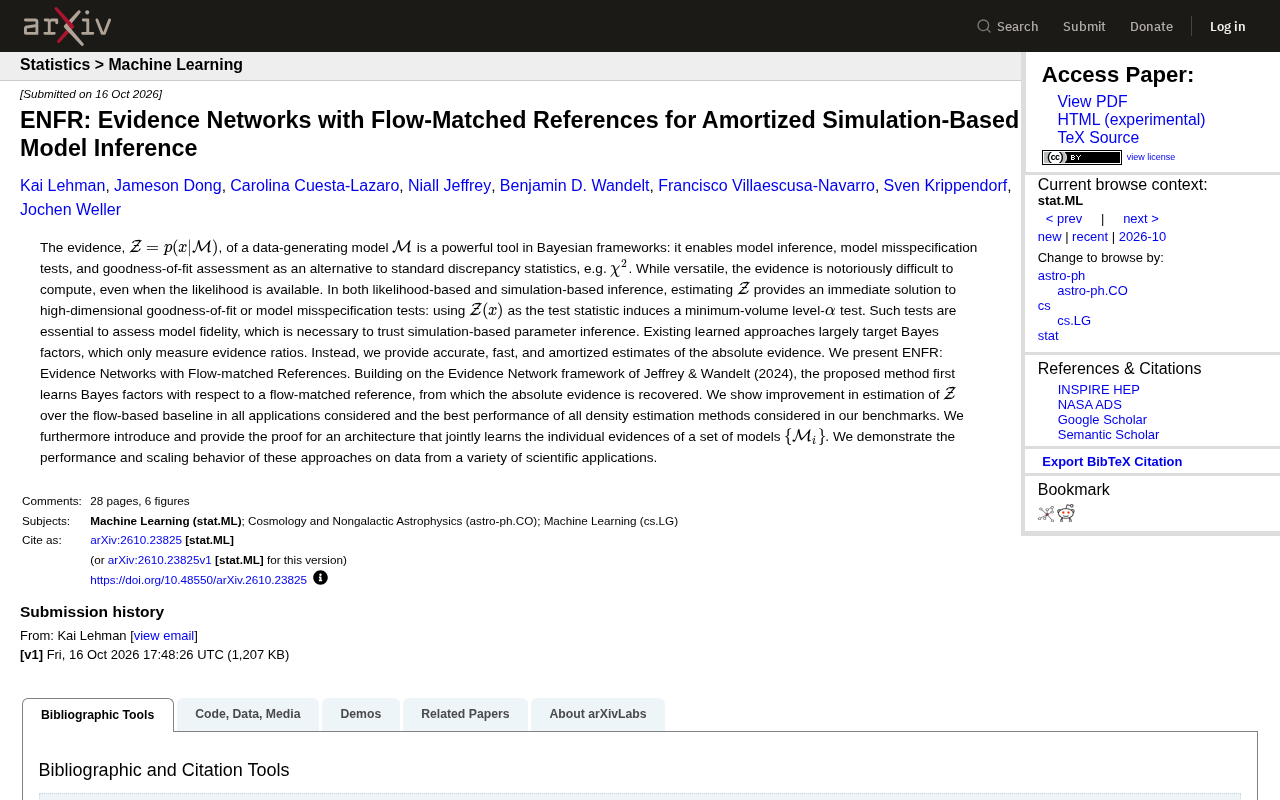
A recent study titled ENFR: Evidence Networks with Flow-Matched References for Amortized Simulation-Based Model Inference proposes a fast, amortized, and accurate method for absolute evidence estimation. Building on the evidence network framework of Jeffrey & Wandelt (2024), the method learns Bayesian factors via flow-matched reference distributions to recover absolute evidence.
Bayesian evidence, also known as the marginal likelihood, is defined as the marginal probability density of observing data (x) under a given model (\mathcal{M}): (\mathcal{Z} = p(x|\mathcal{M}) = \int p(x|\theta,\mathcal{M}) p(\theta|\mathcal{M}) , d\theta). By integrating over the parameter prior (p(\theta|\mathcal{M})), it marginalizes over model parameter uncertainty, thereby naturally implementing an automatic penalty for model complexity (Occam's razor): an overly complex model may fit the data, but its prior probability mass is spread over a larger parameter space, so its evidence value does not dominate.
The ratio of the evidences of two models is the Bayesian factor (\mathcal{B}_{12} = \mathcal{Z}_1 / \mathcal{Z}_2), the central quantity in Bayesian model comparison. The absolute value of the evidence also directly determines the model's predictive probability and can serve as a test statistic for constructing goodness-of-fit tests—this is precisely why ENFR focuses on absolute evidence rather than only ratios.
Why Evidence Estimation Matters
In simulation-based inference, we typically can only approximate the likelihood by generating samples through forward simulation. In this setting, the credibility of parameter inference depends heavily on the assessment of model fidelity. The evidence (\mathcal{Z}(x)) provides a natural test statistic: using (\mathcal{Z}(x)) as a statistic induces a minimum-volume level-(\alpha) test, which can be directly used for high-dimensional goodness-of-fit or model misspecification testing.
However, most existing learning methods focus only on the Bayesian factor, i.e., they measure only evidence ratios and cannot provide absolute evidence values. ENFR's motivation is precisely to fill this gap: to provide accurate, fast, and amortized absolute evidence estimation.
SBI (simulation-based inference) is a class of methods for Bayesian inference in settings where the likelihood function is not analytically tractable but samples can be generated via forward simulation; typical applications include cosmology, particle physics, and epidemiology. Mainstream techniques such as approximate Bayesian computation (ABC), neural posterior estimation (NPE), and neural likelihood estimation (NLE) all train neural networks to approximate the posterior or the likelihood.
However, most SBI methods focus on the parameter posterior and typically do not directly output the evidence, because evidence requires integrating over the parameter prior while simulators only provide forward sampling. ENFR's amortized nature means that the training phase can integrate large amounts of simulated data to learn the evidence as a function of the data (x), so that subsequent evidence estimation for any new data does not require repeated simulations—addressing SBI's shortcoming in model testing.
Core of the ENFR Method
The key innovation of ENFR lies in a two-stage strategy:
- Flow-matched reference learning: First, learn the Bayesian factor relative to a flow-matched reference distribution. This reference distribution is flexibly modeled via a normalizing flow and serves as a contrast to the target model.
- Absolute evidence recovery: Recover the absolute evidence (\mathcal{Z}) from the learned Bayesian factor.
The method improves upon the reference distribution design of the evidence network of Jeffrey & Wandelt (2024), significantly enhancing the accuracy of evidence estimation. The authors show across multiple benchmarks that ENFR outperforms flow-based baselines in estimating the evidence (\mathcal{Z}) and achieves the best performance among all density estimation methods considered.
Joint Multi-Model Evidence Learning
The paper further proposes and proves an architecture for jointly learning the respective evidences of multiple models ({\mathcal{M}_i}). This means that when selecting among multiple competing models, ENFR can simultaneously estimate the absolute evidence of each model in an amortized manner without training separately for each model. The paper provides a proof of this architecture and demonstrates its performance and scaling behavior on data from various scientific applications.
Normalizing flow is a class of generative models that map a simple base distribution (such as a standard normal) to a complex target distribution through invertible transformations. Its key property is that the Jacobian determinant of the transformation is analytically computable, allowing exact computation of the probability density at any point—precisely what is needed for learning Bayesian factors (density ratios).
Flow matching is a technique for training continuous-time normalizing flows by matching the vector field along a probability path to learn the transformation, avoiding the computational overhead of simulating ordinary differential equations during training in traditional flow models, resulting in more stable and efficient training. ENFR uses flow matching to construct the reference distribution, enabling it to flexibly approximate the posterior or evidence structure of the target model, thereby improving the accuracy of Bayesian factor estimation.
Experiments and Benchmark Performance
The authors validated ENFR's performance on data from various scientific applications:
- In all test cases, ENFR's estimation of (\mathcal{Z}) outperformed flow-based baselines.
- In a comprehensive benchmark of density estimation methods, ENFR achieved the best performance.
- The joint multi-model architecture demonstrated good scaling behavior, providing an efficient tool for model comparison.
These results indicate that ENFR not only improves the accuracy of absolute evidence estimation but also preserves the speed advantage of amortized inference, making it suitable for simulation-based scientific scenarios that require frequent model testing (such as astrophysics and particle physics).
Implications for Simulation-Based Inference Practice
For researchers relying on SBI, ENFR provides a practical model diagnostic tool. Traditionally, goodness-of-fit testing requires computing the evidence, a step often skipped due to computational cost. ENFR's amortized nature means that once training is complete, evidence estimation for new data requires only a single forward pass, greatly lowering the barrier to testing.
Moreover, the joint multi-model evidence learning architecture enables Bayesian model comparison to be completed within a unified framework, avoiding repeated training and manual tuning. This has direct engineering value for fields that require comparing a large number of candidate models—such as cosmological parameter inference.
Limitations and Outlook
The paper focuses mainly on the method itself and benchmark tests, and has not yet discussed performance on extremely high-dimensional data or complex simulators. The impact of the choice of flow-matched reference on final accuracy also remains to be further analyzed. Future work may include extending ENFR to more complex hierarchical models and combining it with active learning strategies to reduce simulation costs.
Overall, ENFR provides a solid absolute evidence estimation scheme for simulation-based model inference, and its open-source implementation (if provided) will further promote the application of this direction.
One-line Summary
ENFR uses flow-matched references to learn Bayesian factors, enabling amortized and accurate absolute evidence estimation.
Paragraph Summary
ENFR is a new method for absolute evidence estimation in simulation-based inference (SBI). Building on the evidence network framework, it adopts a two-stage strategy: first, it uses normalizing flows and flow matching to learn the Bayesian factor relative to a flexible reference distribution; then it recovers the absolute evidence (\mathcal{Z}) from it. Absolute evidence is more practically valuable than the Bayesian factor because it can construct a minimum-volume level-α test for high-dimensional goodness-of-fit and model misspecification diagnostics. Experiments show that ENFR's estimation of (\mathcal{Z}) outperforms flow-based baselines and achieves the best performance among all density estimation methods. The paper also proposes and proves an architecture for jointly learning the respective evidences of multiple models, supporting amortized Bayesian model comparison. Its amortized nature means that evidence estimation for new data requires only a single forward pass, significantly lowering the computational barrier to model testing in simulation-based science.
Related articles

Random Pruning of the DPO Computation Graph: 1.4x Training Speedup and Lower Peak Memory
DPO training too slow and memory-hungry? This paper proposes a random pruning framework for the DPO computation graph, sampling independently across position, sequence, and branch dimensions; branch pruning achieves a 1.426x step-time speedup and cuts training time by about 30%, with in-depth attribution of memory and time gains.

Why Does JEPA Underperform MLM in Longitudinal EHR Representation Learning?
New study compares JEPA and MLM for longitudinal EHR representation learning on MIMIC-IV: three JEPA variants train stably without collapse but underperform MLM; target size, not heterogeneity, drives prediction error.

Transfer Learning + Visible Light Communication: A New Approach to Energy-Efficient Indoor Positioning
A study proposes a transfer learning-based visible light communication indoor positioning method, achieving 47% accuracy improvement on the BOSCH factory dataset, 67.5% model efficiency under high noise, and introducing the ME composite metric for energy-efficient positioning in energy-constrained industrial IoT scenarios.