Enterprise Agent in Practice: Four Agents from PRD to Code Testing, Plus Loop Guardrails

Big-tech AI programming: code context first, controllable foundation next, autonomous loops later, knowledge base as the base.
Based on a big-tech tech talk, this article traces AI programming's evolution from hobby to production: AI needs code context, four Agents connect PRD to testing, container isolation and SDK calls ensure reviewability, Loop guardrails define when autonomous loops stop, and domain knowledge bases set the ceiling.
From Hobby to Production: The Evolution of AI Programming at Big Tech
Many teams still think of AI programming as "getting the model to complete a snippet of code," but actually putting Agents into production workflows involves far more than generation quality. According to a tech talk from a frontline big tech company shared on Bilibili, the company started with multiple internal teams each forming their own groups to build AI projects. The first scenario they picked was intelligent analysis of business monitoring alerts — traditional alerting requires people to watch dashboards and make judgments, and the team wanted AI to take over that analysis work.
This trial run surfaced a key prerequisite: AI must have access to the code to get enough context. The speaker stated plainly that they had tried graphical drag-and-drop workflow platforms early on, but the biggest bottleneck with such tools is precisely the lack of context: "If it can't get the code, it will most likely fail, and the results definitely won't be great." This explains why pure workflow orchestration struggles with complex business logic, and why a coding Agent that can read repositories and understand call chains becomes the only viable path.
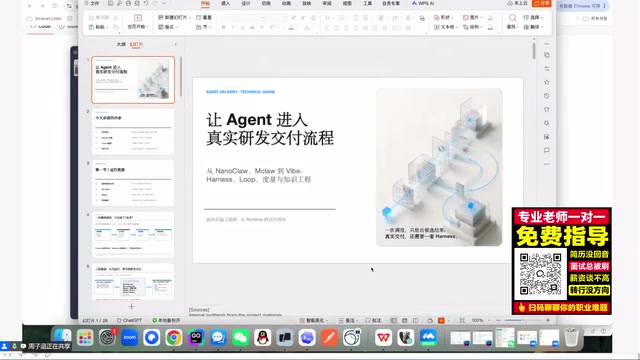
How Four Agents Connect PRD to Code Testing
Rather than leaving "multi-agent" at the conceptual level, the speaker provided a deployable division-of-labor model. Based on their description, a complete delivery chain is roughly connected by four roles: a requirements-parsing Agent that breaks the PRD into executable tasks; a coding Agent that produces the implementation after receiving code context; a testing Agent that generates and runs verification for the changes; and a review/guardrail Agent that checks outputs against specifications for reproducibility and traceability.
The core logic of this division is giving each Agent a clear identity and clear boundaries of responsibility, enforced through prompts, Skills, and MCP. The speaker specifically noted that calling the large model directly early on produced results that were "sometimes reliable, sometimes not," so the outputs must be reviewable and reproducible. According to the speaker, the team integrates this pipeline into enterprise communication tools like Feishu and DingTalk, so that Agent outputs feed directly into multi-person collaborative workflows rather than staying on individual terminals.
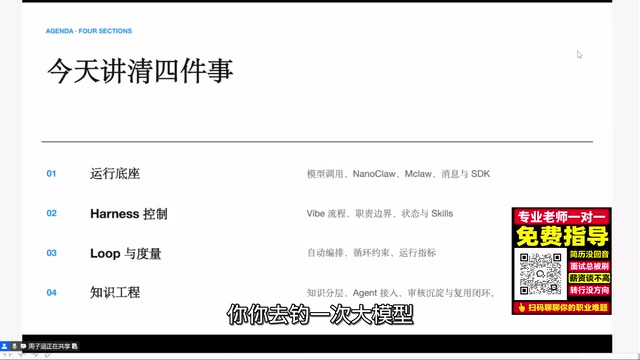
MCP (Model Context Protocol) is an open protocol that standardizes how large language models connect to external tools and data sources. Proposed by Anthropic in late 2024, its core idea is to abstract "what the model can call" into a unified server interface: file systems, databases, APIs, code repositories, and more can all be wrapped as MCP Servers, which the model discovers and invokes through the protocol without needing separate integration code for each tool. In enterprise Agent scenarios, MCP's value lies in letting different Agents share a single tool-access standard, reducing integration costs during multi-agent collaboration and making it easier to uniformly govern the resources each Agent can access.
Skill in this context usually refers to a predefined, reusable capability unit or prompt template that codifies best practices for a class of tasks into structured instructions, loaded by the Agent on demand. Compared with writing long prompts directly, Skills emphasize modularity and maintainability, making it easier for teams to accumulate domain experience and reuse it across multiple Agents.
Container Isolation and the Runtime Foundation
For an Agent to truly run in production, the runtime foundation is the first engineering problem. The speaker summarized the evolution path as: first use SDKs to call model APIs (rather than simple HTTP calls) to ensure metrics can be recorded, conversations can happen within team tools, and a complete Agent invocation can be completed; on that basis, gradually standardize the process.
Although container isolation was not fully elaborated, the emphasis on "deliverable, reviewable, reproducible" implies that the purpose of isolation is to put each Agent execution into a controllable sandbox — preventing unauthorized operations while making failures rollback-able and results auditable. Without this foundation, the more aggressive the Agent's autonomous loop, the greater the risk exposure.
Calling model APIs via SDK means integrating the model through officially or community-provided software development kits (such as the OpenAI SDK or Anthropic SDK) rather than hand-writing HTTP requests. SDKs encapsulate authentication, retries, streaming output, structured parsing, and other details, and more importantly make unified instrumentation easier: you can record metrics such as token consumption, latency, success rate, and error types for each call, providing the data foundation for subsequent guardrail design. By contrast, raw HTTP calls are flexible but require you to implement metric collection and error handling yourself, which easily gets out of control in complex multi-agent pipelines.
Loop Guardrails: Letting the Autonomous Loop Know When to Stop
The speaker calls the current stage "Loop engineering" — reducing human intervention while letting the Agent orchestrate and loop autonomously. But an autonomous loop must have termination conditions, and those conditions must be defined by metrics.
The key insight here is: guardrails don't limit capability; they make the loop sustainable. The speaker mentioned the need to design a set of runtime metrics to measure the quality of each loop iteration's output, and use them as the basis for deciding whether to continue or roll back. This aligns with the summary from another guest on the call — from prompt engineering to context engineering to Loop engineering, the terminology keeps changing, but the essence is always the same question: how to preserve human control over the process while unleashing the model's autonomy.
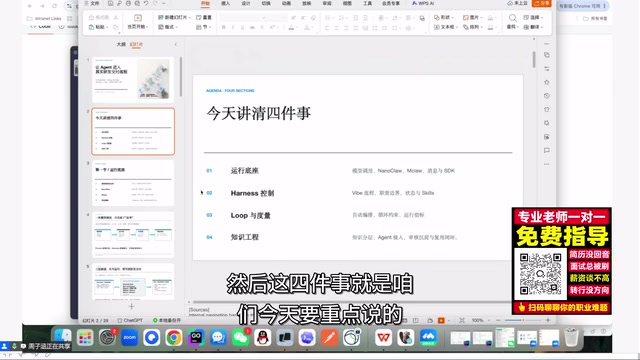
Agent Loop refers to the execution pattern in which an Agent iterates repeatedly through "observe — think — act — observe again": the model decides which tool to call and what information to obtain based on the current state, then feeds the result back to the model for the next round until a termination condition is met. This pattern enables Agents to handle complex tasks requiring multi-step reasoning and tool calls, but it also brings risks such as runaway loops, cost inflation, and error accumulation. Therefore, the core of Loop engineering is not getting the loop to run, but designing termination conditions, maximum iterations, failure rollback, and human intervention points so that autonomy and controllability are balanced.
Knowledge Base: The Hidden Variable That Determines an Agent's Ceiling
One final point the speaker inserted may be the most underrated in the whole talk: the same pipeline can be applied to any domain, but results depend on the company's own knowledge base. "Accumulate knowledge from each specialized domain and feed it in, and it will quickly reach the same level of understanding as us, doing the job as well as us or even better; without that accumulation, it will most likely be worse than a human."
This also explains why big tech tends to be more stable in Agent deployment than small teams — not because their models are stronger, but because their domain knowledge accumulation is deeper. For teams evaluating Agent projects, this advice has far more practical value than chasing new buzzwords: first take stock of what reusable domain knowledge you have, then talk about multi-agent orchestration.
Takeaways for Developers
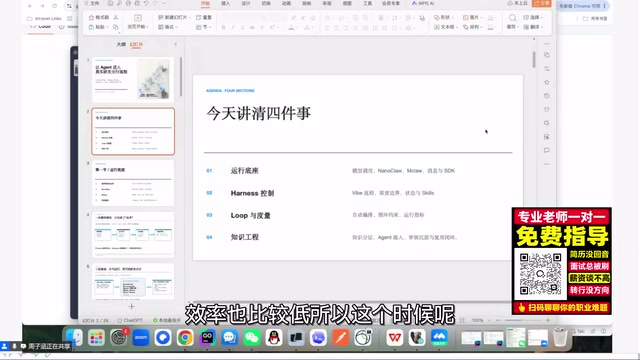
The most valuable part of this talk is not the specific implementation of the four Agents, but the clear evolution logic it presents: first solve context (code access), then solve controllability (responsibility boundaries and container isolation), then talk about automation (Loop and guardrails), and finally back it all with a knowledge base. Reverse the order, and the project will most likely get stuck midway. The guest on the call also reminded viewers that concepts like Harness and Agent Loop are now high-frequency topics in interviews and on the job, and understanding why they emerged matters more than memorizing the terms.
One-line Summary
AI programming at big tech: get code context first, build a controllable foundation, then discuss autonomous loops, with the knowledge base as the ultimate backing.
Paragraph Summary
Based on a tech talk from a frontline big tech company shared on Bilibili, this article maps the evolution of AI programming from hobby to production. The core views: AI must have access to code to obtain sufficient context, and pure graphical workflows struggle with complex business logic; deployment connects four Agents — requirements parsing, coding, testing, and review — with strict responsibility boundaries enforced through prompts, Skills, and MCP; the runtime foundation emphasizes SDK-based calls and container isolation to ensure execution is reviewable, reproducible, and rollback-able; the current stage is Loop engineering, where runtime metrics define the termination conditions of autonomous loops; and the ultimate ceiling depends on the depth of a company's domain knowledge base. The order cannot be reversed, and understanding why concepts emerged matters more than memorizing the terms.
Related articles

Nothing CMF Buds 2A Drops to $17.89 on Black Friday: A New Low for ANC Earbuds
Nothing CMF Buds 2A wireless earbuds Black Friday deal: just $17.89 on Amazon, about $11 off retail and a record low. ANC earbuds at an entry-level price.

When AI Creation Gets Accused of "Spitting": Hacker News Heats Up Over the Glaude Controversy
A Hacker News post, "Spitting in the Face of Glaude," sparks debate on AI creation transparency and attribution ethics. This analysis examines the blurred creator identity behind the controversy and offers practical advice for AI content production.

Akai Embraces Custom Firmware: MPC Sample 1.4 Lets Users AI-Program Their Sampler
Akai embraces the modding community with MPC Sample 1.4 firmware, supporting vibe-coded custom firmware and effects. We analyze the impact of this open strategy on music hardware and AI-assisted programming.