Enterprise AI Agent Development in Practice: From Low-Code to Multi-Agent Collaboration

The core of enterprise AI Agents isn't smarter chat—it's giving LLMs hands and feet, with low-code and code frameworks in parallel.
The article argues that enterprises' AI demands have shifted from "being able to chat" to "being able to do things": chatbots stop at Q&A, while AI Agents can invoke tools, execute processes, and close the loop—compressing financial bookkeeping from hours to seconds and moving sentiment discovery up to the spark stage. The implementation path advocates running low-code and code frameworks in parallel—Coze, Dify, and n8n for quick validation, LangChain and LangGraph for core data and complex approvals, with the MCP protocol as key infrastructure. Structured around nine job-role scenarios and four deliverable projects, it emphasizes that the real barrier is business insight, not coding.
Large language models can write copy and analyze data, but back at the office, your workload hasn't shrunk at all—copying, pasting, and endlessly revising generated content is still your daily routine. So where does the problem lie? An LLM is a brain that's knowledgeable but has no hands or feet. It won't automatically format a WeChat article, it can't go look up orders in your CRM system, and it certainly won't proactively chase progress in DingTalk. What AI Agents set out to solve is exactly this: giving that brain a pair of hands and feet.
Why Enterprises Need AI Agents Rather Than Smarter Chatbots
According to an analysis from an enterprise-level AI Agent hands-on course on Bilibili, the core demand enterprises have for AI has shifted from "being able to chat" to "being able to do things." A chatbot's boundary is clear—you ask, it answers, the exchange ends. An Agent's boundary lies elsewhere: it can invoke tools, execute processes, and close the loop on tasks.
This distinction matters enormously in enterprise scenarios. Take financial bookkeeping: traditionally you need to manually enter, reconcile, and generate reports; a smart bookkeeping assistant can compress account processing from hours to seconds. Or consider public sentiment monitoring—by the time a human scrolls through comments and spots a trend, it's often too late. A real-time monitoring Agent can automatically raise an alert and push a response plan the moment a spark appears.
This is why the course designers repeatedly stress one point: the value of learning Agent development isn't in how much code you memorize, but in mastering the underlying logic of turning business processes into AI—being able to identify which repetitive tasks are wasting people's lives and then solving them with Agents.
Low-Code vs. Code Frameworks: How to Choose Between Two Paths
A common misconception in enterprise AI Agent development is that you either go all-in on low-code platforms for speed, or all-in on code frameworks for flexibility. But the approach this course proposes is running low-code and code frameworks in parallel on two tracks, choosing tools based on the scenario.
Low-Code: Rapid Validation, Getting a Business Line Running in a Week
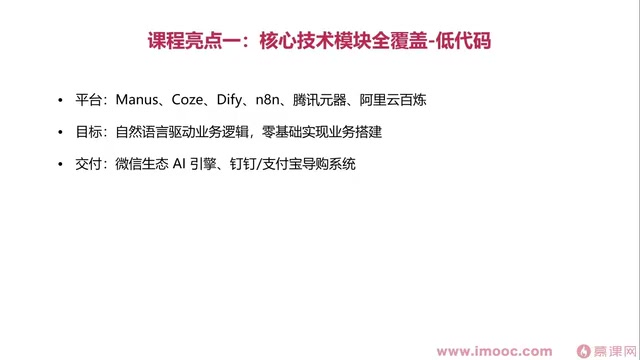
Low-code platforms like Coze, Dify, and n8n are like Lego bricks—you can build applications by dragging prompts and nodes together. The course mentions a typical scenario: building a short-video production line for a business department, automating everything from topic selection to voiceover synthesis, delivered and validated within a week.
For business staff without a technical background, as long as they can express their needs clearly in natural language, these platforms can help them build what they need. WeChat ecosystem AI engines and shopping-guide systems linked with DingTalk and Alipay all fall within the scope of these platforms.
It's worth distinguishing between two types of low-code platforms. Coze and Dify are "LLM-native application platforms," building conversational or task-based Agents around prompts, knowledge bases, plugins, and workflow orchestration—suited for business users who want to quickly assemble a usable agent; n8n, on the other hand, originated in the automation integration space and is essentially a visual workflow engine. Its strength lies in connecting the APIs of hundreds of SaaS and internal systems, chaining together "trigger—process—dispatch" automation pipelines, which is why the article uses it to build a global news intelligence system. Tencent Yuanqi and Alibaba Cloud Bailian are one-stop Agent development and hosting platforms from major cloud vendors, with the advantage of deep integration with their own ecosystems (WeChat, DingTalk, Alipay, etc.). When selecting a platform, enterprises can first ask three questions: Is the main thing you're handling conversation or process? How many external systems do you need to connect? Do you require private deployment and data compliance? Different answers lead to noticeably different platform choices.
Code Frameworks: A Must-Have for Core Business
But when it comes to core business data, high-confidentiality requirements, or complex approval flows, the ceiling of low-code platforms becomes apparent. Custom approvals, core customer data processing, multi-Agent collaborative customer service—these scenarios require frameworks like LangChain and LangGraph to break past platform limitations.
The frameworks covered in the course include: LangChain, LangGraph, LlamaIndex, AutoGen, CrewAI, and MetaGPT. The core things to master are inter-Agent collaboration and communication, state management, and enterprise knowledge base construction.
The frameworks mentioned each have their own focus, and understanding their differences helps with selection. LangChain is the earliest popular LLM application development framework, offering general abstractions for models, prompts, retrieval, and tools; LangGraph is its extension in the direction of complex orchestration, using graph structures (nodes + edges + shared state) to express flows with loops, branches, and human intervention—naturally suited for "state machine"-style tasks, such as meeting to-do tracking that requires cross-step memory; LlamaIndex focuses more on data ingestion and retrieval-augmented generation (RAG), excelling at turning enterprise documents and databases into a knowledge layer that Agents can query; AutoGen (Microsoft) centers on multi-Agent conversation, letting multiple Agents collaborate through back-and-forth messages; CrewAI organizes Agent teams using the metaphor of "roles + tasks + processes," making it intuitive to get started; MetaGPT goes further by simulating the division of labor in a software company, mapping requirements directly into executable product/code output. Selection is typically judged along three dimensions: single-Agent or multi-Agent, whether complex state control is needed, and whether the knowledge base is the primary focus.
MCP Protocol: Breaking Down Enterprise Information Silos
Many companies' data is locked inside local databases and internal APIs, and AI simply can't get in. The MCP protocol is like a master key—once you master it, Agents can securely read local files and call internal interfaces. This is critical infrastructure for enterprise AI adoption, and the course covers it specifically.
MCP (Model Context Protocol) was proposed and open-sourced by Anthropic at the end of 2024. It's a standardized protocol for letting LLM applications connect to external data sources and tools in a unified way. Its core idea is similar to a "USB-C port for the AI world": previously, every Agent that wanted to read a database, call an API, or access a file system had to write separate adapter code for each data source; with MCP, data providers only need to implement an MCP Server once, and any MCP-compatible client (Claude, various Agent frameworks, etc.) can plug and play. The protocol itself specifies three types of capabilities—tool invocation, resource reading, and prompt templates—along with a JSON-RPC-based communication method, and includes built-in permission and transport-layer design (local stdio, remote HTTP/SSE). For enterprises, the significance of MCP is that it turns "connecting AI to internal systems" from a one-off engineering project into reusable infrastructure, lowering integration costs while making permission boundaries clearer and auditing more controllable.
AI Transformation in Practice Across Nine Enterprise Job Roles
A common flaw of technical courses is that they only teach you to write code, and when you get to the company you find you don't know where the business pain points are. What differentiates this course is that it roots its cases directly in nine core roles that actually operate within enterprises.
- Marketing: Automatic lead syncing and cleaning, so valuable customers don't get missed
- Finance: Smart bookkeeping assistant, compressing account processing from hours to seconds
- R&D: Query databases with natural language, no more writing complex SQL by hand
- PR & Operations: Real-time public sentiment monitoring, with Agents automatically alerting and pushing response plans
- HR: Automated resume screening
- Customer Service: Multi-round complaint handling
- Product: Data analysis support
- Content Operations: Automated production lines
The significance of this role panorama isn't just a wealth of cases—it demonstrates a methodology: go back to the company, take a look around, identify where repetitive work is concentrated, and then develop Agents in a targeted way. The principle emphasized in the course is straightforward—strike wherever the pain point is.
Four Comprehensive Projects: From Demo to Deliverable System
The course designs four enterprise-level comprehensive hands-on projects, with the goal that what you end up with isn't scattered code snippets but a complete system you can deploy directly to production.
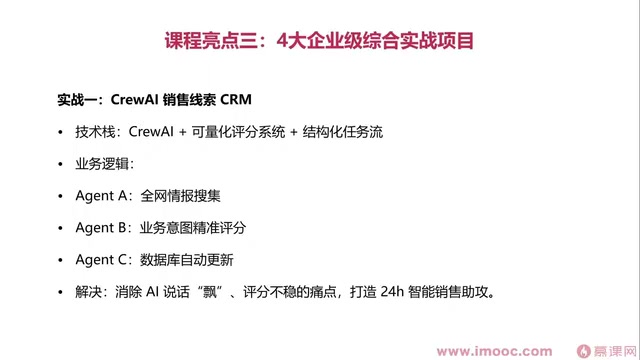
Project 1: CrewAI-Based Intelligent Sales Lead Scoring CRM
Simulates the division of labor in a complete sales team—one Agent searches the entire web for intelligence, another Agent formulates an evaluation plan based on business logic, transforming non-standard customer leads into quantifiable scoring results. Traditional manual screening is not only inefficient but also inconsistent in standards, and good customers often get missed.
Project 2: LangGraph-Based Intelligent Meeting Summaries and To-Do Tracking
What it solves isn't "summarizing a passage" but "getting something done." From meeting recording ingestion, to automatically identifying the person responsible, to dispatching tasks to email to-dos, it achieves a genuine business closed loop. This is a representative scenario of LangGraph state machine practice, with the core training focused on Agent memory and state management under complex logic.
This involves two key mechanisms of Agents: memory and state management. Memory is usually divided into short-term (the current session context, limited by the context window) and long-term (facts and preferences written to a vector store or database, retrievable across sessions). State management focuses on where an Agent is in a multi-step task—"which step it's on, what information it knows, what to do next." LangGraph uses a shared State object to pass data between nodes and supports checkpoint persistence, allowing flows to resume after interruption, support insertion of human approvals, and also replay for debugging. In the meeting to-do scenario, this means: recording transcription → topic extraction → responsible person identification → to-do generation → email dispatch. The result of each step is recorded as state, and if a step fails or needs confirmation, it can pause without having to start over from the beginning. This is precisely the technical foundation for crossing over from "summarizing a passage" to "getting something done."
Project 3: Coze-Based Self-Media Short-Video Automated Production Line
Input a keyword, and the entire process is automated—from viral topic selection and storyboard scripts to automatic voiceover and video synthesis. For individual creators, one person equipped with this production line can match the output of a team.
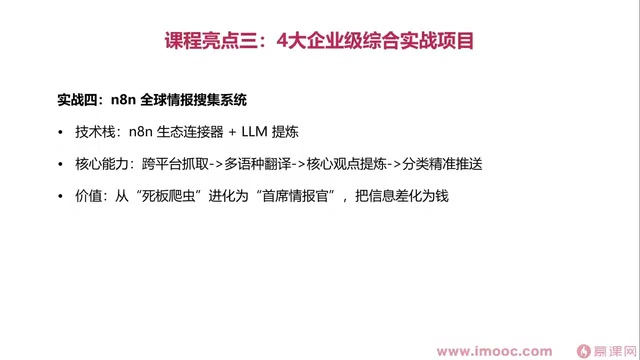
Project 4: n8n-Based Global Industry News Intelligence System
Leverages n8n's connectivity to build an intelligence system with thinking capability, automatically shuttling across global news websites, completing content structuring, core viewpoint extraction, and precise distribution. It's not a rigid scraper—it's an intelligence officer that can make judgments based on your logic.
What Are the Core Competencies of Enterprise AI Agent Development?
After breaking down the content of this course, you'll find the competency layers it trains are very clear:
At the tool level, master dual-track capabilities in low-code platforms (Coze, Dify, n8n, Tencent Yuanqi, Alibaba Cloud Bailian) and code frameworks (LangChain, LangGraph, etc.). At the protocol level, understand how the MCP protocol breaks through enterprise internal data silos. At the scenario level, possess an "AI eye" for identifying business pain points, able to judge which links are suitable for Agent transformation. At the delivery level, accumulate hands-on experience through four complete projects that can be put on a resume and deployed to production.
The course designers offer one judgment: today's workplace doesn't lack people who can chat with AI—what it lacks is scarce talent who can turn AI into a productivity tool. Whether this judgment holds depends on the actual pace of enterprise AI adoption—but looking at hiring demand trends, people who can simultaneously understand business scenarios and technical implementation are indeed in short supply.
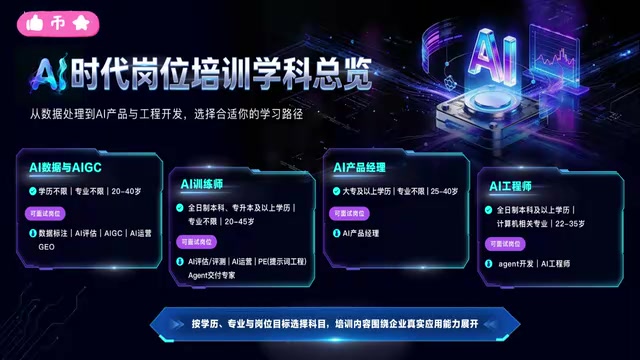
Whether you want to transition into an AI development role or want to use Agents to boost efficiency in your current position, the core path is the same: understand the business pain point → choose the right toolchain → close the complete loop. Low-code helps you get started quickly, code frameworks help you customize deeply, and the real barrier lies in the depth of your understanding of the business.
One-line Summary
The core of enterprise AI Agents isn't smarter chat—it's giving LLMs hands and feet, with low-code and code frameworks running in parallel to deliver business closed loops.
Paragraph Summary
The article points out that enterprises' demands for AI have shifted from "being able to chat" to "being able to do things": chatbots stop at Q&A, while AI Agents can invoke tools, execute processes, and close the loop on tasks—compressing financial bookkeeping from hours to seconds and moving sentiment discovery up to the spark stage. On the implementation path, it advocates running low-code and code frameworks in parallel—Coze, Dify, and n8n are suited for quickly validating a business line within a week, while frameworks like LangChain and LangGraph are used for core data, high-confidentiality, and complex approval scenarios; the MCP protocol is the key infrastructure for breaking through enterprise data silos. The course is structured around nine job-role scenarios and four deliverable complete projects, training four layers of capability: tools, protocols, scenario identification, and delivery, emphasizing that the real barrier isn't coding but the judgment to identify business pain points and architectural thinking.
Related articles

Amphibious Transforming Drone: Beyond 100x Power Savings, What Are the Real Needs?
Is the amphibious transforming drone just a gimmick? Starting from the 100x power difference of the M4 Morphobot, explore real application scenarios and thesis topic ideas, analyzing boundary conditions where pure drones and pure ground robots both fail.

Warhound Raises $200 Million: Genetically Engineered "War Dogs" Paired with Anduril Gear
Warhound raises $200M, backed by Ben Lamm and Palmer Luckey, to genetically engineer dogs for military and law enforcement use and equip them with Anduril gear. This article analyzes its technology direction, funding logic, and ethical controversy.

Claude API Comes to Google Cloud: IAM Integration and SDK Access Guide
Anthropic hosts the full Claude API on Google Cloud with IAM-controlled permissions and unified billing. This guide covers the Vertex AI and Anthropic-hosted entry points, IAM role configuration, and SDK access.