Enterprise AI Evaluation Tools: An In-Depth Comparison of Six Leading Platforms

A deep comparison of six leading AI evaluation platforms to help enterprises pick the right fit.
This article compares six leading enterprise AI evaluation tools—Arize, Braintrust, Confident AI, Langfuse, and LangSmith—across three dimensions: governance, framework lock-in, and evaluation vs. monitoring. It offers clear selection logic to help enterprises match tools to their scale and technical needs.
Why AI Evaluation Has Become Critical to Enterprise AI Adoption
As large numbers of AI projects move from prototype to production, the core challenge facing enterprises has shifted from "can we build it" to "how do we ensure quality and reliability." A technical leader responsible for AI infrastructure at a large enterprise shared their real-world dilemma on Reddit: over the past year they launched hundreds of AI projects, and now a large batch of them are entering production. How to establish a solid Evaluation and Monitoring system before scaling up has become an urgent priority.
An important concept needs to be clarified here: evaluation and monitoring are not the same thing. Monitoring focuses on the real-time operational state of a system in production, including quantifiable metrics such as latency, error rates, token consumption, and shifts in model output distribution—essentially observing "behavior that has already occurred." Evaluation, on the other hand, is more about the systematic measurement of a model's or system's capabilities, typically conducted in offline or quasi-offline environments through predefined test sets and scoring criteria to measure "output quality," spanning dimensions such as accuracy, relevance, faithfulness, and harmful content detection. The relationship between the two is analogous to "monitoring" and "testing" in software engineering: you need testing to ensure code quality, and you need monitoring to detect production anomalies. Having only monitoring without evaluation means you can only respond after problems surface, rather than proactively ensuring quality before release.
It's worth noting that this distinction is not merely a division of labor at the tooling level—it also reflects two philosophies of AI system quality assurance. Monitoring evolved from the SRE (Site Reliability Engineering) practices of traditional software operations, emphasizing real-time observability; evaluation is closer to the QA mindset of software testing engineering, emphasizing reproducibility and benchmarked comparison. In the LLM era, the core challenge of evaluation is "quantifying subjectivity"—unlike traditional ML tasks that have clear labels and loss functions, the output quality of LLMs often requires human judgment. This has given rise to LLM-as-Judge, an emerging evaluation paradigm—using a more capable large language model (such as GPT-4o or Claude 3.5 Sonnet) to score the outputs of the model being evaluated. This approach addresses the pain points of high manual annotation costs and poor scalability, but it also introduces new systematic biases: the judge model itself may exhibit "position bias" (tending to select the first answer), "length bias" (preferring longer responses), and "self-preference" (inflated scores when models from the same family evaluate each other). Therefore, enterprise-grade evaluation platforms typically need to support multi-judge model combinations, human-in-the-loop calibration, and meta-evaluation of the reliability of the judge models themselves.
This issue is highly representative. When AI use cases within an organization scale from single digits to hundreds, the lack of unified evaluation standards brings serious consequences: teams work in silos, quality varies wildly, reproducible test benchmarks are absent, and compliance and governance requirements cannot be met. Therefore, choosing the right AI evaluation tool is not just a technical decision—it's a strategic choice at the organizational level.
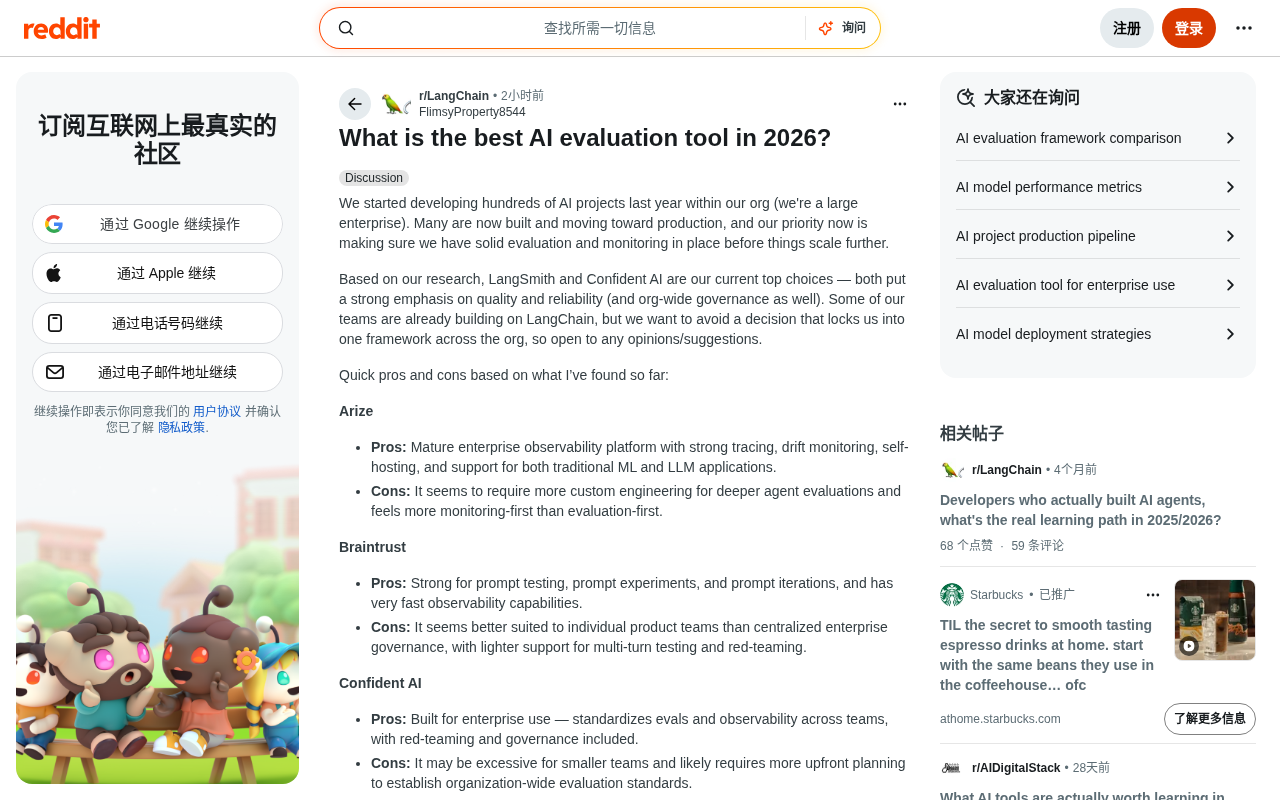
A Side-by-Side Comparison of Six Leading AI Evaluation Tools
Based on the enterprise's research, the mainstream AI evaluation and observability tools on the market can broadly be divided into two categories: Monitoring-first and Evaluation-first. Below, we review each one drawing on the analysis from the original post.
Arize: A Mature Enterprise Observability Platform
Strengths: Arize is a mature enterprise-grade observability platform with powerful tracing, drift monitoring, and self-hosting capabilities, supporting both traditional machine learning and LLM applications. For enterprises that have existing traditional ML assets while expanding into LLM initiatives, Arize can provide a unified monitoring perspective.
It's worth noting that drift monitoring faces unique challenges in LLM scenarios. Drift detection in traditional ML relies on statistical methods (such as KL divergence and the PSI metric), but LLM inputs are high-dimensional, unstructured natural language, making distribution description itself difficult. Even more insidious is "silent drift"—when the underlying model (such as GPT-4) quietly updates its version, output style and quality may change without anyone noticing. Arize offers embedding-based drift detection for these scenarios: the underlying principle is to map text inputs to points in a high-dimensional vector space and quantify the "semantic drift" of input data by tracking centroid shifts, variance changes, or cosine similarity distributions of the vectors. Unlike the PSI of traditional numerical features, embedding drift can capture distributional changes at the semantic level—for example, when the topics of user queries gradually shift from "product inquiries" toward "complaints and disputes." This is precisely where Arize's core competitiveness lies during the transition from traditional ML to LLMs.
Weaknesses: It leans overall toward being "monitoring-first," and deep agent evaluation often requires substantial custom engineering effort. For teams hoping to perform complex agent evaluations out of the box, this may be a hurdle.
Braintrust: A Powerful Tool for Prompt Iteration
Strengths: Braintrust excels at prompt testing, experimentation, and iteration, with fast-responding observability capabilities—well suited to the rapid trial-and-error pace of product development.
Weaknesses: It is better suited to individual product teams rather than centralized enterprise governance. Its support for multi-turn testing and red-teaming is relatively lightweight, making it difficult to fulfill the role of an organization-wide unified standard.
The technical complexity of multi-turn conversation evaluation deserves special mention: this capability needs to account for the cumulative effect of context (i.e., the model's response in turn N depends on the history of the previous N-1 turns), evaluate session-level task completion rates, and, in agent scenarios, trace the complete reasoning trace that accompanies tool calls. The absence of multi-turn conversation evaluation capabilities is precisely the core shortcoming that prevents many lightweight tools from meeting complex enterprise scenarios.
Confident AI: Built for Enterprise Governance
Strengths: Confident AI was designed from the ground up for enterprise-grade scenarios, able to standardize evaluation and observability across multiple teams, with built-in red-teaming and governance capabilities. This hits precisely on the most critical pain point for large organizations—cross-team consistency and compliance assurance.
The importance of red-teaming is rising rapidly. Originating in the military and cybersecurity fields, in LLM application scenarios it refers to systematically probing the model's safety boundaries using edge cases, adversarial prompts, jailbreak attempts, and similar methods, with test dimensions including prompt injection attacks, harmful content generation, privacy information leakage, and hallucination triggering.
The institutional demand for this capability should not be underestimated either. The EU AI Act came into force in 2024, requiring high-risk AI systems (covering fields such as healthcare, finance, and human resources) to complete mandatory compliance assessments before deployment and to establish ongoing risk management systems, with fines for violations reaching up to 3% to 7% of global annual revenue. Standards such as the AI Risk Management Framework (AI RMF) released by NIST in the U.S. and ISO/IEC 42001 are also driving the standardization of AI auditing. This means enterprises need evaluation tools not only to improve model quality but also to generate evaluation reports and compliance evidence chains that can be audited by regulators. Platforms with built-in red-teaming capabilities can standardize the safety testing process, allowing different product teams to reuse the same library of attack test cases, thereby avoiding duplicate construction of safety testing infrastructure across teams.
Weaknesses: It may feel too heavy for small teams and requires more upfront planning to establish organization-wide evaluation standards. Its value can only be fully realized in scaled scenarios.
Langfuse: A Cost-Effective Open-Source, Self-Hosted Solution
Strengths: Langfuse is a powerful open-source and self-hosted option. Teams can quickly build an LLM tracing and observability system, which is especially friendly to enterprises sensitive to data sovereignty.
Weaknesses: It too leans toward observability, and its capabilities in evaluation, governance, and red-teaming are relatively lightweight compared to enterprise-grade solutions. For enterprise applications built around RAG (Retrieval-Augmented Generation) architectures, Langfuse's depth of support for RAG-specific evaluation metrics is also relatively limited—for RAG systems, the industry has developed a dedicated evaluation framework, with frameworks like RAGAS defining four core dimensions: faithfulness, answer relevancy, context precision, and context recall, which together form the "quality quadrilateral" of a RAG pipeline. The absence of these fine-grained metrics leaves enterprises without a foothold when diagnosing bottlenecks in RAG systems.
LangSmith: The Best Companion for the LangChain Ecosystem
Strengths: For teams deeply standardized on LangChain and LangGraph, LangSmith is the strongest choice—tracing, debugging, datasets, and evaluation features work together seamlessly.
Weaknesses: Precisely because it is deeply bound to the LangChain ecosystem, its appeal as a "centralized unified standard" drops significantly when different teams within an organization use different frameworks. This is also the biggest concern for many enterprises: they don't want to be locked into a single framework because of their tooling choice (Framework Lock-in).
The risk of framework lock-in is particularly pronounced in the AI toolchain space. Once an enterprise's evaluation infrastructure is deeply coupled with LangChain, when some teams choose to use LlamaIndex, AutoGen, direct calls to the OpenAI SDK, or self-built frameworks, evaluation data becomes siloed and cannot be uniformly compared. More importantly, the AI framework space iterates extremely quickly—today's mainstream framework may be superseded by a new paradigm 18 months from now. Choosing a framework-neutral evaluation tool is essentially about preserving flexibility for the future at the technical architecture level, reducing the historical baggage of ecosystem migration.
The Core Tension in Enterprise Selection: Governance vs. Flexibility
From this discussion, we can distill three key decision-making principles for enterprise-grade AI evaluation tool selection.
Avoid Framework Lock-in
The diversity of large enterprise tech stacks is the norm, and AI evaluation tools should remain framework-agnostic rather than reinforcing dependence on a single ecosystem. This is precisely the fundamental reason why LangSmith, despite its outstanding capabilities, gives many enterprise architects pause.
Evaluation-First, Not Monitoring-First
Both Arize and Langfuse are "monitoring-first" tools. When an enterprise needs to evaluate hundreds of AI use cases, what it truly needs are "evaluation-first" capabilities: reproducible test sets, multi-turn conversation evaluation, red-team safety testing, and cross-team unified scoring standards. This is precisely why Confident AI and LangSmith are listed as top enterprise-grade choices. It's worth noting that "evaluation-first" tools should also support RAG-specific evaluation, LLM-as-Judge multi-judge configurations, and other modern evaluation paradigms to address the diversity of enterprise AI application architectures.
Governance Capability Determines the Ceiling for Scaling
When AI use cases grow from dozens to hundreds, org-wide governance becomes a hard requirement. Without unified governance, teams reinvent the wheel, evaluation results cannot be compared across teams, and compliance auditing becomes difficult to implement. As global regulatory frameworks such as the EU AI Act come into effect one after another, platforms with built-in governance and red-teaming capabilities can also help enterprises build auditable compliance evidence chains, transforming regulatory pressure into an institutional driver for building out an evaluation system.
Conclusion: There's No Silver Bullet, but There Is Clear Fit Logic
Taken together, there is no single "best" answer when it comes to AI evaluation tool selection—the choice should be matched to the organization's scale and technical status quo:
- Single product team, rapid prompt iteration: Braintrust is lighter and more efficient.
- Emphasis on data sovereignty, wanting to build in-house quickly: Langfuse's open-source, self-hosted approach is the cost-effective choice.
- Both traditional ML and LLMs, with a focus on monitoring: Arize's maturity is trustworthy.
- Deeply bound to the LangChain ecosystem: LangSmith offers the smoothest experience.
- Large enterprise, hundreds of use cases, strong governance needs: Confident AI's standardization and red-teaming capabilities are the best fit.
For large enterprises moving from prototype to scale, the core criterion should be: can the tool provide evaluation-first capabilities and org-wide governance on a framework-neutral basis? This also serves as a reminder to all teams scaling AI—the evaluation system should be established before expansion, rather than scrambling to fix things after problems surface.
Key Takeaways
Related articles

Kimi K3 Launches on Telnyx Inference API: A New Path for Chinese LLMs Going Global
Moonshot AI's Kimi K3 is now available on Telnyx Inference API. Explore how Chinese LLMs are entering global developer ecosystems through third-party inference platforms.

The Truth Behind Codex 'Build a Website in 5 Minutes': AI Isn't Creating Sites—It's Helping You Copy Them
Exposing the truth behind viral Codex 5-minute website videos: creators aren't building original sites with AI—they're copying shared prompts or scraping others' work. Learn AI coding tools' real limits.

Getting Started with AI Agent Development: A Complete Guide from Concept to Practice
A comprehensive guide to AI Agent architecture and development, covering automated marketing, intelligent customer service, and investment analysis scenarios with single and multi-agent collaboration.