Enterprise AI Governance Architecture: How Chief Ethics Officers and Governance Committees Work Together

A paper proposes the CAIGA framework, bridging the AI governance gap with dual pillars of executive roles and cross-functional committees.
The article introduces the "Corporate AI Governance Architecture" (CAIGA) framework from an academic paper, aimed at resolving the contradiction in enterprise AI governance where principles come first but implementation lags. Data shows nearly half of organizations prioritizing AI governance still lack formal frameworks. CAIGA centers on two pillars: executive roles like CPO and ChEO transforming into accountability cores, and cross-functional AI governance committees for strategic approval. It also embeds accountability policies, structured risk management, and ethical culture, with financial services as an example. The paper is conceptual and lacks large-scale empirical testing.
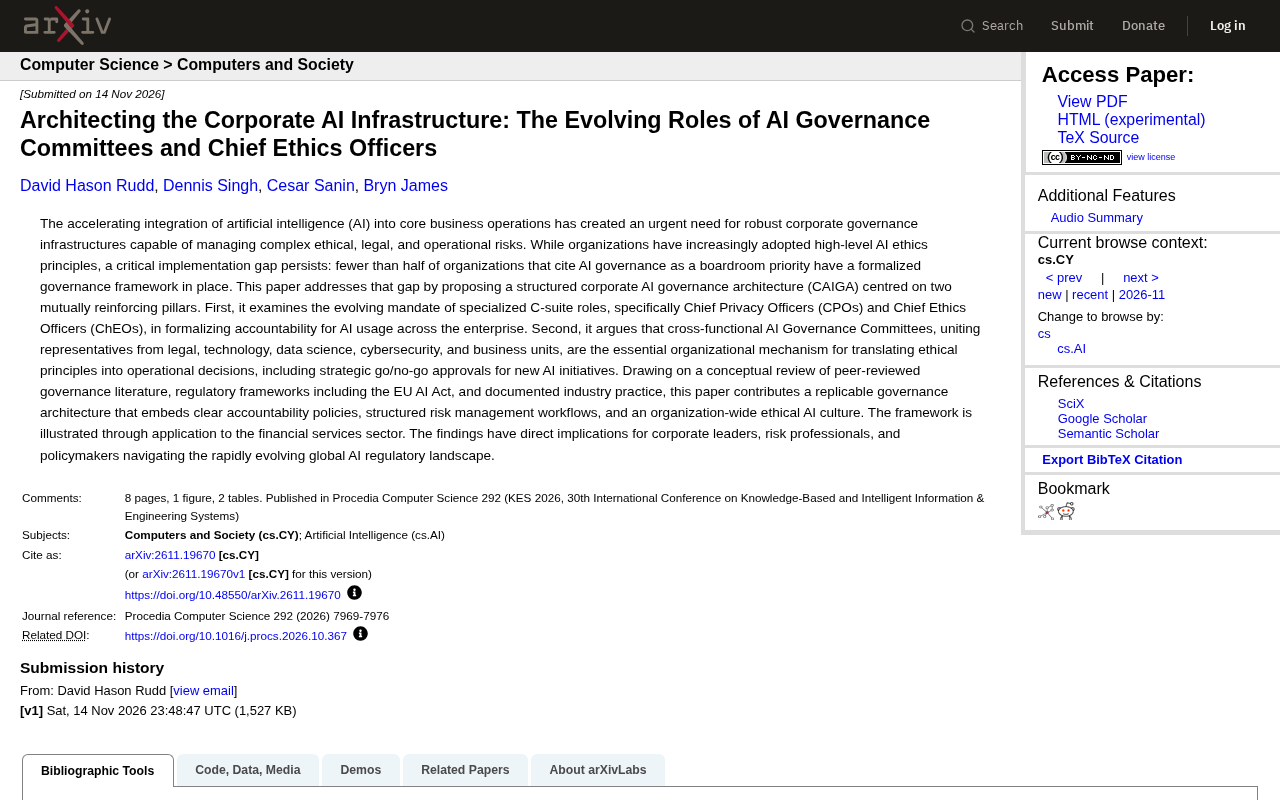
As AI evolves from an experimental project into a core business engine, enterprises face more than just technology selection—they must build a governance infrastructure capable of addressing ethical, legal, and operational risks simultaneously. A paper published on an academic platform proposes a framework called the "Corporate AI Governance Architecture" (CAIGA), attempting to answer a key question: when boards of directors prioritize AI governance, why do nearly half of organizations still lack a formalized governance framework?
The Governance Gap: Principles First, Implementation Lagging
The paper opens by pointing out a widespread contradiction: more and more enterprises have adopted high-level AI ethics principles, but there is a difficult-to-bridge gap between principles and operable governance mechanisms. Data shows that among organizations that treat AI governance as a board priority, fewer than half have established formalized governance frameworks. This means most enterprises' AI governance remains at the level of declarations, lacking clear accountability chains and decision-making processes.
The causes of this gap are not complex. AI ethics principles are usually broadly stated—such as "fairness," "transparency," and "explainability"—but when applied to specific business scenarios, who determines whether a model is fair enough? Who has the authority to approve or veto a high-risk AI initiative? These questions require organizational structure and role definitions to answer, not just principle documents.
Dual-Pillar Architecture: Executive Roles and Cross-Functional Committees
The core of the CAIGA framework consists of two mutually reinforcing pillars.
The first pillar focuses on the evolution of C-level executive roles, particularly the Chief Privacy Officer (CPO) and Chief Ethics Officer (ChEO). The paper argues that these two roles are transforming from traditional compliance gatekeepers into accountability cores for AI use. The CPO's focus extends from data protection to privacy impacts across the entire AI system lifecycle, while the ChEO is responsible for embedding ethical considerations into business decisions, not just post-hoc review. The boundaries of their responsibilities overlap in AI scenarios, but it is precisely this overlap that constitutes redundant accountability safeguards.
The second pillar is the cross-functional AI governance committee. The paper argues that the committee should bring together representatives from legal, technology, data science, cybersecurity, and business units to become the organizational mechanism for translating ethical principles into operational decisions. One of the committee's key functions is strategic "go/no-go" approval of new AI initiatives. This design brings governance from abstract discussion back to concrete decision scenarios, avoiding the disconnect between ethical principles and actual business.
The relationship between the two pillars is complementary rather than substitutive: executive roles provide vertical accountability authority, while the committee provides horizontal cross-departmental coordination. Without either, the governance architecture would be fractured.
The Chief Privacy Officer (CPO) and Chief Ethics Officer (ChEO) are executive positions that have gradually emerged as independent roles in corporate governance structures in recent years. The CPO was initially widely established due to the proliferation of privacy regulations such as the General Data Protection Regulation (GDPR), primarily responsible for overseeing compliance in the collection, storage, and cross-border transfer of personal data; the ChEO emerged later, stemming from enterprises' responses to AI ethics, algorithmic fairness, and related issues, with responsibilities typically including developing ethical guidelines, conducting ethics reviews, and providing advice on high-risk decisions. In traditional organizations, these two roles often fall under legal and compliance systems with limited authority. The key argument of the CAIGA framework is that when AI systems deeply intervene in business decisions, CPOs and ChEOs need to move from back-office compliance functions to front-line accountability cores, possessing substantive voice in AI system design, deployment, and continuous monitoring. This role evolution also brings new challenges: how to delineate the boundaries of authority and responsibility between the two positions, how to set reporting relationships, and how to avoid conflicts with existing roles such as the Chief Technology Officer (CTO) and Chief Information Security Officer (CISO)—all organizational design questions that must be answered during implementation.
From Principles to Processes: Three Embedded Elements of Governance Architecture
The paper emphasizes that a replicable governance architecture needs to embed three types of elements. First, clear accountability policies that specify responsibility attribution for each AI system, avoiding the dilemma of "collective responsibility equals no one responsible." Second, structured risk management processes that embed AI risk assessment into existing enterprise risk management systems rather than starting from scratch. Third, organization-wide ethical AI culture, which is not just a training issue but also involves adjustments to incentive structures and decision-making habits.
Interestingly, the paper cites regulatory frameworks such as the EU AI Act as references. Rising regulatory pressure is forcing enterprises to transform governance from voluntary action into compliance requirements, but the paper's position is that effective governance architectures should be established ahead of regulatory requirements, rather than passively responding.
The EU AI Act was formally adopted in 2024 and is the world's first comprehensive horizontal legislation targeting AI systems. The Act adopts a risk-based tiered regulatory approach, classifying AI applications into four categories: unacceptable risk, high risk, limited risk, and minimal risk, imposing a series of compliance obligations on high-risk systems including risk management systems, data governance, technical documentation, transparency, human oversight, and accuracy and robustness. For AI deployers in finance, healthcare, critical infrastructure, and other sectors, this means governance is no longer a voluntary ethical initiative but a legally binding compliance requirement. The paper cites this Act as a reference to illustrate that regulatory trends are providing external impetus for corporate governance architectures, but also points out that passive compliance often leads to "checkbox governance"—meeting only minimum requirements without substantive accountability. The CAIGA framework's position is that enterprises should proactively build governance capabilities that exceed regulatory baselines, embedding compliance requirements into daily decision-making processes rather than responding hastily before regulations take effect.
Application Example in Financial Services
The paper uses the financial services industry as an example to demonstrate how the framework can be implemented. The financial sector's use of AI involves high-risk scenarios such as credit decisions, fraud detection, and customer interaction, while also being subject to strict privacy and fair lending regulations. In this context, the collaboration between CPOs and ChEOs, the governance committee's approval authority over model deployment, and assessment mechanisms embedded in existing risk management processes constitute a relatively complete governance loop. The paper chose the financial industry as an example also because it has both high regulatory pressure and a mature compliance culture, making it easier to observe how governance architectures integrate with existing systems.
The financial services industry is a frequently cited typical scenario in AI governance research because its AI applications simultaneously touch multiple high-risk dimensions. In credit decisions, models may produce discriminatory outcomes against specific groups due to training data bias, directly violating fair lending regulations; in fraud detection, misjudgments may harm customer rights and trigger complaints; in customer interaction, chatbots and personalized recommendations involve large-scale personal data processing and are strictly constrained by privacy regulations. At the same time, the financial industry itself has a mature compliance culture, well-established risk management systems, and clear regulatory reporting lines, providing a ready organizational foundation for embedding AI governance architectures. The paper chose the financial industry as an example precisely because of this combination of "high risk + high compliance maturity," making it convenient to observe how governance committees collaborate with existing risk management departments, how CPOs and ChEOs intervene across the model lifecycle, and how accountability policies connect with existing compliance frameworks. This example also implies that other industries, when borrowing the CAIGA framework, need to adjust according to their own regulatory environments and compliance maturity.
Practical Implications and Open Questions
For enterprises and risk managers, the value of the CAIGA framework lies in providing a referenceable organizational design approach rather than yet another set of abstract principles. It reminds enterprises that the bottleneck of AI governance often lies not in technology but in the design of accountability structures and decision-making processes.
However, the paper is based on conceptual review and literature review and has not yet provided large-scale empirical testing. The actual operational efficiency of governance committees, the friction in authority and responsibility division between executive roles in real organizations, and the adaptability under different industries' regulatory environments all remain to be further studied. For enterprises currently building AI governance systems, this framework is more suitable as a design starting point than a ready-made template.
One-line Summary
A paper proposes the CAIGA framework, bridging the AI governance gap with dual pillars of executive roles and cross-functional committees.
Paragraph Summary
The article introduces the "Corporate AI Governance Architecture" (CAIGA) framework proposed in an academic paper, aimed at resolving the common contradiction in enterprise AI governance where principles come first but implementation lags. Data shows that even among organizations that prioritize AI governance at the board level, nearly half still lack formal governance frameworks. CAIGA is centered on two pillars: first, executive roles such as the Chief Privacy Officer (CPO) and Chief Ethics Officer (ChEO) transforming from compliance gatekeepers to accountability cores, providing vertical accountability authority; second, a cross-functional AI governance committee bringing together legal, technology, data science, cybersecurity, and business representatives, responsible for strategic go/no-go approval of new AI initiatives and providing horizontal coordination. The framework also embeds three elements: accountability policies, structured risk management processes, and ethical culture, and uses the financial services industry as an example to demonstrate implementation paths. The paper is based on conceptual review and has not undergone large-scale empirical testing, so the framework is more suitable as a design starting point.
Related articles

Zero-Code Replication of a $10,000 3D Website with Claude Code: A Six-Tool Breakdown
Bilibili creator Yomi used Claude Code plus five free tools to build a 3D product landing page quoted at $10,000 overseas—zero code. Breakdown of the six-tool division of labor, image-to-3D workflow, and the core collaboration method: "give AI a reference, not 'make it look better.'"

Claude Code in Practice: Install, Connect Models, Calculate Tokens, and Ship a Full-Stack Project with a Single Document
Based on a Bilibili public course demo, this covers Claude Code installation, model connection, token cost calculation, and the practical path of shipping a full-stack project with a single document, plus comparisons with Copilot, Cursor, Trae, and other coding assistants.

Who Accepts AI-Written Code? A 25-Minute Deep Dive into Verification Loops and the New Code Review Paradigm
After AI writes lots of code, how should Code Review verify it? This article breaks down the Claude Code team's verification loop framework: surface-level end-to-end verification, setup/drive/check three-stage skills, hybrid end-to-end testing and reliability checklists, and how to tighten the loop when issues slip through.