Enterprise AI Skills Training: How to Help Your Team Learn Skills That Actually Matter
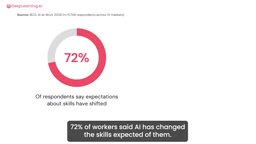
AI skill requirements have changed, but only 36% receive adequate training — organizational support is key.
Based on a 2026 BCG survey and analysis of 10,000+ job roles, the article shows AI is rapidly changing engineers' skill requirements: 72% of professionals feel the change, but only 36% believe they've received adequate upskilling. Data also shows engineers learning through enterprise programs have 5x the continued learning rate of self-taught individuals, with teams of 100+ from the same company enrolling in the same course becoming increasingly common and growing at double the rate. The article argues the gap stems not from individual willingness but from whether organizations provide structured learning paths, clear goals, and peer pressure. For technical managers, collective learning, continuity, and data-driven skill selection are the three key levers for closing the AI skills gap.
Engineers' AI Anxiety: Skill Requirements Have Changed, But Training Hasn't Kept Up
Companies across every industry are asking engineers to quickly master AI skills. But AI technology evolves faster than talent can be developed — no one can clearly say which skills truly matter.
A 2026 BCG survey revealed an uncomfortable reality: 72% of professionals say AI has already changed the skill requirements for their roles, but only 36% feel they've received adequate upskilling training. The gap between these two numbers is the most authentic pain point in today's enterprise AI transformation.
The problem isn't that engineers are unwilling to learn. The problem is that organizations haven't provided them with structured learning paths.
BCG (Boston Consulting Group) is one of the world's top three management consulting firms, and has long published research on enterprise digital transformation and talent strategy. The "BCG 2026 survey" referenced here refers to the firm's annual skills and employment study targeting professionals worldwide, with samples spanning multiple industries and regions. The value of such surveys lies in using quantitative data to reflect trend-level changes rather than individual cases. It's worth noting that the survey results measure respondents' subjective perceptions — "feeling adequately trained" is not entirely equivalent to "actually meeting skill standards" — but this is precisely the point: when more than 60% of employees subjectively feel training is insufficient, organizations have gaps on both the information delivery and resource supply sides.
Behind the 10,000+ Role Analysis: What Counts as the "Right" Skills
To figure out which AI skills are most worth investing in, one organization analyzed over 10,000 job roles and interviewed dozens of frontline AI engineering experts. The scale of this data analysis itself makes one thing clear: AI skills training cannot rely on gut feeling to determine course direction.
Another dimension of the data source is equally noteworthy — over 11 million developers have already been building their AI skills on this platform. This means a large number of engineers are actually already learning proactively, though often in a fragmented, spontaneous way.
An even more interesting phenomenon: every month, engineering teams of 100+ people from the same company register together — and they often choose the same course.

This phenomenon shows that collective team learning is becoming a trend. And this year's growth rate is double last year's.
Going Solo vs. Organizational Support: A 5x Difference in Learning Outcomes
One key data point deserves every technical manager's attention: engineers who learn through enterprise programs are 5 times more likely to continue learning than self-taught individuals.

This gap isn't about intelligence, or even learning ability. It reflects a structural factor: when organizations provide clear learning goals, peer pressure, and progress tracking, engineers' learning behavior undergoes a qualitative shift.
The problem with self-study is this: no deadlines, no peer comparison, no positive feedback from the organization. Skill learning itself is something that requires sustained investment, and persistence is precisely the hardest part.
"Continued learning rate" is a key metric for measuring training effectiveness, typically defined as the proportion of learners who continue studying related content for some time after completing a course or program. It's more telling than "completion rate" because AI skills have strong timeliness and iterativeness — stopping upon completion means skills quickly expire. The "commitment mechanism" and "social facilitation effect" from behavioral science can explain the gap that organizational support creates: clear deadlines, visible peer progress, and attention from managers all reduce the probability of procrastination. Self-taught individuals often lack all three external constraints, so even with identical initial motivation, the proportion who persist long-term is significantly lower. The 5x gap is more likely to come from structural design than individual willpower.
Questions Managers Need to Face
Engineers are already learning — this is the default assumption of many managers, but the follow-up question is: has the organization created conditions for them to keep going?
If enterprises need a structured AI skills training system, the first step is ensuring the training mechanism can keep up with engineers' learning pace. Many corporate training systems still operate on the traditional model of "schedule courses at year-start, assess at mid-year," while AI competency requirements may shift every quarter.

For individual engineers, if their company hasn't yet built such a system, communicating this need to managers is the most direct approach. For managers, now is the time to seriously consider a team AI skills development strategy.
Several Signals Worth Watching
From these data points and phenomena, several judgments of reference value for technical managers can be distilled:
Collective learning beats individual self-study. When engineers from the same team choose the same course, not only is the learning outcome better, but a shared technical language forms within the team. This collaborative effect cannot be replicated by self-study.
Continuity is the core metric for training effectiveness. One-off training courses have limited value; the key is whether engineers can maintain their learning state after the course ends. Enterprise programs have an advantage here that self-study simply cannot match.
Skill selection needs data support. Facing a rapidly changing AI tech stack, choosing training directions by intuition is very risky. Analysis based on large-scale job data is more reliable than any single person's judgment.
The 72% vs. 36% gap is the strongest signal for action. When most employees feel skill requirements have changed but only one-third feel prepared, this gap is the space organizations need to fill.
"Collective learning" in the enterprise training field is also often called "team learning" or "group learning." Its core isn't the number of participants, but the existence of working collaborative relationships among members. Engineers from the same team taking the same course yields benefits beyond individual skill improvement: they can directly reuse shared terminology and debugging experience in daily work, reducing communication costs. This contrasts with "individual subscription-based learning," where knowledge often struggles to accumulate within the team. It's worth noting that collective learning can also bring homogenization risk — if the team as a whole chooses the wrong direction, the deviation is amplified synchronously. Therefore, skill selection should still be built on job data and business objectives; collective learning solves the persistence problem, not the direction problem.
Background Notes
"Job role analysis" typically refers to structured extraction from job postings, position descriptions, and skill tags, statistically analyzing the frequency, combination patterns, and level requirements of a given skill across different roles. Compared to questionnaire surveys, this type of analysis reflects real demand signals from the labor market rather than respondents' subjective impressions. Another function of large-scale analysis is identifying the association network between skills — for example, "prompt engineering" often co-occurs with "model evaluation" and "data pipelines," and teaching just one of them in isolation has limited effect. This is also why the article emphasizes that "course direction cannot be determined by gut feeling": skill selection needs demand-side evidence, not the personal experience of course designers or vendor marketing orientation.
Related articles

Meta vs. Publishers: The AI Data Battle Over Terms of Service Changes and the Future of the Internet
Meta changed its business account terms to allow AI training on linked website data, sparking backlash from publishers and creators. Industry groups demanded negotiations, forcing Meta to remove 'training' wording and delay the effective date. The dispute reveals the deeper battle over data authorization and the future of the internet in the AI era.

When Outside Xbox Meets Blood on the Clocktower: A Legion Match in Minecraft
Outside Xbox guests Ellen and Mike play Minecraft Blood on the Clocktower in a Legion game. How can three good players fight an evil majority amid information noise? This article breaks down Legion mechanics, information-role mind games, and the endgame reversal.

Kimi K3.1 Hands-On Test: Open-Source Model Nears Opus, Video Generation Steals the Show
Kimi K3.1 completed motion graphics, 3D rendering, mini-games, and video generation in a live test. Analysis of its 2.8T MoE architecture, gap vs Opus/GPT, and hidden video generation.