Enterprise Deep Research Agent Implementation Guide: Architecture Design and Core Pain Points
A complete guide to building production-ready enterprise Deep Research Agents with LangChain.
This article systematically analyzes the core challenges enterprises face when building Deep Research Agents — uncontrolled tools, context contamination, cost overruns, and security risks — and explains how next-generation frameworks like LangChain address these through standardized components. It covers Deep Research's three core capabilities, the case for enterprise customization, and a three-layer technical architecture spanning task decomposition, web search, and structured report generation.
Introduction: Why Enterprises Need Deep Research Agents
Anyone who has built AI Agents knows there's a massive gap between a demo and a production environment. Uncontrolled tool calls, context contamination, skyrocketing token costs, and recurring security vulnerabilities — these problems are amplified many times over in enterprise settings.
This article provides a complete breakdown of how to build a production-ready Deep Research system using next-generation Agent frameworks. It covers everything from architecture design to solving real-world pain points, helping enterprises achieve intelligent upgrades across use cases like market research, academic investigation, and financial analysis.
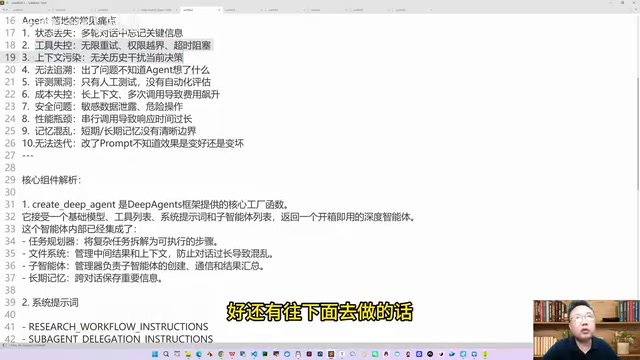
Core Pain Points in Agent Development: Tool Chaos and Cost/Security Challenges
Uncontrolled Tools and Context Contamination
In enterprise-grade Agent development, uncontrolled tool calls and context contamination are the two most difficult problems to tackle.
Uncontrolled tool calls, simply put, means the Agent calls the wrong tool. The root cause lies in the Function Calling mechanism of large language models — when an LLM needs to invoke an external tool, it relies on semantic understanding of the Tool Description to make routing decisions. With fewer than 10 tools, the model can usually match accurately. But as the tool set scales to dozens or hundreds, semantic overlap between tool descriptions causes the model to become confused. In personal projects with few tools, this isn't obvious. But enterprise environments often have complex tool chains with dozens or even hundreds of tools, making it easy for Agents to go wrong:
- Tool recognition failure: The Agent can't determine which tool to use for the current task
- Parameter extraction errors: It fails to accurately extract the required Arguments from the user's natural language query
- Broken call chains: An error at one step in a multi-step tool call sequence causes the entire research workflow to collapse
Context contamination is equally common — information from earlier in the conversation "bleeds" into the current turn, interfering with role judgment and decision logic, causing the Agent to behave unexpectedly. This issue is closely tied to the attention mechanism in Transformer architectures: when processing long conversations, information from early turns continues to influence later generation through attention weights, and the model has no built-in "forgetting" mechanism to actively discard stale information. For example, data discussed in a previous turn might be cited as the latest conclusion in the current turn — a critical flaw in enterprise research scenarios that demand high timeliness.
Cost Overruns and Security Risks
Cost issues are especially pronounced in long-chain autonomous planning scenarios like Deep Research. Tokens are the basic unit of text processing for LLMs, and API providers charge based on the number of input and output tokens. Deep Research scenarios are particularly prone to cost overruns because they involve multi-round iterative reasoning: each round of search results must be injected into the context for the model to analyze, and the context window grows cumulatively with each round. For GPT-4o, a single 128K context call costs roughly $0.30–$0.50. A complete Deep Research task may involve 10–30 such calls, putting the cost of a single research session at $5–$15. If an enterprise runs hundreds of research tasks per day, the monthly API bill can easily exceed six figures. When Agents perform complex multi-step reasoning and multi-round searches, token consumption grows exponentially, and API bills can blow past budget within days.
Security risks are equally important to address:
- Sensitive data leakage: Agents may expose internal enterprise data during processing and transmission
- Dangerous operation execution: Agents with code execution capabilities may perform high-risk operations like deleting files or modifying configurations
- Blurry permission boundaries: The Agent's operational scope lacks effective constraints, making unauthorized access easy
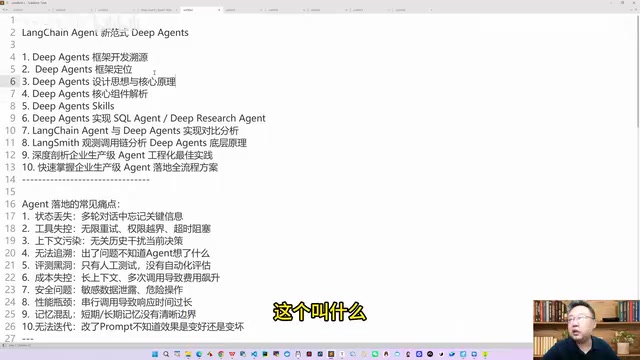
How Next-Generation Agent Frameworks Solve Enterprise Development Challenges
If developers had to manually address each of these problems one by one, the workload would be enormous and consistency nearly impossible to guarantee. Next-generation frameworks like LangChain have placed Agent capabilities at the center of their design since V1, opening up a complete Agent development toolkit on top of the existing framework — providing standardized solutions specifically targeting enterprise pain points.
LangChain is one of the most popular LLM application development frameworks in the world. Its ecosystem includes the core library LangChain, the orchestration engine LangGraph, the observability platform LangSmith, and the deployment service LangServe. From the early Chain (sequential call) paradigm to the Agent-centric V1 architecture of today, LangChain has undergone a major design philosophy shift. V1 introduced a standardized Tool interface specification, structured Agent state management, and directed graph workflow orchestration via LangGraph — enabling developers to define complex Agent behavior logic declaratively, without writing large amounts of flow control code by hand.
The design philosophy of this framework is clear: abstract the common hard problems in Agent development into standardized components. Tool scheduling, context management, security controls, and cost monitoring — the messy, labor-intensive work — are handled uniformly at the framework level, so developers can focus purely on business logic.
This means building an enterprise-grade Deep Research Agent no longer requires starting from scratch. Instead, developers can build quickly on the shoulders of a mature framework.
What Is Deep Research: A Paradigm Shift from Q&A to Autonomous Research
The Essence of Deep Research
Deep Research is an intelligent research technology powered by large language models (LLMs), built on the autonomous search and reasoning capabilities of AI Agents. It is fundamentally different from traditional keyword search or simple RAG retrieval.
It's worth explaining RAG (Retrieval-Augmented Generation) here, as it's the most mainstream technical paradigm in enterprise AI applications today. The core RAG workflow is: convert the user's question into a vector, retrieve the most relevant document chunks from a pre-built knowledge base, and feed those chunks as context to the LLM to generate a response. RAG is essentially a "single-round retrieval + single-pass generation" process — it assumes the answer can be found directly in an existing knowledge base. Deep Research is fundamentally different: it's a multi-round iterative autonomous exploration process. The system doesn't presuppose where the answer is. Instead, like a human researcher, it dynamically adjusts its research direction based on information gathered at each step, progressively converging on a complete conclusion.
Traditional AI conversation is one question, one answer — the user asks, the model responds, and the interaction ends. Deep Research operates on a completely different philosophy: like an experienced researcher, it autonomously plans a research path for complex topics, executes multiple rounds of search, and deeply integrates heterogeneous information — ultimately delivering a structured, professional report.
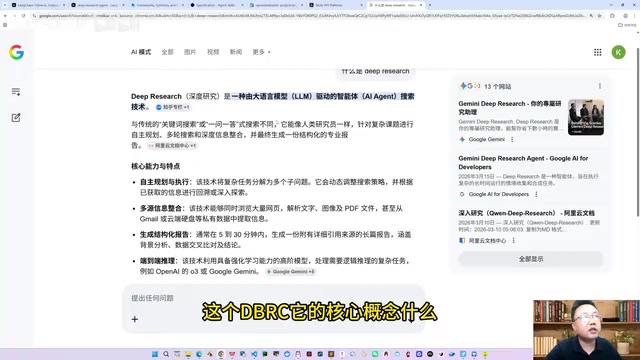
Three Core Capabilities of Deep Research
1. Autonomous Planning and Dynamic Execution
Deep Research can automatically decompose a complex research task into multiple sub-questions. For example, when you input "Write a research report on the new energy vehicle market," the system will:
- Break the task down into multiple research dimensions: market size, competitive landscape, technology trends, policy environment, and more
- Dynamically adjust search strategy based on information already gathered, deciding which direction to dig deeper into next
- Autonomously judge whether current information is sufficient — if not, continue searching; if so, move to the synthesis phase
This autonomous planning capability typically relies on the ReAct (Reasoning + Acting) paradigm, which lets the Agent alternate between reasoning and acting during execution. Unlike predefined workflows, the ReAct paradigm allows the Agent to dynamically revise its task plan based on intermediate results rather than fixing the entire execution path upfront — giving the system the flexibility to handle complex, open-ended research topics.
2. Multi-Source Heterogeneous Information Integration
The system collects information from multiple sources — web pages, PDF documents, databases, charts, and more — and integrates this data in various formats into a unified knowledge framework. This multi-source information fusion capability is the most critical differentiator between Deep Research and ordinary search.
3. Structured Report Output
The final deliverable is not a collection of scattered information fragments or a simple summary mashup, but a professionally structured research report with clear logic, solid evidence, and complete organization. For enterprise decision-making, academic research, market analysis, and similar scenarios, this output format offers far greater practical value than traditional search results.
Typical Application Scenarios
Deep Research covers a wide range of real-world use cases:
- Market research: Industry landscape analysis, in-depth competitive research, market trend forecasting
- Academic research: Topic investigation, literature review generation, research direction exploration
- Financial analysis: Earnings report interpretation, investment target research, risk assessment modeling
- Government and compliance: Policy research, industry regulatory tracking, compliance review assistance
Deep Research is especially in high demand at government agencies, public institutions, state-owned enterprises, and consulting firms — organizations that routinely produce large volumes of research reports, where doing so manually is time-consuming and expensive.
Why Generic Solutions Fall Short: The Case for Enterprise-Customized Deep Research
The Ceiling of Off-the-Shelf Products
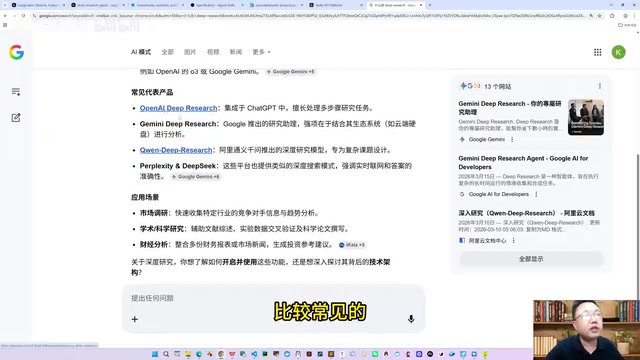
There are already quite a few Deep Research products on the market, including OpenAI Deep Research, Google Gemini Deep Research, and similar features from domestic platforms like Doubao and Qianfan.
But one thing must be clearly understood: these products are all designed for general-purpose scenarios. They can help with basic desk research, but they often fall short of the professional standards and satisfaction levels that enterprises require.
The main limitations of generic solutions include: inability to connect to private enterprise data, no support for industry-specific analytical frameworks, fixed report templates with no customization, and incomplete control over data security.
Why Enterprises Must Take the Customization Route
What enterprises truly need is a Deep Research system deeply adapted to their vertical domain, with specific requirements including:
- Private data integration: Connect to internal knowledge bases, CRM, ERP, and other data sources so research isn't limited to publicly available information
- Industry analytical frameworks: Built-in analytical models and report templates that conform to specific industry standards
- Data security and compliance: Meeting classified protection requirements, keeping sensitive data within the domain, with complete and traceable audit logs. In China, classified protection (等保, or Classified Protection of Cybersecurity) is the foundational cybersecurity regime. Under the Cybersecurity Law, operators of critical information infrastructure and enterprises handling important data must pass the corresponding level of security evaluation. For enterprises deploying Deep Research systems, compliance means: enterprise data involved in model inference cannot be transmitted to overseas servers, API call chains must be fully encrypted, user operations and Agent behavior require complete audit logs, and sensitive data must be desensitized before entering the model context. This is a core reason why many government and enterprise clients prefer private deployment over public cloud AI services.
- System integration capability: Seamless connectivity with existing enterprise systems such as OA, BI, and project management platforms
These requirements make it clear that building a customized Deep Research Agent is a core demand for enterprise intelligent transformation.
The Three-Layer Technical Architecture of Enterprise-Grade Deep Research
A production-ready enterprise Deep Research system can be broken down into three core modules:
Layer 1: Complex Task Decomposition Engine
This is the "brain" of the entire system. It understands the user's research needs, breaks down vague high-level topics into executable sub-task sequences, and establishes dependencies and priorities between tasks. The quality of the task decomposition engine directly determines the upper bound of the final report's quality.
Technically, complex task decomposition typically relies on two strategies: first, LLM-based Chain-of-Thought reasoning, where carefully designed System Prompts guide the model to decompose large tasks into sub-task trees layer by layer; second, graph orchestration engines like LangGraph, which model task decomposition as a Directed Acyclic Graph (DAG), where each node represents a sub-task and edges represent dependencies. The advantage of DAG structure is that it natively supports parallel execution — sub-tasks with no dependencies can run simultaneously, significantly reducing overall research time. More advanced implementations combine both strategies, with the LLM dynamically generating the DAG structure and the graph engine handling scheduling and execution.
Layer 2: Web Search and Information Collection
This is the "hands and feet" of the system. It executes multi-round, multi-dimensional information collection through internet search engines and internal enterprise data sources. The key is intelligent scheduling of search strategies — knowing when to prioritize breadth, when to prioritize depth, and how to balance information quality against collection cost.
Layer 3: Structured Report Generation
This is the system's "pen." It leverages the LLM's text generation and reasoning capabilities to deduplicate, verify, analyze, and structure the collected multi-source information — producing a professional research report with rigorous logic and solid data.
The three modules work together to form a complete loop of "planning → collection → generation," with each stage deeply customizable to meet enterprise needs.
Conclusion: The Critical Path to Enterprise Deep Research Deployment
Deep Research represents a highly valuable direction for AI Agent deployment in enterprise applications. It's not a simple Q&A bot — it's an intelligent research assistant capable of autonomously planning research paths, executing multi-round information collection, and delivering in-depth analysis.
For enterprises, successfully deploying Deep Research comes down to three key factors:
- Choose the right framework: Build on mature Agent frameworks like LangChain to avoid reinventing the wheel
- Invest in customization: Deeply adapt to your own business scenarios, integrate private data sources, and customize analytical frameworks and report templates
- Hold the line on fundamentals: Address core challenges — uncontrolled tools, context contamination, cost control, and security compliance — at the architecture level
As Agent frameworks continue to evolve, the barrier to enterprise Deep Research deployment is dropping rapidly. But that doesn't mean you can simply apply a template — it actually raises the bar for developers' architectural design skills and depth of business understanding. The real competitive advantage lies in who can translate technical capability into business value faster.
Related articles
 Tutorials
ChatGPT Plus Subscription Guide: Are GPT-5.5, image-2, and Codex Worth the Upgrade?
A detailed look at ChatGPT Plus features — GPT-5.5, image-2, and Codex — with a Plus vs Pro comparison and a complete step-by-step subscription guide for users outside the US.
 Tutorials
Harness AI Engineering in Practice: Using Claude Code to Master Enterprise-Level E-Commerce Development
Deep dive into Harness AI Engineering: master enterprise e-commerce development with Claude Code using the Rules, Skills, Wiki, and Changes framework.
 Tutorials
Cursor + Codex Dual-IDE Collaboration: A Practical Methodology for Open-Source Project Customization
A complete methodology for open-source project customization based on real-world experience, detailing the Cursor+Codex dual-IDE workflow, seven-stage process, MVP validation, and AI source code reading techniques.