Enterprise-Grade Complex Agent Systems in Practice: Long-Running Tasks and Multi-Agent Management Explained
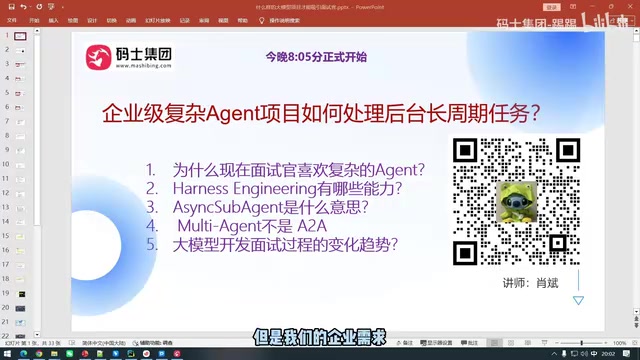
Enterprise AI development has shifted to Multi-Agent systems and complex long-running tasks — single agents are no longer enough.
As enterprise AI demands deepen, agent development is evolving from single-instruction execution to autonomous planning and multi-step decision-making. Multi-Agent architecture has become a core interview topic for LLM roles, requiring candidates to understand multi-agent collaboration, task planning, and state management. Successfully deploying long-running complex tasks hinges on strong reasoning models combined with high-quality prompts, context design, and execution constraints. Developers must shift from "point feature" thinking to a systems engineering mindset — covering inter-agent communication, task state persistence, and fault recovery.
From Single Tasks to Complex Tasks: The Enterprise Dividing Line
For a long time, building intelligent agents meant staying at the "single task" level — checking the weather, querying a database, generating a one-liner response. Under current LLM capabilities, these demands are handled with ease. But real enterprise scenarios demand far more.
What enterprises and users truly want is this: hand off a task without spelling out every step, and expect the agent to think, plan, and decide on its own. That is the fundamental difference between a "complex task" and a "simple task." When there's no predefined execution path, an agent must be able to autonomously decompose goals and dynamically adapt its strategy — a requirement that places entirely different demands on system design.

Put simply, simple tasks test a model's execution ability, while complex tasks test a system's planning and coordination capacity. This capability leap is directly reflected in the rising bar for industry hiring.
Interview Trends Have Shifted: Multi-Agent Is Now a Core Topic
According to content shared in a Bilibili course, interview requirements for LLM-related roles have risen noticeably. Interviewers are no longer satisfied with "I built an agent" — they'll dig deeper with questions like:
- Does your agent project handle complex tasks?
- Did you use a Multi-Agent architecture?
- If so, how do you manage those agents?
- What does the planning mechanism look like when tackling complex tasks?

These questions reflect an industry-wide upgrade in expectations for engineering competence. Compared to the early days when getting a basic demo running was enough, companies now look for a deeper understanding of multi-agent collaboration, task planning, state management, and other systemic concerns. For anyone looking to break into this field, simply "calling an API to build a Q&A bot" won't cut it anymore.
A Multi-Agent architecture is a system design paradigm in which multiple agents — each with independent reasoning and action capabilities — collaborate to complete tasks. Unlike single-agent systems, Multi-Agent systems typically feature a division of roles between an Orchestrator (responsible for task decomposition and scheduling) and Workers/Sub-agents (focused on completing specific subtasks). The core advantages of this architecture are parallel processing, decoupled responsibilities, and greater fault tolerance — a single agent failing won't bring down the entire task. Common implementation frameworks include LangGraph, AutoGen, and CrewAI, which provide infrastructure for inter-agent communication, state sharing, and workflow control. Understanding Multi-Agent topologies (e.g., star, chain, hierarchical) and how context is passed between agents is key to answering in-depth interview questions.
Making Long-Running Tasks Work: Strong Reasoning Models Are Central to Planning
Can agents actually handle complex, long-running tasks? Absolutely — the key lies in who handles the planning step.
At its core, planning capability comes from a sufficiently powerful reasoning model. The engineering approach is to prepare the model with a well-crafted prompt, relevant context, and clear execution guidelines, then let the model generate a full task plan step by step according to those guidelines.

A few engineering points worth highlighting:
Prompt and Context Design
The quality of a model's planning is highly dependent on the quality of its inputs. A clear prompt defines the task boundary; sufficient context provides the necessary background. In long-running tasks, how you maintain and update context often determines whether the agent continues moving in the right direction.
Specification-Driven Execution
Simply letting a model "do its own thing" isn't reliable in production. Engineering practice requires explicit constraints and guidelines so the model reasons and plans within a defined framework. This combination of specification + reasoning preserves the flexibility of LLMs while ensuring output remains controllable and predictable.
In practice, these "execution guidelines" typically take the form of structured output constraints, ReAct (Reasoning + Acting) loops, or finite state machines. In the ReAct pattern, the model is required at each step to first output its reasoning (Thought), then an action command (Action), then observe the result (Observation) — forming a closed feedback loop until the task is complete. This externalizes the model's reasoning process, making it easier to debug and intervene. In stricter production environments, developers also introduce JSON Schema constraints on output format or use Function Calling to clearly decouple the model's "decision-making" from "execution" — ensuring downstream systems can reliably parse and act on agent instructions without depending on secondary interpretation of natural language.
From Theory to Details: The Real Engineering Challenges of Complex Agent Systems
Explaining the "why" and "what" is just the starting point. The real challenge lies in the implementation details. Background long-running tasks involve a whole range of engineering problems that simple agents never encounter: task state persistence, communication and coordination between multiple agents, and exception handling and recovery mechanisms.

For developers aiming to build enterprise-grade agents, understanding this ecosystem requires moving beyond "point feature" thinking and adopting a systems engineering perspective: how to organize multiple agents to collaborate with clear divisions of labor, how to manage long-running task state, and how to keep the entire system stable in the face of uncertainty. These are the core competencies that enterprises and interviewers care about most right now.
Task state persistence is one of the most underestimated engineering challenges in long-running agent systems. Because LLM context windows are finite, it's impossible to retain the entire task history in a single inference pass. Developers need to design external memory mechanisms across three layers: short-term memory (current session cache), long-term memory (vector database retrieval), and working memory (task execution state storage). When a task runs for minutes or even hours, the agent needs to be able to resume from a checkpoint after an interruption — not restart from scratch. Furthermore, the communication protocol design between multiple agents — whether asynchronous message queues or synchronous shared-state communication — directly affects system throughput and consistency. These architectural decisions never arise in single-agent scenarios, yet they are the foundational guarantees for stable operation in enterprise-grade systems.
Related articles

How Big Can Stars Really Get? The Physical Limits of the Largest Stars
Red supergiants are the largest stars by volume, with radii up to 2,000 times the Sun, engulfing the inner solar system. But there is no precise upper limit on stellar size—models predict up to 15,000 solar radii. The most massive blue stars are far smaller than red supergiants—biggest and heaviest are two different things.

Apple HomeView Smart Display Full Feature Breakdown: Wall-Mount or Desktop, $299
Apple launches HomeView, a $299 smart display with wall-mount and desktop options, 12MP camera for facial recognition, smart home control, music playback, and recipe step-by-step cooking. Full breakdown of watch faces, apps, privacy, and cooking integration.

Where Did the Promised New Studio Go? Craft Computing Answers After Five Years
Craft Computing's host responds to viewer questions: the new studio promised five years ago was shelved as construction costs soared from $30,000 to $75,000, and was replaced by a 168-square-foot garage conversion.